
Official statement
Other statements from this video 11 ▾
- □ Is page experience really enough to guarantee good UX for Google?
- □ Should you really prioritize users over machines in SEO?
- □ Why does Google prefer hyphens over underscores in URLs—and what's the real impact on your rankings?
- □ Do accordions really hurt your SEO, or is it just an old myth?
- □ Has hidden content become just as important as visible content for Google?
- □ Does Googlebot really fail to index content hidden behind user clicks?
- □ Is Google really unable to crawl your navigation if it doesn't use proper anchor links?
- □ Are Core Web Vitals really enough to measure user experience?
- □ Why won't Google give you precise criteria on certain UX aspects—and what should you do about it?
- □ Does web accessibility directly impact your Google rankings?
- □ Is Lighthouse really missing poor quality anchor text on your site?
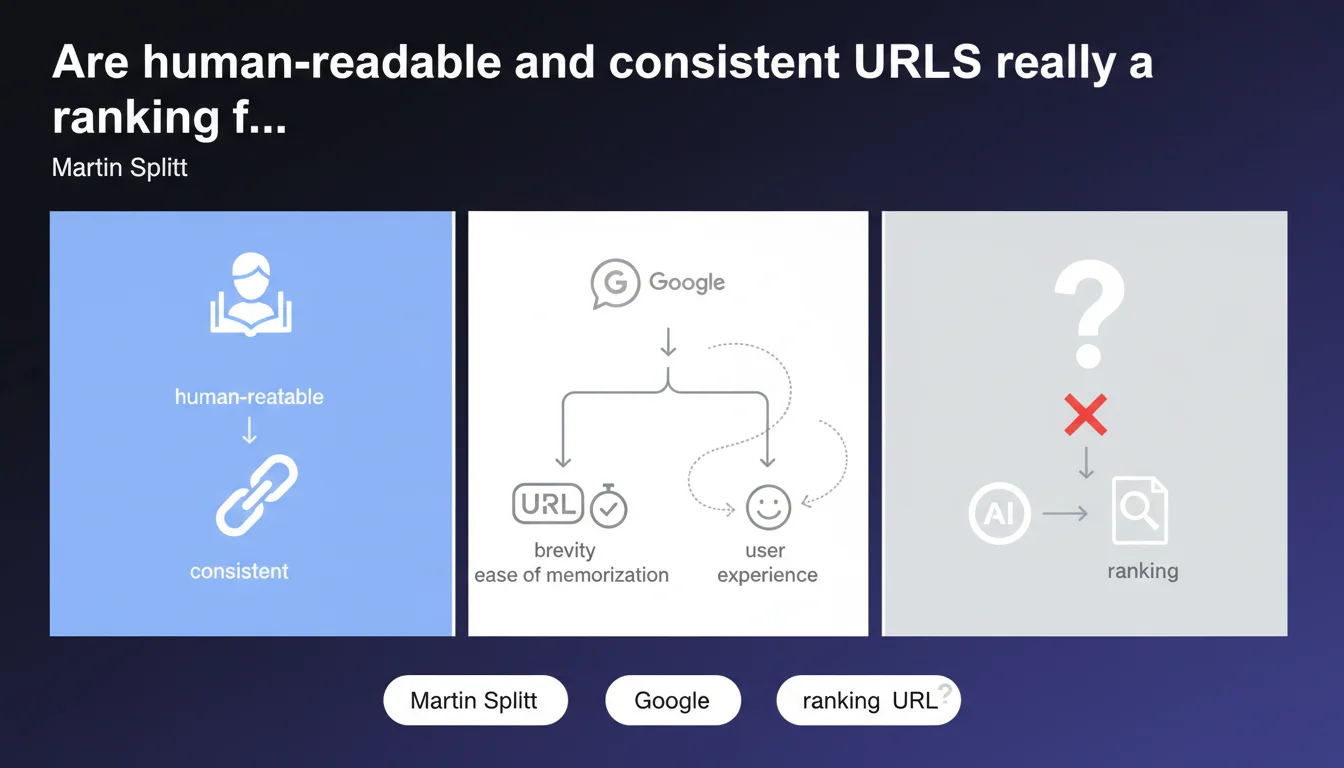
Google recommends making URLs human-readable, short, and consistent in structure. The stated objective: improve user experience and make them easier to remember. But what is the real SEO impact of this recommendation?
What you need to understand
Why does Google insist on URL readability?
Martin Splitt reminds us of a principle Google has been hammering home for years: URLs must be understandable by any average user. Say goodbye to endless parameter strings, cryptic numeric identifiers, or inconsistent structures from one section of the site to another.
Concretely? A URL like /running-shoes-mens-nike-air will always be preferable to /product.php?id=47382&cat=12&ref=xyz. The logic behind this recommendation boils down to three points: content clarity, site structure consistency, and shareability ease.
What does Google mean by "consistency" in structure?
Consistency is the uniformity of URL patterns across the site. If your product pages follow the scheme /category/subcategory/product, don't suddenly switch to /p/product in another section. Google and users appreciate predictability.
This recommendation also extends to separators: hyphens vs underscores, presence or absence of trailing slashes, HTTPS everywhere. Inconsistencies create friction—and potentially canonicalization issues or crawl problems.
Does brevity and memorability have a direct impact on SEO?
Google doesn't explicitly say that URL length is a ranking factor. However, a short and memorable URL improves click-through rates in SERPs and facilitates sharing on social networks or via email—which can indirectly influence visibility.
An overly long URL risks being truncated in search results, which harms message clarity. Additionally, some CMS or e-commerce platforms generate excessively long URLs that dilute semantic relevance.
- Human readability: favor descriptive keywords over IDs
- Structural consistency: maintain a uniform pattern across the entire site
- Brevity: avoid URLs longer than 60-80 characters when possible
- Separators: use hyphens (-) rather than underscores (_)
- Systematic HTTPS: no HTTP pages should remain
SEO Expert opinion
Is this recommendation consistent with what we observe in the field?
Yes and no. We regularly see sites with terrible URLs—dynamic parameters, session IDs, random codes—ranking well if content and backlinks are solid. Google manages to index and understand these pages, even if the URL looks like gibberish.
On the other hand, sites that switched to clean and descriptive URLs often see an improvement in organic CTR and better featured snippet performance. It's not a direct ranking boost, but the cumulative effect on UX and user signals can make the difference on competitive queries.
What nuances should we add to this statement?
Google doesn't specify how far to take the optimization. Should you absolutely include all long-tail keywords in the URL? No—it can quickly become counterproductive and create visible keyword stuffing. The URL should be descriptive, not exhaustive.
Another point: the notion of "brevity" remains vague. [To verify] Google has never given an official threshold (50, 75, 100 characters?). In practice, we observe that URLs longer than 100 characters rarely cause technical issues but lose visual readability in SERPs.
In what cases does this rule not apply strictly?
Sites with very high volume (Amazon, eBay, marketplaces) often use numeric identifiers in their URLs for technical and inventory management reasons. This doesn't prevent them from dominating SERPs. The difference? They compensate with massive domain authority and a meticulously structured internal architecture.
Similarly, SaaS platforms or complex web applications sometimes generate URLs with parameters—which isn't a deal-breaker if the content is properly indexable and canonical tags are correctly placed. What matters is that Google can crawl, index, and understand the page, even if the URL isn't poetic.
Practical impact and recommendations
What should you do concretely to optimize your URLs?
Start with an audit of your existing architecture. Identify inconsistent patterns, unnecessary dynamic parameters, overly long or poorly structured URLs. Prioritize high-traffic sections or those underperforming despite quality content.
Next, define a clear URL convention for each content type: blog articles, product pages, category pages, landing pages. Document it so everyone on the team (developers, writers, marketers) applies it consistently.
What mistakes should you avoid when revamping URLs?
Never change a URL without setting up a permanent 301 redirect to the new version. Forgetting this means losing accumulated SEO juice and creating 404 errors that degrade user experience and crawl budget.
Another trap: trying to stuff the URL with keywords. /mens-running-shoes-nike-air-zoom-pegasus-39-blue-size-42 adds nothing more than a simpler version—and harms readability. Keep the URL descriptive but concise.
How can you verify that your URLs follow best practices?
Use tools like Screaming Frog or Oncrawl to extract all your URLs and analyze their length, structure, presence of parameters, or special characters. Cross-reference this data with your GSC performance to identify pages that could benefit from optimization.
For monitoring, track your organic click-through rates post-migration. If you see a CTR improvement without a position change, it means the new URL is more engaging for the user—real-world validation of Google's recommendation.
- Audit current architecture and identify inconsistencies
- Define a URL convention for each content type
- Use hyphens (-) to separate words
- Limit length to 60-80 characters when possible
- Avoid superfluous dynamic parameters (?id=, &ref=)
- Set up 301 redirects for any URL modifications
- Test URL display in SERPs (Google Search Console)
- Monitor organic CTR after migration
❓ Frequently Asked Questions
Les URLs avec des underscores (_) au lieu de tirets (-) nuisent-elles au SEO ?
Dois-je absolument inclure mes mots-clés principaux dans l'URL ?
Peut-on changer une URL sans perdre son référencement ?
Les URLs courtes rankent-elles mieux que les longues ?
Faut-il supprimer les mots vides (le, de, à) des URLs ?
🎥 From the same video 11
Other SEO insights extracted from this same Google Search Central video · published on 21/06/2022
🎥 Watch the full video on YouTube →
💬 Comments (0)
Be the first to comment.