
Official statement
Other statements from this video 11 ▾
- □ L'expérience de page suffit-elle vraiment à garantir une bonne UX pour Google ?
- □ Faut-il vraiment penser aux utilisateurs avant les machines en SEO ?
- □ Le contenu masqué dans les accordéons pénalise-t-il votre référencement ?
- □ Le contenu caché est-il devenu aussi important que le contenu visible pour Google ?
- □ Googlebot peut-il vraiment indexer du contenu caché derrière des clics utilisateur ?
- □ Pourquoi Google ignore-t-il votre navigation si elle n'utilise pas de vrais liens anchor ?
- □ Les Core Web Vitals suffisent-ils vraiment à mesurer l'expérience utilisateur ?
- □ Pourquoi Google refuse-t-il de donner des critères précis sur certains aspects de l'UX ?
- □ Les URLs lisibles et cohérentes sont-elles vraiment un critère de ranking ?
- □ L'accessibilité web influence-t-elle directement le classement dans Google ?
- □ Lighthouse rate-t-il vraiment la qualité de vos ancres de liens ?
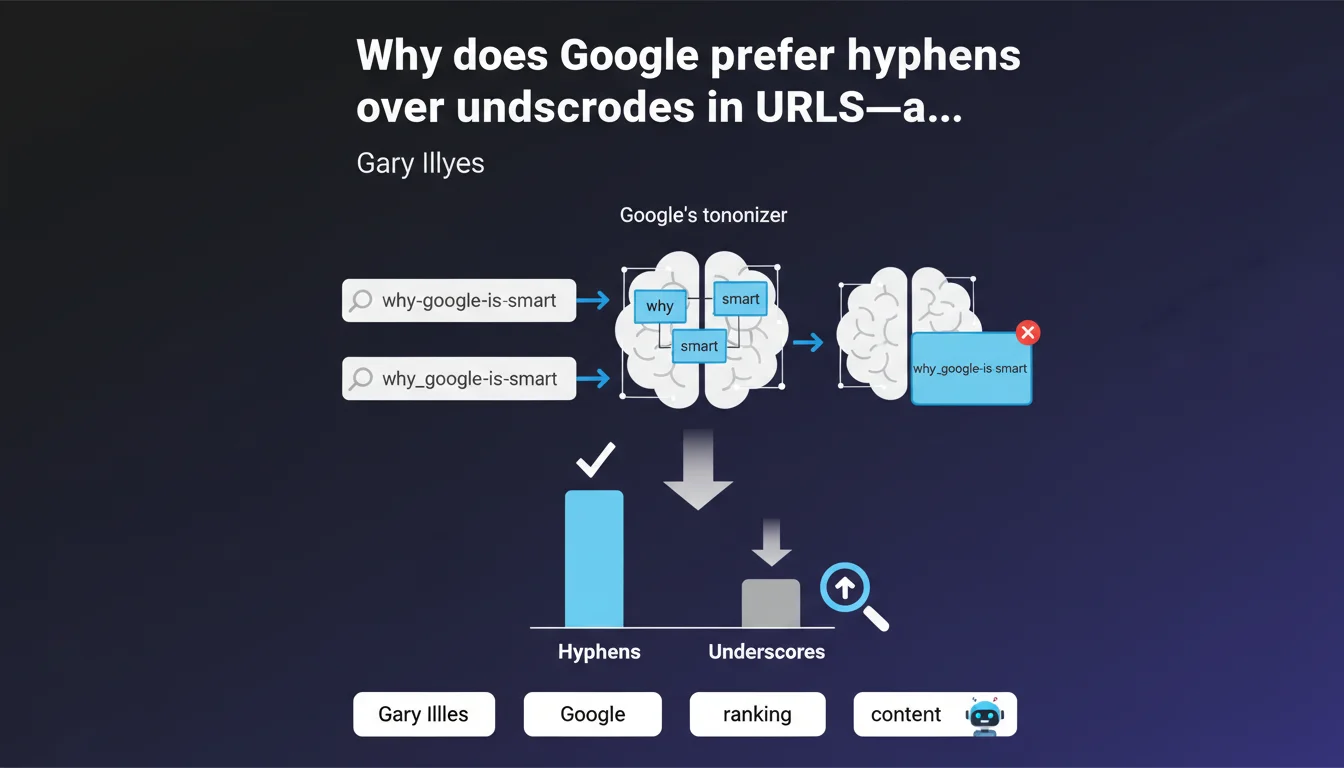
Google recommends using hyphens rather than underscores in URLs because its tokenizer does not recognize the underscore as a word separator. In practice: 'seo-audit' will be understood as two distinct words, while 'seo_audit' will be treated as a single term. This technical limitation directly affects Google's ability to interpret your page content through their URLs.
What you need to understand
Why can't Google segment underscores?
The issue stems from the historical use of underscores in programming and variable names. In many languages, the underscore is an integral part of the name — removing or segmenting at this character would literally break the term.
Google therefore calibrated its tokenizer to treat the underscore as a standard alphanumeric character, not as a delimiter. The hyphen, on the other hand, is recognized as a natural word separator — just like a space.
Which parts of the URL does Google actually analyze?
Gary Illyes speaks of the "tokenizer" that uses "certain parts of the URL" — deliberately vague wording. In practice, Google primarily examines the slug (the part after the last slash) and potentially directory segments.
The URL becomes a relevance signal among others. Not decisive, but not negligible either — especially when other signals are balanced between multiple candidate pages.
Does this recommendation apply to all types of websites?
In theory yes, but the impact varies enormously. On an e-commerce site with thousands of dynamically generated URLs, refactoring the entire architecture to replace existing underscores can cause more damage than benefits.
On a new project or a site undergoing redesign, however — there's no excuse for not applying this rule from the start.
- Hyphens = word separators recognized by Google
- Underscores = treated as alphanumeric characters, no segmentation
- Primary impact on the slug and URL segments
- Recommendation especially applicable to new projects
- On existing sites, evaluate the cost/benefit of major migration
SEO Expert opinion
Is this statement consistent with field observations?
Completely. Empirical testing confirms that Google does indeed dissociate terms separated by hyphens, while underscores produce a single token. This is measurable in SERPs for multi-term queries.
However — and this is crucial — the actual ranking impact remains marginal in the vast majority of cases. We're talking about a micro-signal among hundreds. Good content, solid authority, and relevant backlinks far outweigh this technical difference.
When does this rule become really problematic?
Two scenarios where it gets serious: multilingual sites with translated slugs, and e-commerce platforms with SKUs or technical identifiers in the URL. If your URLs contain product references like "REF_12345_BLUE", Google won't segment anything.
Another edge case: legacy CMS or frameworks imposing naming conventions with underscores. Migration can require heavy server rewrites or deep code modifications — with regression risks.
Should you really redo everything if your site uses underscores?
Let's be honest: probably not. Unless you're in an ultra-competitive sector where every micro-optimization counts, the ROI of a massive migration is questionable.
However, two simple rules apply: for any new page or section, use hyphens systematically. And if you're completely redesigning the site, take the opportunity to normalize — but don't do a migration just for this isolated reason.
Practical impact and recommendations
What should you do concretely on a new project?
Set it up in advance. Enforce the hyphens only convention in your templates, URL generation rules, and editorial guidelines. Most modern CMS platforms (WordPress, Shopify, Drupal) handle this natively.
If you're developing custom solutions: configure your router or slug generator to automatically replace spaces and special characters with hyphens, never underscores. Test with accented characters, apostrophes — the devil is in the edge cases.
How do you audit an existing site to spot underscores?
Crawl with Screaming Frog, Oncrawl, or Botify. Filter URLs containing "_" and evaluate their SEO weight: current organic traffic, rankings, backlinks. Prioritize strategic pages if you decide to migrate.
Also check for automatic generation patterns — pagination, filters, categories. A hidden underscore in a parameter or facet segment can multiply across thousands of URLs.
What mistakes should you avoid during migration?
Never migrate without an exhaustive redirect plan. Each old URL with underscore must point to its hyphenated version via permanent 301 redirect. Test in preprod, verify redirect chains (never more than one hop).
Second pitfall: forgetting canonical tags and sitemaps. After migration, update your XML sitemap, resubmit via Search Console, and monitor indexation for at least 4-6 weeks.
- Configure your CMS or URL generator to use hyphens by default
- Crawl the existing site to identify all URLs with underscores
- Evaluate the SEO weight of each affected URL (traffic, rankings, backlinks)
- Prioritize strategic pages if partial migration
- Create a complete mapping of old URLs → new URLs
- Implement permanent 301 redirects (never 302)
- Update XML sitemap and canonical tags
- Monitor indexation and rankings in Search Console post-migration
- Document the convention for future site evolution
❓ Frequently Asked Questions
Dois-je migrer toutes mes URLs si elles contiennent des underscores ?
Les underscores pénalisent-ils vraiment mon référencement ?
Cette règle s'applique-t-elle aussi aux noms de fichiers images ou PDF ?
Peut-on mélanger tirets et underscores dans une même URL ?
Les autres moteurs de recherche ont-ils la même logique ?
🎥 From the same video 11
Other SEO insights extracted from this same Google Search Central video · published on 21/06/2022
🎥 Watch the full video on YouTube →
💬 Comments (0)
Be the first to comment.