
Official statement
Other statements from this video 11 ▾
- □ L'expérience de page suffit-elle vraiment à garantir une bonne UX pour Google ?
- □ Faut-il vraiment penser aux utilisateurs avant les machines en SEO ?
- □ Tirets vs underscores dans les URLs : pourquoi Google préfère-t-il l'un à l'autre ?
- □ Le contenu masqué dans les accordéons pénalise-t-il votre référencement ?
- □ Le contenu caché est-il devenu aussi important que le contenu visible pour Google ?
- □ Googlebot peut-il vraiment indexer du contenu caché derrière des clics utilisateur ?
- □ Pourquoi Google ignore-t-il votre navigation si elle n'utilise pas de vrais liens anchor ?
- □ Les Core Web Vitals suffisent-ils vraiment à mesurer l'expérience utilisateur ?
- □ Pourquoi Google refuse-t-il de donner des critères précis sur certains aspects de l'UX ?
- □ Les URLs lisibles et cohérentes sont-elles vraiment un critère de ranking ?
- □ Lighthouse rate-t-il vraiment la qualité de vos ancres de liens ?
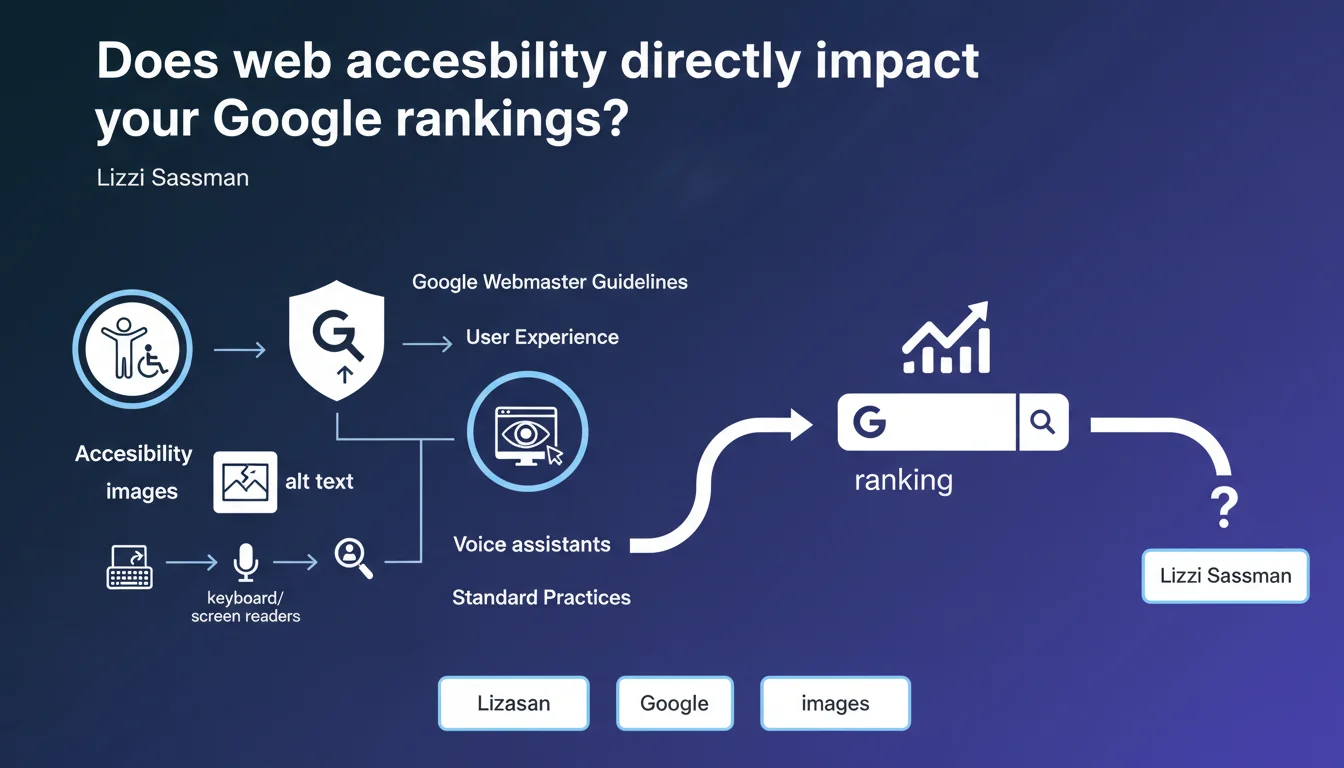
Google considers accessibility as a component of documented user experience in its guidelines. Image alt text and other accessibility practices are mentioned explicitly, but their direct impact on ranking remains unclear. In practice? Accessibility improves overall UX, which matters — but Google doesn't confirm a dedicated SEO boost.
What you need to understand
What does Google really say about accessibility?
Google integrates web accessibility into its webmaster guidelines, positioning it as an element of user experience. Lizzi Sassman notably emphasizes image alt text and other standard accessibility practices.
This statement does not create a new ranking signal. It simply reminds us that accessibility contributes to overall UX, a criterion Google has valued for a long time — without ever specifying how or to what extent.
Why does Google specifically mention alt text?
Alt text serves two functions: it helps Googlebot understand visual content and improves the experience for visually impaired users. It's been a basic SEO practice for years.
By reintegrating it into an accessibility framework, Google broadens the narrative: it's no longer just for robots, it's for humans. A subtle shift in perspective that changes nothing technically.
Is accessibility becoming an official ranking factor?
No. Google doesn't say that accessibility directly improves your positions. It says that it's part of documented user experience — a deliberately vague formulation.
Accessibility practices can indirectly influence behavioral metrics (time on site, bounce rate, engagement), but no dedicated accessibility signal is confirmed by Google.
- Accessibility = UX component, not a separate ranking signal
- Alt text remains fundamental for image indexing
- Google never quantifies the real impact of accessibility on rankings
- Guidelines evolve without creating new technical criteria
SEO Expert opinion
Is this statement consistent with observed practices?
Yes and no. In the field, accessible sites don't systematically outrank others with equivalent content. [To verify] : no large-scale study has ever correlated accessibility score (WCAG type) and SERP positions in a significant way.
On the other hand, technically well-designed sites — which often comply with accessibility standards — tend to perform better. But this is a side effect: clean HTML structure, logical navigation, optimized performance. Accessibility is just a symptom of good overall architecture.
What nuances should be added to this message?
Google talks about documented user experience — not measured experience. In concrete terms? This looks like an editorial recommendation, not a hard algorithmic criterion.
Alt text is a particular case: it has always been a signal for Google Images and contributes to contextual understanding. But saying that accessibility as a whole boosts SEO is extrapolating far beyond what Google confirms.
In what cases does this rule not apply?
If your site is hyper-accessible but slow, poorly structured, or full of low-quality content, you won't rank better. Accessibility doesn't compensate for fundamental SEO weaknesses.
Conversely, technically poor accessible sites but excellent in content and backlinks still dominate competitive SERPs. Let's be honest: accessibility isn't the priority lever in pure SEO.
Practical impact and recommendations
What should you do concretely right now?
Start by auditing your images: each image must have a descriptive, context-relevant alt attribute. Avoid robotic formulations like "product-image-123.jpg".
Check your HTML semantic structure: coherent heading hierarchy (H1, H2, H3), links with explicit anchors, properly labeled forms. These elements help both screen readers and Googlebot.
What mistakes should you absolutely avoid?
Don't confuse accessibility with over-optimization. A 200-character alt text stuffed with keywords is spam — even if technically valid for a screen reader.
Avoid cosmetic fixes. Adding empty alt attributes (alt="") everywhere to pass a validator accomplishes nothing. True accessibility requires rethinking your navigation logic and content presentation.
How can you verify that your site meets these recommendations?
Use tools like Lighthouse (built into Chrome DevTools) or WAVE to identify accessibility errors. Focus on WCAG level AA criteria at minimum.
Test navigation by keyboard only (without mouse). If you can't reach all interactive elements via Tab, that's a problem — for users AND for bots that simulate this behavior.
- Audit all image alt attributes (descriptive, relevant, no keyword stuffing)
- Verify HTML hierarchy (unique H1, logical subheadings H2/H3/H4)
- Test keyboard navigation (all links and buttons accessible without mouse)
- Check text/background color contrast per WCAG AA minimum (4.5:1 ratio)
- Properly label all form fields
- Use semantic tags (nav, article, aside, footer) for structure
- Avoid auto-playing videos and provide captions
❓ Frequently Asked Questions
Le texte alternatif des images améliore-t-il directement le classement dans Google Search ?
Google pénalise-t-il les sites non accessibles ?
Dois-je prioriser l'accessibilité sur d'autres optimisations SEO ?
Les critères WCAG sont-ils pris en compte par l'algorithme de Google ?
Un audit d'accessibilité peut-il révéler des problèmes SEO cachés ?
🎥 From the same video 11
Other SEO insights extracted from this same Google Search Central video · published on 21/06/2022
🎥 Watch the full video on YouTube →
💬 Comments (0)
Be the first to comment.