
Official statement
Other statements from this video 11 ▾
- □ L'expérience de page suffit-elle vraiment à garantir une bonne UX pour Google ?
- □ Faut-il vraiment penser aux utilisateurs avant les machines en SEO ?
- □ Tirets vs underscores dans les URLs : pourquoi Google préfère-t-il l'un à l'autre ?
- □ Le contenu masqué dans les accordéons pénalise-t-il votre référencement ?
- □ Le contenu caché est-il devenu aussi important que le contenu visible pour Google ?
- □ Googlebot peut-il vraiment indexer du contenu caché derrière des clics utilisateur ?
- □ Pourquoi Google ignore-t-il votre navigation si elle n'utilise pas de vrais liens anchor ?
- □ Pourquoi Google refuse-t-il de donner des critères précis sur certains aspects de l'UX ?
- □ Les URLs lisibles et cohérentes sont-elles vraiment un critère de ranking ?
- □ L'accessibilité web influence-t-elle directement le classement dans Google ?
- □ Lighthouse rate-t-il vraiment la qualité de vos ancres de liens ?
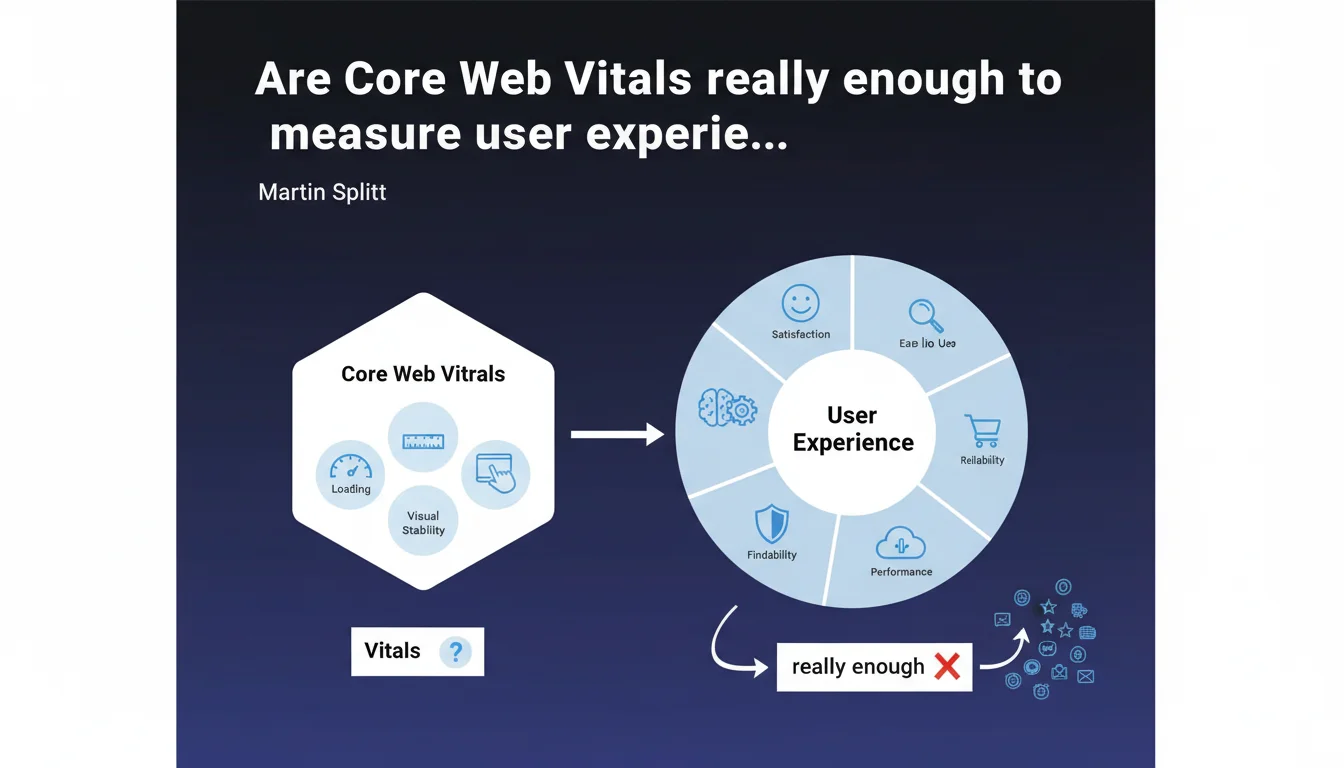
Google confirms that Core Web Vitals capture only a fraction of actual user experience. No single metric can cover all aspects of UX, which is why specific indicators have multiplied. For SEO practitioners, this means that optimizing LCP, FID, and CLS alone does not guarantee an optimal experience.
What you need to understand
Why does Google acknowledge the limitations of its own metrics?
Google admits here what many observe in the field: Core Web Vitals tell only part of the story. LCP measures visual loading, FID measures interactivity, CLS measures visual stability — three important dimensions but far from covering everything.
This statement comes after years of intensive promotion of CWV as a ranking factor. The underlying message? Don't limit yourself to these three metrics if you truly want to improve user experience.
What dimensions of UX do Core Web Vitals miss?
CWV does not measure content relevance, navigation clarity, actual accessibility (beyond technical aspects), or the user's emotional satisfaction with the interface.
A site can have perfect CWV scores and still deliver a frustrating experience: confusing navigation, content hidden behind aggressive popups, counterintuitive design. Technical metrics don't capture these friction points.
How does Google compensate for this fragmented view?
Google's approach is to multiply specific metrics rather than seek a universal one. Hence the continuous emergence of new indicators: INP (Interaction to Next Paint) which replaces FID, Time to First Byte, First Contentful Paint, and more.
Each metric targets a specific aspect of experience. The problem? This multiplication creates complexity and makes optimization more demanding for practitioners.
- CWV covers only a fraction of actual UX
- No single metric can capture the entire user experience
- Google compensates by multiplying specific indicators
- Optimization must go beyond CWV alone
- Qualitative aspects (navigation, relevance) escape technical metrics
SEO Expert opinion
Does this transparency hide a fundamental problem?
Let's be honest: this statement looks like an admission of powerlessness. Google positioned CWV as a major ranking signal, but now acknowledges it measures only part of the experience.
The real problem? No automated metric can capture the complexity of human experience. You can measure display speed, but not a user's frustration with a poorly designed purchase journey. This limitation isn't technical — it's conceptual.
Are SEO practitioners optimizing for the right metrics?
In the field, we observe a disproportionate obsession with CWV at the expense of other UX aspects. Sites achieve 100/100 on PageSpeed Insights but display catastrophic bounce rates.
Why? Because teams optimize what is measurable and visible in tools, not what actually improves experience. Perfect LCP doesn't compensate for confusing navigation or irrelevant content. [To verify]: the actual impact of CWV weight in the algorithm remains unclear — Google doesn't communicate clear weighting.
Should we continue to prioritize Core Web Vitals?
Yes, but with clarity. CWV remains a confirmed ranking signal and a solid foundation for technical optimization. But treating them as the alpha and omega of UX is a strategic mistake.
The balanced approach? Optimize CWV while investing heavily in qualitative aspects: information architecture, CTA clarity, user journey, actual accessibility. User testing often yields more value than hours spent gaining 10 points on PageSpeed.
Practical impact and recommendations
What should you optimize beyond Core Web Vitals?
CWV is just a starting point. For complete user experience, also focus on aspects that automated metrics don't capture.
Analyze actual user journeys via heatmaps and session recordings. Test navigation clarity with real users. Measure the time needed to accomplish a key action (purchase, signup, contact) — not just load time.
How to avoid counterproductive metric obsession?
Don't sacrifice actual experience on the altar of perfect scores. A classic example: delaying useful functionality to artificially improve LCP.
Prioritize optimizations that improve both metrics and perceived experience simultaneously. Compress images? Yes. Remove useful features to gain 100ms? No.
What complementary indicators should you track?
Beyond CWV, track conversion and engagement-oriented metrics: bounce rate adjusted for traffic quality, engagement time, critical journey completion rates, return rate.
Combined with CWV, this set will give you a multidimensional view of your site's actual performance. Qualitative data (user feedback, usability tests) complete the picture.
- Audit your critical user journeys beyond technical metrics
- Implement regular user testing (qualitative)
- Monitor conversion metrics alongside CWV
- Never sacrifice useful functionality for a metric score
- Analyze heatmaps and session recordings
- Measure completion time for key actions
- Follow INP evolution as it progressively replaces FID
- Balance technical optimizations and qualitative improvements
❓ Frequently Asked Questions
Les Core Web Vitals restent-ils un facteur de ranking important malgré leurs limites reconnues ?
Quelles métriques alternatives Google recommande-t-il pour compléter les CWV ?
Un site avec des CWV parfaits peut-il avoir une mauvaise expérience utilisateur ?
Faut-il arrêter de prioriser les CWV au profit d'autres aspects de l'UX ?
Comment mesurer les aspects de l'UX que les CWV ne couvrent pas ?
🎥 From the same video 11
Other SEO insights extracted from this same Google Search Central video · published on 21/06/2022
🎥 Watch the full video on YouTube →
💬 Comments (0)
Be the first to comment.