
Official statement
Other statements from this video 11 ▾
- □ Is page experience really enough to guarantee good UX for Google?
- □ Why does Google prefer hyphens over underscores in URLs—and what's the real impact on your rankings?
- □ Do accordions really hurt your SEO, or is it just an old myth?
- □ Has hidden content become just as important as visible content for Google?
- □ Does Googlebot really fail to index content hidden behind user clicks?
- □ Is Google really unable to crawl your navigation if it doesn't use proper anchor links?
- □ Are Core Web Vitals really enough to measure user experience?
- □ Why won't Google give you precise criteria on certain UX aspects—and what should you do about it?
- □ Are human-readable and consistent URLs really a ranking factor?
- □ Does web accessibility directly impact your Google rankings?
- □ Is Lighthouse really missing poor quality anchor text on your site?
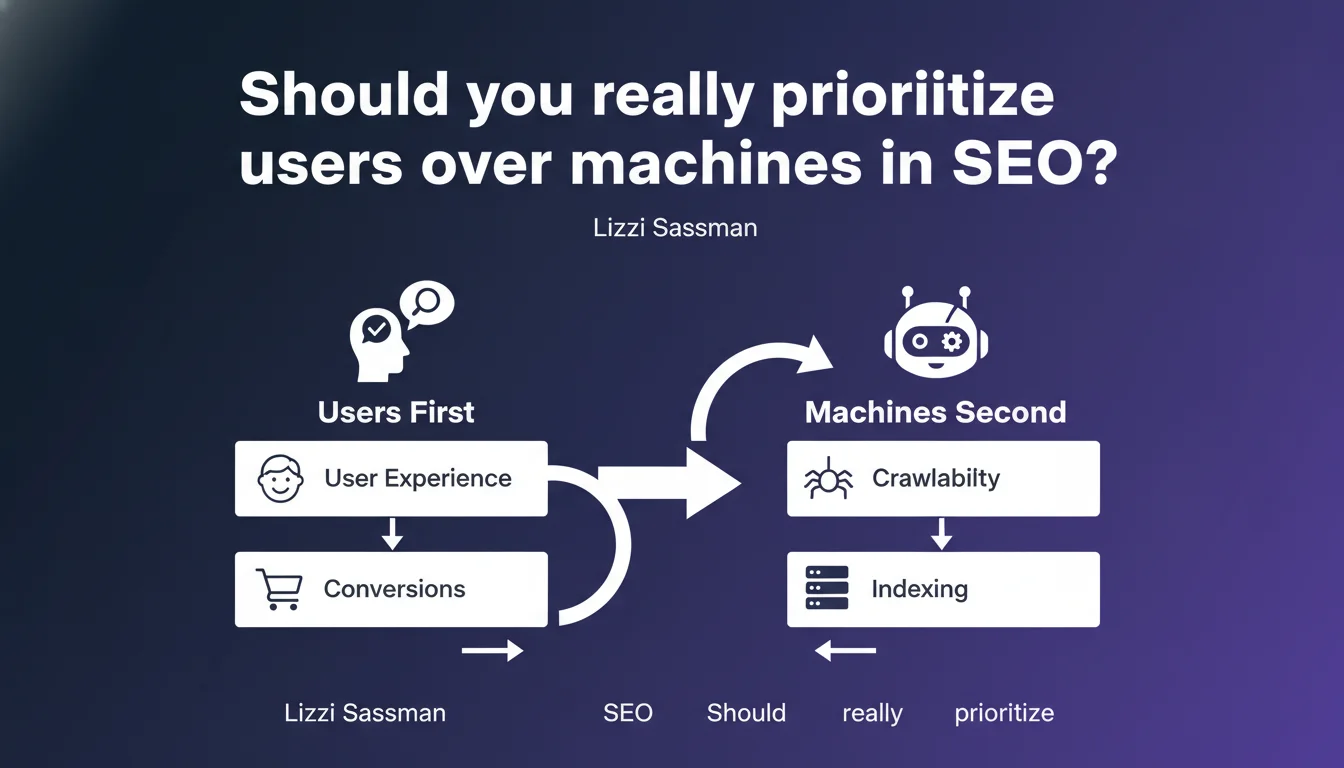
Google reaffirms that websites should be designed primarily for users, not algorithms. This directive emphasizes user experience as a central criterion, but remains vague about how machines evaluate this experience. Concretely, a site that only works for Googlebot but performs poorly for visitors should be penalized.
What you need to understand
Does this recommendation contradict technical optimization?
Not at all. Google isn't saying to ignore machines, but not to design exclusively for them. A user-centered site must remain technically accessible to crawlers.
The nuance matters: you can optimize your crawl budget, structure your data, refine your tags — as long as the end result serves the user. The problem starts when you stuff invisible content, create doorway pages, or manipulate signals without real value.
How does Google measure if a site is designed for users?
That's where it gets complicated. Google uses behavioral signals (session duration, bounce rate, clicks back to SERP), technical metrics (Core Web Vitals), and content analysis itself.
But none of these metrics are perfect. A user might stay 10 seconds on a page because they found their answer immediately — or because the site is so slow it hasn't loaded yet. Google makes assumptions, not certainties.
What's the difference between a user-centered site and a machine-centered site?
A machine-centered site: mass-generated content targeting keywords, illogical navigation but optimized for internal linking, hidden text, over-optimization of anchors. Basically, everything that screams algorithm.
A user-centered site: intuitive architecture, content answering real intent, readable design, decent load times. And — ironically — this type of site often performs better in SEO precisely because Google tries to reward user experience.
- Prioritizing users doesn't mean ignoring technical SEO
- Google evaluates user experience through imperfect signals
- A site designed to manipulate algorithms eventually gets detected
- Alignment between search intent and delivered content remains central
SEO Expert opinion
Is this directive consistent with what we observe in practice?
Partially. We do see user-friendly sites ranking well, and content farms getting crushed. But there are massive exceptions.
Sites stuffed with ads, with catastrophic UX, continue to dominate certain niches — because they have thousands of backlinks and old domain authority. Google says "think users," but in reality, domain authority still weighs heavily. A new site, even perfect in UX, will struggle against an SEO dinosaur.
When doesn't this rule really apply?
Let's be honest: on certain technical B2B queries or ultra-specialized niches, user experience in the "nice design" sense matters much less. A poorly formatted but exhaustive PDF can rank above a polished landing page.
Google adapts its criteria by query type. For a mainstream transactional search, UX and speed are critical. For a pointy informational query, content depth and credibility take priority — even if the site looks like 1998.
Is Google playing fair with this recommendation?
[To be verified] — this directive remains vague. "Thinking about users" is easy to say, hard to measure. Google provides no concrete metrics to evaluate if your site respects this rule.
In practice, it looks more like legal cover to justify manual penalties. "Your site doesn't respect user guidelines" becomes a catch-all argument when the algo isn't enough to explain a sanction.
Practical impact and recommendations
What should you do concretely to follow this directive?
Start by auditing your site from a user perspective, not SEO. Navigate like a regular customer: can you quickly find what you're looking for? Is the design readable on mobile? Are CTAs clear?
Then cross-reference these observations with your Analytics data. Identify pages with high bounce rates or ridiculously low session time — these are your alarm signals. If users are leaving, Google sees it too.
What mistakes must you absolutely avoid?
Never create content purely to rank without real value. Pages generated in bulk to capture long-tail traffic but that help nobody — that's exactly what Google wants to kill.
Also avoid visible over-optimization: mechanical keyword repetition, artificial link anchors, hidden text. Everything that smells like manipulation will get detected — maybe not today, but in the next update.
How do you verify your site is compliant?
Use Core Web Vitals as your technical baseline. If your LCP exceeds 2.5 seconds or your CLS spikes, you have a measurable UX problem.
Run real user tests. Ask non-technical people to navigate your site and observe their friction points. Heatmaps and session recordings (Hotjar, Clarity) often reveal invisible frictions in your Analytics reports.
- Audit your site from a user perspective, not just technical lens
- Analyze bounce rate, session time, and navigation behavior
- Optimize Core Web Vitals (LCP, FID, CLS)
- Test mobile navigation — that's often where things break
- Remove or redesign low-value pages
- Ensure every page answers a specific intent
- Avoid visible over-optimization and manipulation techniques
❓ Frequently Asked Questions
Penser utilisateur signifie-t-il abandonner les techniques SEO classiques ?
Comment Google détecte-t-il qu'un site n'est pas pensé utilisateur ?
Un site moche mais utile peut-il bien ranker ?
Faut-il privilégier le contenu long ou le contenu concis pour l'utilisateur ?
Cette directive change-t-elle quelque chose aux stratégies de contenu SEO ?
🎥 From the same video 11
Other SEO insights extracted from this same Google Search Central video · published on 21/06/2022
🎥 Watch the full video on YouTube →
💬 Comments (0)
Be the first to comment.