
Official statement
Other statements from this video 9 ▾
- □ Do Search Console grouped exports to BigQuery really replace the Search Analytics API?
- □ Does Google's bulk export finally unlock all the performance metrics you've been missing?
- □ Did you know Google counts only one impression when multiple pages from your site appear in the same search results?
- □ Why does Google use 0 as the topmost position in Search Console data?
- □ How does Google's searchdata_url_impression table break down your search performance data?
- □ Are you missing out on rich snippet opportunities? How to master search appearance fields and dominate your SERP real estate?
- □ Why does Google require aggregation functions when analyzing Search Console data?
- □ Should you really limit queries by date in Search Console to optimize your performance?
- □ Should you really filter out anonymized queries from Google Search Console to boost your data quality?
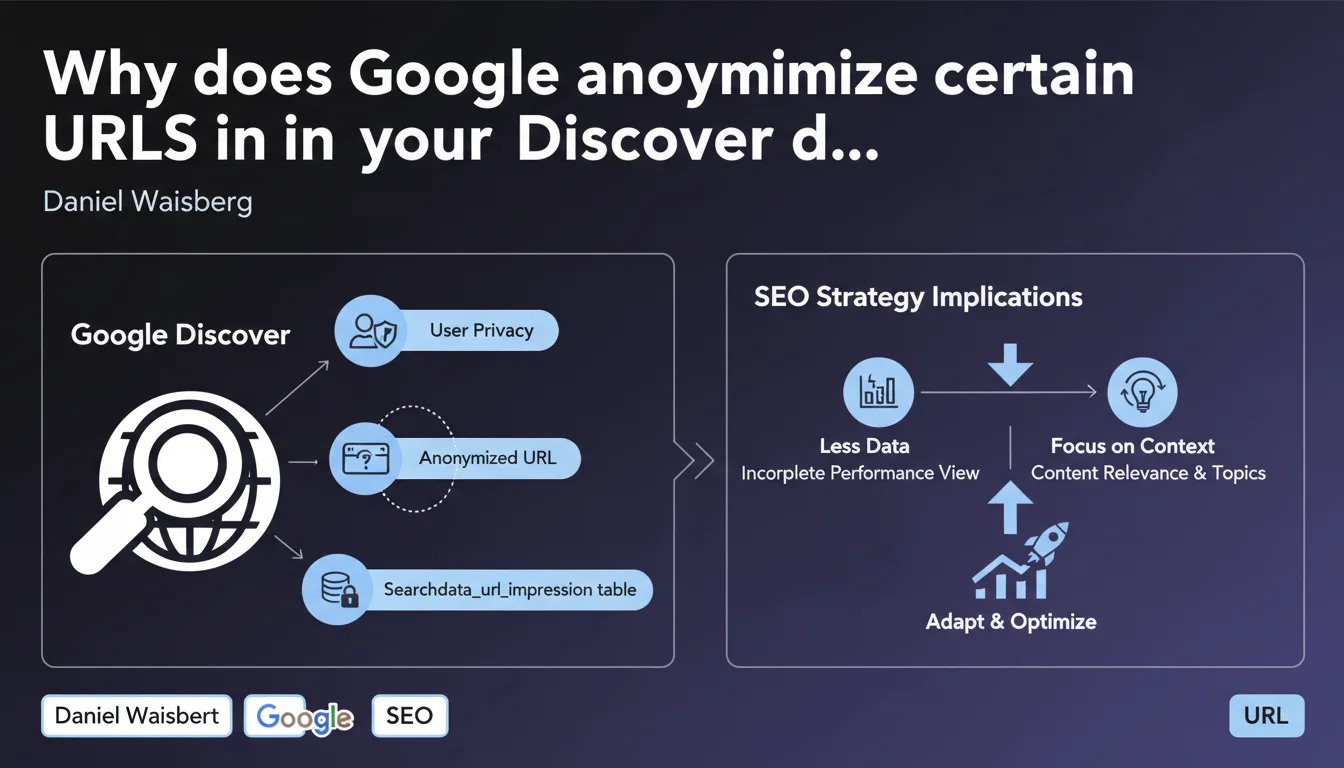
Google confirms the existence of a boolean field in the searchdata_url_impression table of BigQuery Export indicating whether a URL displayed in Discover is anonymized to protect user privacy. In practical terms, certain URLs won't be visible in your Discover reports, even if they generate impressions and clicks. This anonymization affects content related to sensitive or personal searches.
What you need to understand
What exactly is this searchdata_url_impression table?
The searchdata_url_impression table is part of the Search Console BigQuery Export, a feature that allows you to export your Search Console data to BigQuery for advanced analysis. It contains impressions at the level of individual URLs.
Until now, SEO professionals using this system knew that certain data could be missing, but Google now explicitly confirms the reason: a boolean field signals when a URL is intentionally anonymized for Discover.
Why does Google anonymize certain URLs in Discover?
The logic is based on protecting the privacy of Google Discover users. Unlike traditional search where the user formulates an explicit query, Discover proactively suggests content based on browsing history and interests.
Some content viewed through Discover reveals sensitive information about user preferences or habits. By anonymizing the URL, Google prevents site owners from reconstructing user profiles based on traffic patterns.
Which URLs are affected by this anonymization?
Google doesn't provide an exhaustive list — obviously. You can assume it affects content related to health, political or religious orientations, sensitive personal searches, or any topic where privacy is a priority.
In practice, if you notice Discover impressions without corresponding URLs in your BigQuery exports, this boolean field will confirm that it's intentional anonymization and not a data reporting bug.
- The boolean field explicitly indicates whether anonymization is active for a data row
- This anonymization applies only to Discover, not to classic search
- Impressions and clicks are counted, but the URL remains hidden
- There's no way to work around this limitation — it's a Google product decision
SEO Expert opinion
Does this statement really change anything for SEO practitioners?
Let's be honest: not fundamentally. Professionals working with BigQuery Export already knew that certain Discover data was missing. This statement just provides official confirmation and a technical way to distinguish intentional anonymization from a tracking issue.
The real problem is that we're still in the dark about which specific criteria trigger anonymization. Google talks about "protecting user privacy" — a vague enough phrase to cover just about anything. [To be verified] whether this anonymization follows strict GDPR rules or if it's Google's own interpretation.
Can you estimate the volume of Discover traffic lost in these anonymizations?
Now we're hitting the heart of the matter. If you work in health, wellness, or any "sensitive" sector, you probably have a significant blind spot in your Discover analytics. How many impressions? How many clicks? Mystery.
The boolean field tells you "yes, this row is anonymized," but it doesn't give you the URL back. You can therefore count the number of anonymized rows in your export, but it's impossible to optimize those specific pieces of content since you don't know which ones are affected.
Is this limitation consistent with Google's product philosophy?
Completely. Google has always prioritized user data protection over transparency to webmasters when the two conflict. It's consistent with the gradual removal of "not provided" queries in Analytics, the hiding of long-tail queries in Search Console, and so on.
What's frustrating is the lack of clear guidelines: which topics trigger anonymization? Is there a traffic threshold below which anonymization doesn't apply? Google keeps this internal workings well under wraps.
Practical impact and recommendations
What should you do concretely with this information?
First, if you're using BigQuery Export, check this boolean field in your SQL queries. It will give you an idea of the percentage of Discover data anonymized for your site. In practical terms, add a WHERE clause or COUNT on this field to quantify the phenomenon.
Second, accept that you will never be able to optimize these hidden URLs on a granular basis. Your Discover strategy should be based on visible URLs and extrapolate general trends — it's frustrating, but that's how it is.
What errors should you avoid when interpreting this data?
Don't confuse "anonymized URL" with "underperforming URL." A masked URL can very well generate significant traffic — you just can't see the details. So avoid jumping to hasty conclusions about Discover's overall performance based solely on visible URLs.
Another pitfall: don't try to reconstruct anonymized URLs by cross-referencing with other data sources (Analytics, server logs). Google has probably implemented obfuscation mechanisms to prevent this triangulation — and you'll just waste time.
How should you adjust your Discover strategy in light of this limitation?
Focus on broad themes rather than URL-by-URL optimization. If you notice that a category of content is generating Discover traffic (visible), double down on that theme even if certain URLs remain anonymized.
Use aggregated data: average CTR on Discover, overall bounce rate, time spent. These metrics remain reliable even if certain URLs are hidden. They give you strategic direction without requiring URL-level granularity.
- Query the boolean field in your BigQuery exports to quantify anonymization
- Document the proportion of anonymized URLs by content category
- Don't try to bypass anonymization — it's a waste of time
- Optimize at the thematic level rather than at the individual URL level
- Compare Discover performance with other channels to detect anomalies
- Monitor the evolution of the anonymization rate over time
❓ Frequently Asked Questions
Le champ booléen me donne-t-il accès à l'URL masquée ?
Cette anonymisation affecte-t-elle aussi les données dans l'interface standard de la Search Console ?
Tous les sites sont-ils concernés par cette anonymisation ?
Peut-on demander à Google de désanonymiser certaines URLs pour notre site ?
L'anonymisation impacte-t-elle le référencement de ces URLs ?
🎥 From the same video 9
Other SEO insights extracted from this same Google Search Central video · published on 01/06/2023
🎥 Watch the full video on YouTube →
💬 Comments (0)
Be the first to comment.