
Official statement
Other statements from this video 10 ▾
- □ Are snippets really the most underestimated SEO lever to boost your CTR?
- □ How do you write page titles that won't get truncated by Google?
- □ Do you really need to repeat your keywords in titles to rank higher on Google?
- □ Why does Google insist so strongly on having unique title tags for every page?
- □ Does Google really generate different snippets for the same page based on each search query?
- □ Can Google really override your title tags and meta descriptions?
- □ Should your meta description really be a sales pitch?
- □ Should you really forget about the 155-character limit for meta descriptions?
- □ Should you really write meta descriptions as complete sentences?
- □ Should you really write a unique meta description for every single page?
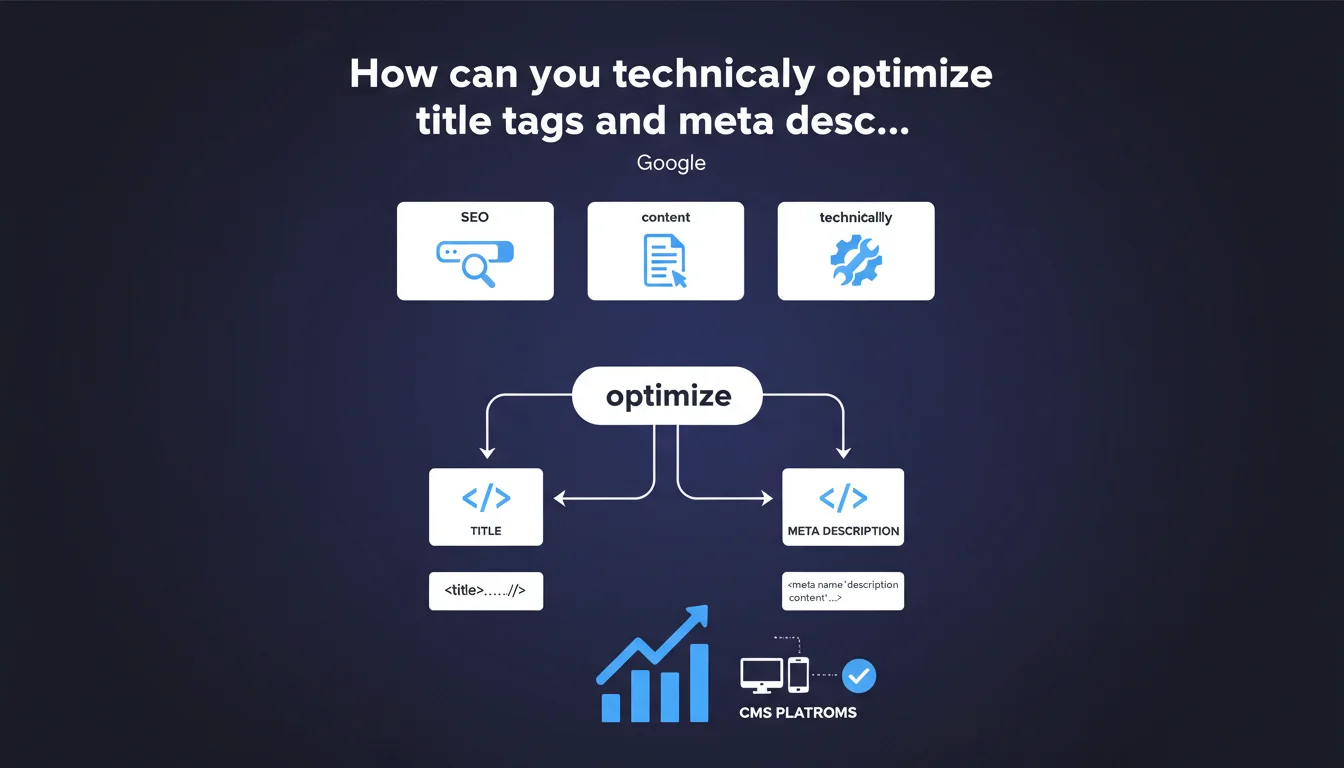
Google reiterates the fundamentals: the title goes in the <title> tag between the <head> tags, the meta description in the content attribute of the meta name='description' tag. Most CMS platforms include interfaces to manage these elements without touching code. A basic statement that confirms practices established for two decades.
What you need to understand
Why does Google reiterate these technical fundamentals?
This statement is aimed at beginners or site managers who have no knowledge of HTML. Google regularly hammers home these basics to reduce implementation errors that harm display in SERPs.
For an SEO professional, this is entry-level stuff. But the explicit mention of CMS platforms shows that Google encourages the use of simplified interfaces rather than manual code editing — probably to limit syntax errors.
What technical pitfalls exist despite this apparent simplicity?
The devil is in the details. A poorly encoded title (UTF-8 not respected), an empty content attribute, or worse — duplicate tags — can torpedo display. Some CMS platforms also auto-generate titles that overwrite your changes if you don't disable the right modules.
JavaScript frameworks pose another problem: if the title is injected client-side, Googlebot may not see it immediately — even though dynamic rendering eventually captures it. Position in the DOM also matters: a title outside the will be ignored.
Does the statement address best practices for writing?
No. Google remains silent on optimal length, keyword usage, or semantic relevance. This statement deals exclusively with technical implementation, not editorial strategy — which remains the true SEO lever.
- The title is placed in the <title> tag within the <head>
- The meta description uses the content attribute of <meta name="description">
- Modern CMS platforms offer interfaces to edit these elements without coding
- Position in the DOM and UTF-8 encoding are critical for correct display
- No guidance on editorial best practices — it's purely technical
SEO Expert opinion
Does this statement bring anything new in 2025?
Let's be honest: nothing at all. It's a repackaging of advice that's twenty years old. Title tags and meta descriptions haven't changed since the days when Internet Explorer 6 dominated the market.
The only notable element is the mention of CMS platforms. Google is clearly pushing users toward turnkey solutions — WordPress, Shopify, Wix — that automatically handle these aspects. It aligns with their drive to simplify the web for non-technical users, but it doesn't help professionals grasp the nuances.
What gray areas does Google deliberately ignore?
Several crucial points are absent. Nothing on managing titles in JavaScript SPAs (Single Page Applications), where the title changes dynamically without page reload. Nothing on conflicts between multiple SEO plugins installed on the same CMS — an ultra-frequent case I still encounter every week.
Not a word either on titles truncated in SERPs. Google can rewrite your title if it deems it irrelevant, but this statement doesn't even address this behavior — though it's documented elsewhere. [To verify]: to what extent does this rewriting really affect CTR? Public data is lacking.
Does real-world observation contradict this statement?
No, it's factually accurate. But it's incomplete. I've seen sites with perfectly implemented titles that were systematically rewritten by Google — particularly on e-commerce category pages.
The real problem is that Google presents this as a solved problem. In reality, technical implementation is only 20% of the work. The remaining 80% concerns editorial strategy, semantic optimization, and managing Google's automatic rewrites — none of these points are mentioned here.
Practical impact and recommendations
What should you concretely verify on your site?
First audit the actual presence of these tags on all your strategic pages. Use a crawler (Screaming Frog, Sitebulb, OnCrawl) to detect pages without titles, with duplicate titles, or missing meta descriptions.
Next verify that your tags are properly in the <head> and not lost in the <body>. Some poorly coded visual builders occasionally insert these tags anywhere. Also test display in Google Search Console: if the displayed title differs from your code, Google is rewriting it — and you need to understand why.
What technical errors should you avoid at all costs?
Never leave a content attribute empty in the meta description — you might as well not include the tag. Avoid special characters with poor encoding (curved quotes, exotic emojis) that can break display in some configurations.
On multilingual sites, watch out for hreflang tags that can conflict with poorly adapted titles per language. And if you use JavaScript fragments to dynamically inject these elements, ensure that server-side rendering (SSR) or prerendering is active — otherwise Googlebot risks seeing nothing.
How do you automate management at scale?
For large sites (e-commerce, marketplaces, classifieds), manual editing is impossible. Set up dynamic templates that generate titles and meta descriptions from structured data: product name, category, key attributes.
Integrate fallback rules: if a field is missing (empty product description), use a relevant default value rather than generic text. Monitor Google's rewrite rates via Search Console — a high rate signals a relevance problem.
- Crawl your site to identify pages without title or meta description
- Verify that tags are properly placed in the <head> of the HTML
- Check UTF-8 encoding to avoid broken characters
- Test actual display in SERPs via Google Search Console
- On JavaScript sites, validate server-side rendering (SSR) or prerendering
- Eliminate conflicts between multiple SEO plugins on CMS
- For large sites, automate with dynamic templates and fallback rules
- Monitor your titles' rewrite rate by Google — an alarm signal
❓ Frequently Asked Questions
Google réécrit-il systématiquement les titles et meta descriptions que j'ai définis ?
Les meta descriptions ont-elles un impact direct sur le ranking ?
Quelle est la longueur optimale pour un title et une meta description ?
Puis-je utiliser plusieurs balises title ou meta description sur la même page ?
Les CMS gèrent-ils automatiquement les titles et meta descriptions de manière optimale ?
🎥 From the same video 10
Other SEO insights extracted from this same Google Search Central video · published on 24/02/2022
🎥 Watch the full video on YouTube →
💬 Comments (0)
Be the first to comment.