
Official statement
Other statements from this video 8 ▾
- □ Can SafeSearch really blacklist an entire mixed website that's poorly configured?
- □ Is the meta rating tag really useful for flagging explicit content?
- □ Should you really isolate adult content in a subdomain or separate folder to protect your main domain?
- □ Should you allow Googlebot to fetch your video files to improve their search visibility?
- □ Should you really disable age verification for Googlebot?
- □ How does SafeSearch actually filter explicit content from your search results?
- □ Is your site being secretly filtered by SafeSearch? Here's how to find out
- □ Why does Google really enforce a 2-3 month waiting period before reconsidering a SafeSearch classification?
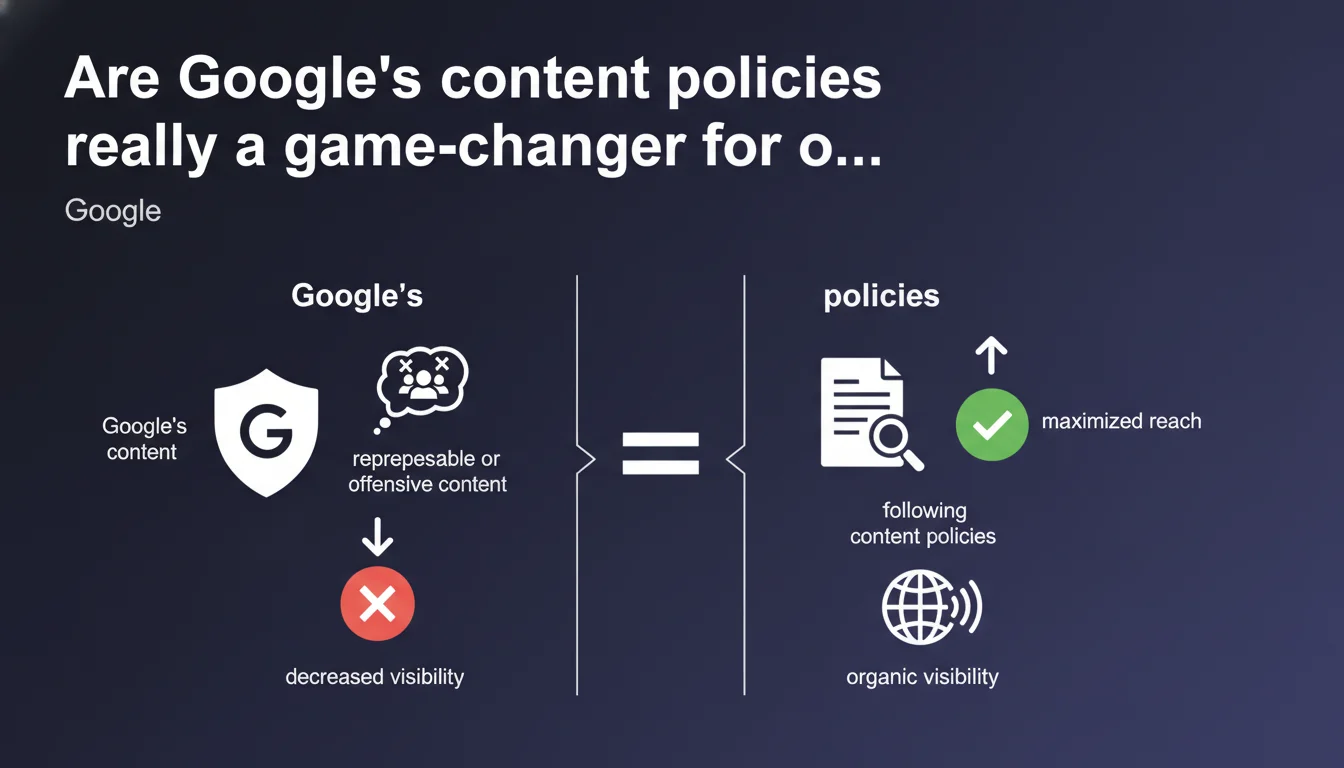
Google claims that adhering to its content policies helps maximize reach by avoiding reprehensible or offensive content. However, the phrasing remains vague: is this a direct ranking criterion or simply a measure to deindex problematic content? No concrete metrics are provided to quantify this impact.
What you need to understand
What does Google really mean by "maximize reach"?
The wording chosen — "maximize reach" — is deliberately ambiguous. Google doesn't say that complying with policies improves rankings, but rather that it prevents content from being limited or removed. An important distinction.
In practice, content policies aim to filter dangerous medical misinformation, non-consensual pornography, manipulative spam, or explicit violent content. Nothing that should affect 99% of websites.
Are content policies a ranking factor?
Nothing in this statement confirms that respecting policies actively boosts your positions. It's more of a safeguard: violating these rules can trigger manual actions or even deindexation.
Google draws a clear distinction between E-E-A-T quality criteria (which influence rankings) and content policies (which define what's acceptable in the index). This statement addresses the latter.
Why is Google making this announcement now?
This communication looks like a defensive reminder in the face of mass-generated AI content, often borderline in terms of accuracy or editorial standards. Google likely wants to regulate abuses before they become systemic.
It's also an indirect way of saying: "We're not responsible if your problematic content disappears." Both a legal and algorithmic safety net.
- Content policies are not a traditional ranking criterion
- They define what can stay in the Google index or be excluded from it
- Violating these rules can lead to manual actions or deindexation
- This statement likely aims to curb abuses linked to mass-generated AI content
- No quantitative data on the actual impact of these policies on visibility
SEO Expert opinion
Is this statement consistent with what we observe in practice?
Yes and no. Sites that blatantly violate policies — scams, deepfakes, serious medical misinformation — are indeed sanctioned or deindexed. But for the majority of professional sites, these policies have no visible daily impact.
The problem is that Google conflates two distinct issues here: editorial compliance (not being offensive) and SEO performance (maximizing reach). A piece of content can be perfectly compliant with policies while remaining invisible in the SERPs due to lack of relevance or authority.
Which gray areas should you monitor?
Google's content policies remain open to interpretation, especially on YMYL topics (health, finance, security). The same content might go unnoticed on an established media site but trigger a manual action on an anonymous blog — [To verify] but this is a frequently observed pattern.
Another blind spot: AI-generated content. Google says it's not inherently forbidden, but if a tool produces masses of factually inaccurate or misleading text, it can cross into anti-spam policies. The line is thin and constantly shifting.
Is it really worth dedicating SEO time to this?
For a typical niche B2B or standard e-commerce site, these policies are a non-issue. You're not at risk if you're selling lamps or offering project management training.
However, if your strategy relies on YMYL content (alternative health, crypto, financial coaching), you should regularly audit what could be interpreted as deceptive or harmful. A manual action can destroy 6 months of SEO work.
Practical impact and recommendations
What specifically should you check on your site?
Start by consulting Google Search Console and checking the Manual Actions tab. If nothing appears, you're probably in basic compliance. Next, review your YMYL content — health, finance, legal, security — and ensure it's sourced, nuanced, and authored by identifiable people.
If you're generating content via AI, systematically review it before publishing. These tools hallucinate, invent studies, and confuse concepts. False or misleading content can shift from a quality issue to a content policy issue if Google determines it poses potential harm.
Which mistakes should you avoid at all costs?
Don't republish or slightly rewrite content copied from dubious sites — Google often associates spam with content policy violations. Also avoid clickbait headlines promising miracle results (health, money) without disclaimers or nuance.
Another trap: fake or manipulated customer reviews. Google classifies this under deceptive content policies, not just anti-spam. A manual action for fabricated reviews can affect your entire domain.
- Check for the absence of manual actions in Search Console
- Audit your YMYL content to ensure it's sourced and authored by credible experts
- Systematically review AI-generated content before publishing to avoid factual errors or harmful claims
- Remove or correct any potentially misleading, offensive, or unsourced content
- Avoid sensationalist headlines without nuance on sensitive topics (health, finance)
- Never publish fabricated or manipulated customer reviews
- Document content authors for YMYL pieces (bio, qualifications, external links)
❓ Frequently Asked Questions
Les politiques de contenu Google sont-elles un critère de classement ?
Mon contenu IA peut-il violer les politiques de contenu ?
Comment savoir si mon site respecte les politiques de contenu ?
Un contenu conforme aux politiques peut-il quand même être invisible dans Google ?
Faut-il auditer régulièrement son site pour ces politiques ?
🎥 From the same video 8
Other SEO insights extracted from this same Google Search Central video · published on 01/11/2023
🎥 Watch the full video on YouTube →
💬 Comments (0)
Be the first to comment.