
Official statement
Other statements from this video 8 ▾
- □ SafeSearch peut-il vraiment blacklister l'intégralité d'un site mixte mal configuré ?
- □ La balise meta rating est-elle vraiment utile pour signaler du contenu explicite ?
- □ Faut-il vraiment isoler le contenu adulte dans un sous-domaine ou un dossier séparé ?
- □ Faut-il autoriser Googlebot à récupérer vos fichiers vidéo pour améliorer leur visibilité ?
- □ Faut-il vraiment désactiver la vérification d'âge pour Googlebot ?
- □ Comment SafeSearch filtre-t-il vraiment le contenu explicite dans les résultats de recherche ?
- □ Comment vérifier si SafeSearch filtre votre site avec l'opérateur site: ?
- □ Les politiques de contenu Google sont-elles vraiment un levier de visibilité organique ?
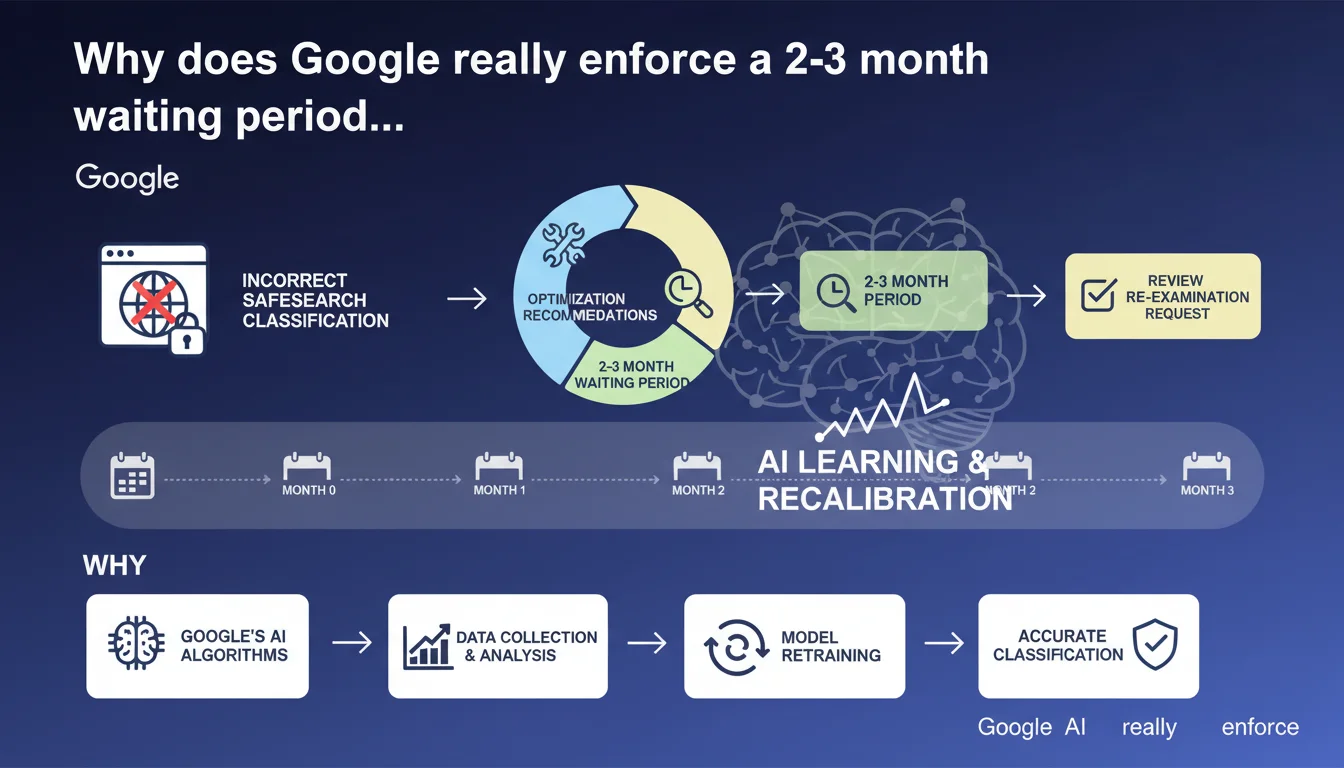
If SafeSearch has incorrectly categorized your site, Google requires a non-negotiable 2-3 month waiting period after making corrections before accepting a re-examination request. In other words: there's no way to speed up the process, even if the error clearly came from their side. Your site remains filtered throughout this entire period, with all the resulting consequences for traffic.
What you need to understand
What is SafeSearch and why might your site be misclassified?
SafeSearch is Google's filter that hides explicit or adult content from search results. When activated, pages deemed "sensitive" simply disappear from SERPs for affected users.
The problem: this automated system frequently malfunctions. Legitimate sites — e-commerce, health, art, education — get categorized as "adult content" without valid reason. Sometimes it's due to a single image, a misinterpreted keyword, or a semantic analysis error.
Why does Google impose a 2-3 month delay before re-examination?
Google justifies this delay by claiming the need to verify that corrections are sustainable. The idea: prevent a site from temporarily cleaning up its content to get reclassified, then reverting to its original practices.
Concretely, Google wants to observe multiple crawl passes over an extended period to ensure the site has genuinely changed. Except for a site misclassified from the start, it's Kafkaesque: you're penalized for an error you never committed.
What happens during these 2-3 months of waiting?
Your site remains filtered by SafeSearch. If a significant portion of your audience uses this filter — particularly in corporate environments, education, or with certain ISPs — you lose that traffic. Period.
No expedited recourse exists. Even if you prove beyond doubt that your site contains nothing objectionable, you must wait. It's a dead period in terms of visibility for affected users.
- Non-negotiable delay of 2 to 3 months after corrections
- The site remains filtered throughout this entire period
- No possibility to accelerate the process, even in case of obvious error
- Substantial traffic loss if your audience uses SafeSearch
- Obligation to demonstrate "sustainable" corrections even when no violation has been committed
SEO Expert opinion
Does this rule make operational sense?
Let's be frank: imposing a 2-3 month waiting period on a site misclassified by error borders on absurdity. Google assumes all delisted sites genuinely violated its guidelines, when in practice, false positives are commonplace.
The delay makes sense for actual violators — those genuinely attempting to circumvent the filter. But for legitimate sites caught in the net? It's a disproportionate punishment. And that's where it breaks: Google offers no mechanism to distinguish a technical error from an intentional manipulation attempt.
Do field observations contradict this statement?
In practice, real-world feedback shows that the delay can extend well beyond 3 months. Some sites wait 4, 5, or even 6 months before getting a re-examination. [Verify] as Google never publishes official statistics on actual processing times.
Another point: the notion of "optimization recommendations" remains vague. Google never specifies precisely what triggered the classification or what needs to be corrected. You're navigating blind, hoping your modifications align with the expectations of an opaque algorithm.
What risks does this policy pose to legitimate sites?
The real danger is irreversible revenue loss. For an e-commerce site, 2-3 months of reduced traffic adds up. For media or content sites, it's a sharp audience drop with no quick recourse.
Worse: this policy pushes some sites to over-censor their content. Fear of misclassification makes them avoid legitimate topics — sexual health, anatomical education, art — creating preventive self-censorship that impoverishes the web.
Practical impact and recommendations
How do I know if my site is misclassified by SafeSearch?
First step: activate SafeSearch in a private browser window and search for your brand or key pages. If your results disappear, you're filtered. Also check Search Console to see if Google sent you a notification — though this isn't always systematic.
Analyze your analytics: an unexplained traffic drop on certain demographic segments (education, enterprises, specific regions with default filtering) may signal a SafeSearch issue. Compare your impression rates in Search Console with your actual rankings.
What should I do concretely if I'm misclassified?
Start by scrutinizing all your content: images, text, embedded videos, user comments. Hunt for anything an algorithm might interpret as "sensitive". Be paranoid — Google's AI has strange biases.
Clean up, moderate, adjust. Then wait 2-3 months before requesting re-examination via the dedicated form. Yes, it hurts. No, you can't bypass this delay. Document all your modifications for your re-examination request.
What mistakes should I avoid to prevent making things worse?
Don't mass-delete legitimate content out of panic. This risks creating other SEO issues (404 errors, lost internal linking). Make surgical corrections to identified problematic elements.
Avoid requesting re-examination before the advised delay either. It frustrates Google and can slow down your case processing even more. Strictly respect the 2-3 months, even if it's frustrating.
- Test your site regularly with SafeSearch activated
- Monitor Search Console for any classification notifications
- Analyze your analytics to spot suspicious traffic drops on specific segments
- Audit all your content (images, text, videos, user-generated content) to identify potentially ambiguous elements
- Make targeted corrections without mass-deleting legitimate content
- Wait strictly 2-3 months after corrections before submitting a re-examination request
- Precisely document all modifications made for your request file
- Never follow up with Google before the advised delay expires
❓ Frequently Asked Questions
Peut-on accélérer le délai de 2-3 mois imposé par Google ?
SafeSearch affecte-t-il le classement organique global d'un site ?
Google notifie-t-il toujours les sites mal catégorisés ?
Quels types de contenus déclenchent le plus souvent SafeSearch ?
Faut-il informer Google dès qu'on corrige son site ?
🎥 From the same video 8
Other SEO insights extracted from this same Google Search Central video · published on 01/11/2023
🎥 Watch the full video on YouTube →
💬 Comments (0)
Be the first to comment.