
Official statement
Other statements from this video 8 ▾
- □ SafeSearch peut-il vraiment blacklister l'intégralité d'un site mixte mal configuré ?
- □ Faut-il vraiment isoler le contenu adulte dans un sous-domaine ou un dossier séparé ?
- □ Faut-il autoriser Googlebot à récupérer vos fichiers vidéo pour améliorer leur visibilité ?
- □ Faut-il vraiment désactiver la vérification d'âge pour Googlebot ?
- □ Comment SafeSearch filtre-t-il vraiment le contenu explicite dans les résultats de recherche ?
- □ Comment vérifier si SafeSearch filtre votre site avec l'opérateur site: ?
- □ Pourquoi Google impose-t-il un délai de 2 à 3 mois avant de réexaminer une classification SafeSearch ?
- □ Les politiques de contenu Google sont-elles vraiment un levier de visibilité organique ?
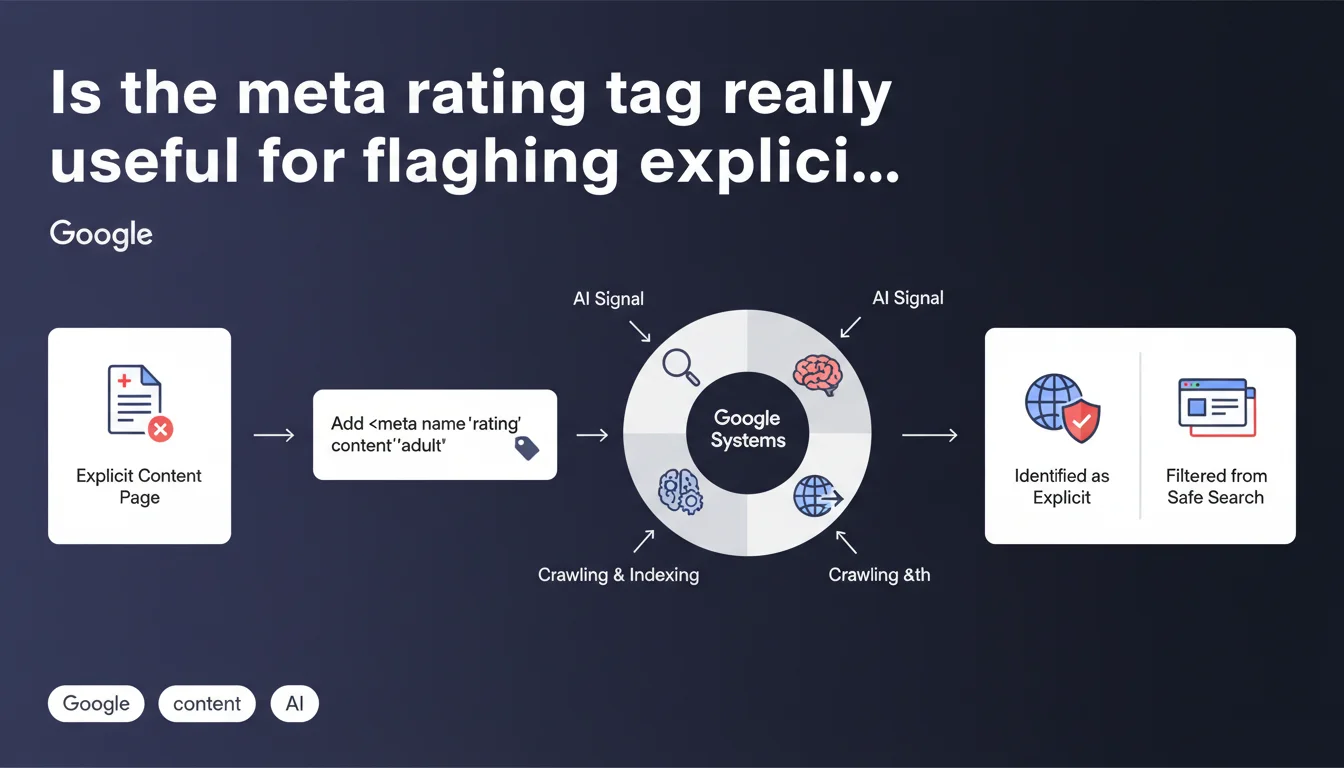
Google recommends adding the 'rating' meta tag to any page containing explicit content. It's one of several signals used by its systems to identify this type of content. The question remains whether it's sufficient and whether it actually changes anything in rankings.
What you need to understand
Google has just clarified the use of the meta rating tag, a little-known HTML element that allows you to indicate the maturity level of a page's content. Contrary to what one might think, this tag is not a recent invention — it has existed for years, but its use remains marginal.
The search engine specifies that it is one of the signals used to detect explicit content. Not the only one, therefore. This means Google has other mechanisms — probably algorithmic — to identify this type of content, even without this tag.
Why is Google pushing this tag now?
Hard to say with certainty. [To verify]: we can suppose that Google is looking to refine its content filters to improve SafeSearch or respond to regulatory pressures.
What is certain is that this statement comes at a time when platforms are increasingly scrutinized for their ability to protect minors. The meta rating tag then becomes a simple and declarative way to classify your content.
How does this tag work in practice?
The syntax is basic: <meta name="rating" content="adult"> or <meta name="rating" content="mature">. You insert it in the <head> of the page, like any other meta tag.
Google does not detail the accepted values, but the industry generally uses "general", "mature" or "restricted". The confusion persists — and that's typical of Google, which leaves webmasters navigating in the dark.
What types of content are affected?
Google speaks of "explicit content" without giving a precise definition. You'd imagine: nudity, graphic violence, vulgar language, sexually explicit content. But the boundary is subjective.
Should a medical information website with anatomical photos use this tag? An contemporary art site with nudes? [To verify]: Google provides no clear guidance, leaving each publisher in uncertainty.
- The meta rating tag is a declarative signal, not a legal requirement
- Google uses it among other signals — its actual weight is unknown
- No official list of accepted values or affected content
- It's probably linked to improving SafeSearch and regulatory constraints
SEO Expert opinion
Does this tag really have an impact on rankings?
Let's be honest: we don't know. Google says it's "one of the signals", but doesn't specify its weight or concrete effects. Will a page with this tag be automatically filtered by SafeSearch? Will it be penalized in regular organic results?
Field experience doesn't help us much here, because very few sites currently use this tag. We lack data to compare. What is certain is that Google already has very effective systems for detecting adult content — with or without the tag.
Why does this statement look like wishful thinking?
Because Google is asking webmasters to self-declare on a sensitive topic. However, those who publish explicit content without wanting to be filtered have no incentive to add this tag. And those who want to be compliant ask themselves a thousand unanswered questions.
Result: this recommendation risks being followed only by the most virtuous sites, those who probably didn't need it anyway. The others will continue to play cat and mouse with the algorithm.
What risks if you don't implement it?
Google isn't making any threats. It "recommends", it doesn't "require". This ambiguity is revealing: if it were truly critical, the message would be firmer.
That said, ignoring this recommendation on a site with assumed adult content could cause problems in the medium term — especially if Google decides to make it a more binding criterion. Better to anticipate than suffer a sudden algorithm change.
Practical impact and recommendations
What should I do concretely if my site contains explicit content?
First step: audit your content. Identify pages that could fall into the "explicit" category based on your own judgment. Nudity, violence, crude language — anything that could shock an unsuspecting audience.
Next, add the <meta name="rating" content="adult"> tag in the <head> of these pages. If your CMS allows it, create a custom field to automate adding it based on content type.
What mistakes should you absolutely avoid?
Don't systematize this tag across your entire site if only certain sections are concerned. You risk over-signaling and being filtered more broadly than necessary.
Also avoid playing with values. If your content is clearly adult, own it with the appropriate value. Trying to circumvent the system by using "mature" instead of "adult" won't fool anyone — especially not Google.
How do you verify that the tag is being picked up?
Inspect the source code of your pages to confirm the tag is present. Use Google Search Console to monitor any changes in your impressions or clicks after implementation.
Also test SafeSearch: search for your brand or your content with SafeSearch enabled, and check whether your explicit pages are actually filtered. If they still appear, it means Google doesn't (yet) consider them explicit.
- Audit the site to identify explicit content
- Add
<meta name="rating" content="adult">in the <head> of affected pages - Automate adding it via CMS if possible
- Verify the tag is present in the source code
- Monitor performance in Search Console post-implementation
- Test SafeSearch to confirm filtering
The meta rating tag is a simple signal to implement but whose actual impact remains unclear. If you publish explicit content, add it as a precaution. If your content is borderline, ask yourself: is it better to be transparent and risk filtering, or let Google decide?
For complex sites or catalogs with thousands of pages, this classification can quickly become a headache. In that case, contacting a specialized SEO agency can save you precious time and avoid errors that cost you dearly in visibility.
❓ Frequently Asked Questions
La balise meta rating est-elle obligatoire pour tous les sites ?
Quelles valeurs sont acceptées pour cette balise ?
Est-ce que cette balise impacte le classement dans les résultats organiques ?
Si je ne l'ajoute pas, mon site sera-t-il pénalisé ?
Comment Google détecte-t-il le contenu explicite sans cette balise ?
🎥 From the same video 8
Other SEO insights extracted from this same Google Search Central video · published on 01/11/2023
🎥 Watch the full video on YouTube →
💬 Comments (0)
Be the first to comment.