
Official statement
Other statements from this video 8 ▾
- □ Can SafeSearch really blacklist an entire mixed website that's poorly configured?
- □ Is the meta rating tag really useful for flagging explicit content?
- □ Should you allow Googlebot to fetch your video files to improve their search visibility?
- □ Should you really disable age verification for Googlebot?
- □ How does SafeSearch actually filter explicit content from your search results?
- □ Is your site being secretly filtered by SafeSearch? Here's how to find out
- □ Why does Google really enforce a 2-3 month waiting period before reconsidering a SafeSearch classification?
- □ Are Google's content policies really a game-changer for organic visibility?
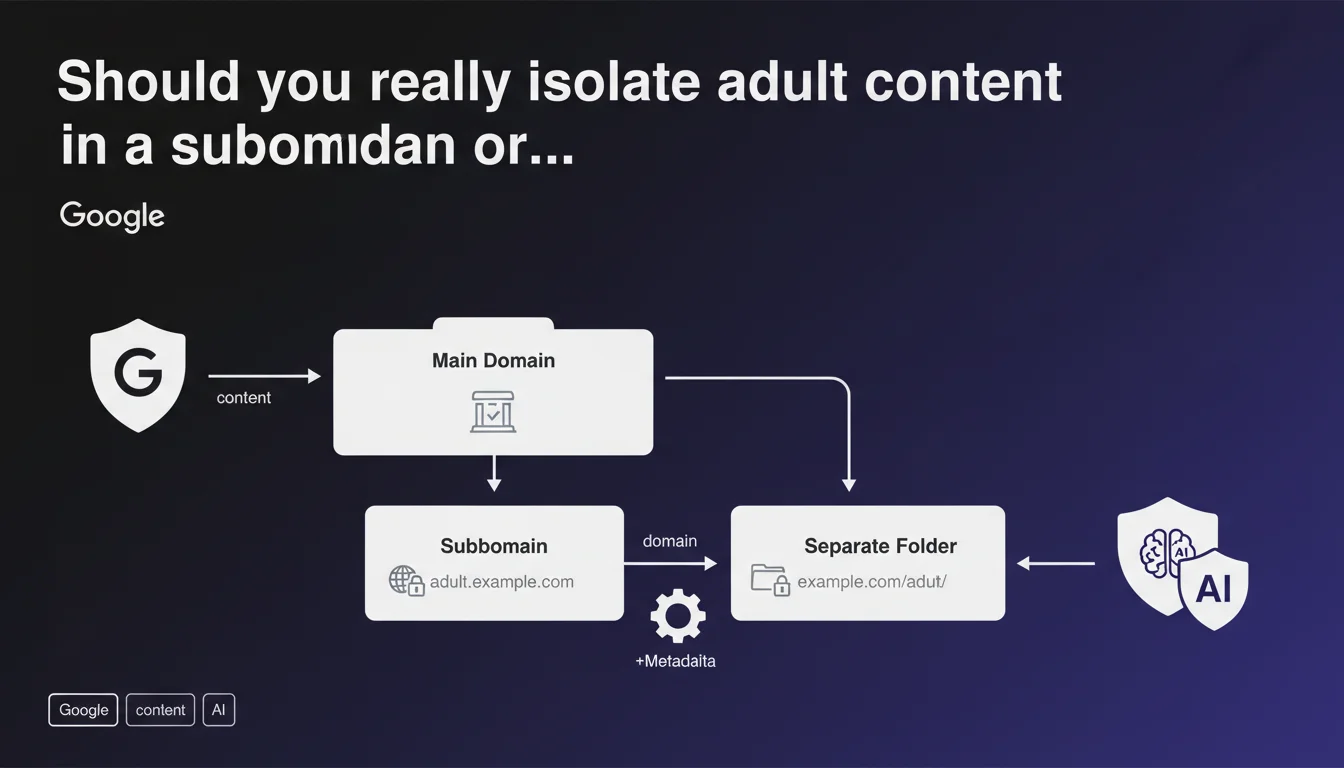
Google recommends grouping explicit pages in distinct subdomains or folders, along with appropriate metadata. This structural separation facilitates crawling and helps Google better categorize your content. The stakes: prevent adult content from contaminating the reputation of your mainstream pages.
What you need to understand
Why does Google insist on this physical separation of content?
Google's recommendation goes beyond metadata (tags, attributes). It requires structural separation — subdomain (adult.site.com) or folder (/adult/). This approach allows algorithms to treat these areas as distinct entities.
Concretely? This prevents crawl budget from being wasted trying to determine whether a given page is mainstream or explicit content. Google can then apply SafeSearch filters more effectively and without ambiguity.
Does this directive apply only to adult sites?
Not exclusively. Any site that mixes mainstream content and adult-only content (e-commerce with lingerie sections, mixed streaming platforms, forums) is concerned. The objective: protect the reputation of the main domain.
If your explicit pages are scattered throughout the site structure without clear logic, Google risks categorizing the entire domain as "adult". The consequences: systematic filtering, loss of visibility for neutral searches, advertiser distrust.
Are metadata alone insufficient?
No. Google is explicit: metadata (meta tags, ARIA attributes, content annotations) must complement structural separation, not replace it. Metadata alone is too easy to circumvent or poorly implement.
Physical separation creates an architectural barrier that algorithms detect immediately. It's a clarity guarantee: no fuzzy interpretation, no gray area. Google can crawl an adult subdomain with specific rules without contaminating the main domain.
- Structural separation required: dedicated subdomain or folder
- Metadata as complement: meta tags, appropriate attributes
- Optimized crawling: each area is treated independently
- Main domain protection: avoids global "adult" categorization
- Effective SafeSearch: filtering without false positives or negatives
SEO Expert opinion
Is this recommendation truly new or just a reminder?
Let's be honest: Google has been repeating this instruction for years. What's changing is the emphasis — and that's telling. Google's teams probably observe that too many sites still ignore this rule or attempt workarounds with cosmetic metadata.
In practice, I regularly see mixed-content sites lose organic traffic abruptly after an update. Analysis often reveals anarchic content mixing. Structural separation isn't optional — it's a prerequisite for survival in SEO for these sites.
Are there cases where this rule doesn't apply?
Yes. If your site is entirely adult, no need for a subdomain. You're already categorized, so you might as well own it. The recommendation targets hybrid sites: those wanting to reach both family and adult audiences.
Another nuance: certain borderline content (art, health, sex education) doesn't necessarily require strict isolation. But be careful — [To verify] — Google provides no clear guidelines on where to draw the line. When in doubt, prudence dictates separation.
Does the choice between subdomain and folder make a difference?
Google doesn't explicitly specify, but in practice, the subdomain offers more radical separation. It's technically a distinct domain in the eyes of many algorithms (linking, trust, PageRank). The folder remains attached to the main domain — easier to manage, but less airtight.
For truly sensitive content, the subdomain is safer. For "light-sensitive" content (lingerie, edgy humor), a folder with metadata may suffice. Again, [To verify] case by case based on your risk tolerance.
Practical impact and recommendations
What concrete steps should you take if your site mixes content?
First step: audit your current setup. List all pages Google might interpret as explicit. Don't limit yourself to pornography — include anything that could trigger SafeSearch (artistic nudity, strong language, sexual products).
Next, choose your architecture. Subdomain if you want maximum isolation, folder if you accept relative proximity to the main domain. Migrate affected URLs, set up 301 redirects, adjust internal linking.
What errors should you absolutely avoid?
Don't leave explicit pages scattered in the general site structure "for now". Every day that passes, Google crawls and categorizes. A partial or delayed migration is worse than inaction — you create confusion.
Another pitfall: forgetting images and videos. If your explicit media remains hosted on the main domain (via an unsegmented CDN), you lose most of the benefit. Isolate assets too.
How do you verify that separation is effective?
Test with SafeSearch enabled: your mainstream pages should appear, your adult pages should disappear. Analyze Search Console separately for the main domain and the separate subdomain/folder — metrics should reflect distinct audiences.
Also check crawl budget: Google must crawl your adult areas with different frequency and depth than your mainstream pages. If this isn't the case after a few weeks, your separation isn't sufficiently clear.
- Exhaustively audit potentially explicit pages (text, images, videos)
- Choose between subdomain (strong isolation) and folder (moderate isolation)
- Migrate URLs with clean and consistent 301 redirects
- Also isolate assets (images, videos, scripts) within the same perimeter
- Add appropriate metadata and tags as complement
- Test with SafeSearch enabled to validate filtering
- Monitor Search Console: distinct metrics between areas
- Monitor crawl budget: differentiated frequencies
❓ Frequently Asked Questions
Un dossier /adulte/ suffit-il ou faut-il absolument un sous-domaine ?
Les métadonnées seules (balises meta) peuvent-elles remplacer la séparation structurelle ?
Cette règle s'applique-t-elle aux sites entièrement adultes ?
Que se passe-t-il si je ne sépare pas le contenu explicite ?
Faut-il aussi isoler les images et vidéos explicites ?
🎥 From the same video 8
Other SEO insights extracted from this same Google Search Central video · published on 01/11/2023
🎥 Watch the full video on YouTube →
💬 Comments (0)
Be the first to comment.