
Official statement
Other statements from this video 8 ▾
- □ SafeSearch peut-il vraiment blacklister l'intégralité d'un site mixte mal configuré ?
- □ La balise meta rating est-elle vraiment utile pour signaler du contenu explicite ?
- □ Faut-il vraiment isoler le contenu adulte dans un sous-domaine ou un dossier séparé ?
- □ Faut-il autoriser Googlebot à récupérer vos fichiers vidéo pour améliorer leur visibilité ?
- □ Faut-il vraiment désactiver la vérification d'âge pour Googlebot ?
- □ Comment vérifier si SafeSearch filtre votre site avec l'opérateur site: ?
- □ Pourquoi Google impose-t-il un délai de 2 à 3 mois avant de réexaminer une classification SafeSearch ?
- □ Les politiques de contenu Google sont-elles vraiment un levier de visibilité organique ?
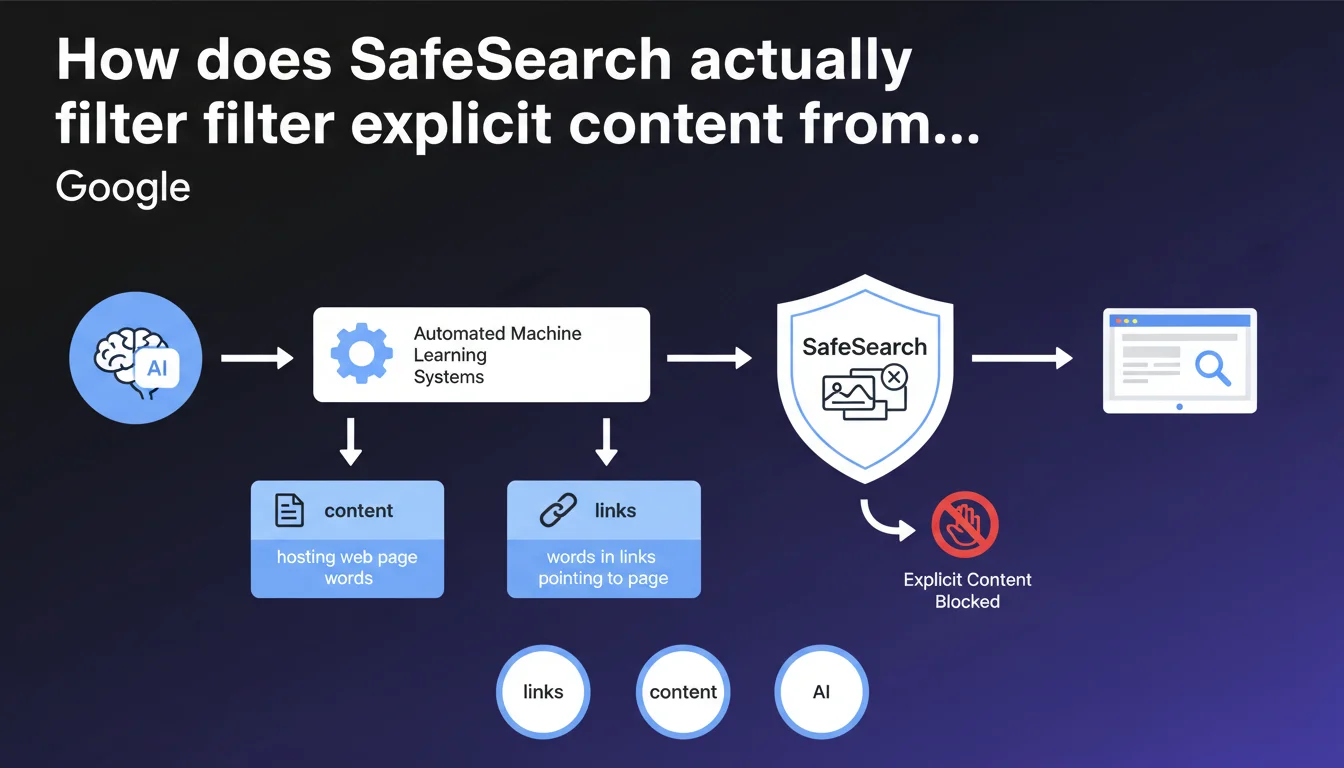
SafeSearch combines machine learning and textual signals — words present on the page and in link anchors — to detect explicit content. Google does not specify the exact nature of the ML models used or the respective weight of each signal. For sites at risk of false positives, this opacity complicates optimization efforts.
What you need to understand
What signals does SafeSearch actually analyze?
Google mentions machine learning systems coupled with textual signals: words present on the hosting page and those contained in links pointing to it. The engine therefore scans both on-page content and the anchor text of backlinks.
The approach is based on detecting linguistic and semantic patterns associated with explicit content. However, Google does not specify whether SafeSearch also exploits behavioral signals, image EXIF metadata, or the domain's classification history.
Why does this opaque functioning create problems?
The opacity of ML models and the absence of published thresholds make it impossible to verify or anticipate for publishers. A site dealing with sexual health, education, or artistic photography can shift under SafeSearch filter without prior warning or clear recourse.
False positives are not uncommon: legitimate medical vocabulary, a poorly worded article title, or over-optimized anchors from third parties can trigger the filter. Google's statement provides no framework for anticipating these situations.
What are the key takeaways about SafeSearch?
- Filtering combines machine learning and on-page + backlink textual analysis
- No public list of trigger words or signal weighting
- False positives primarily affect educational, medical, or artistic content
- No official API or tool to test your SafeSearch ranking in advance
- Correcting an abusive filter often requires manual reporting via Search Console
SEO Expert opinion
Is this statement consistent with field observations?
Yes, but it is incomplete. Tests show that SafeSearch does indeed react to terms present in titles, meta-descriptions, and backlink anchors. A site can be filtered solely because of a toxic link profile with anchors of explicit connotation — even if the content itself is neutral.
However, Google does not mention the role of images in filtering. Yet analysis shows that SafeSearch also applies computer vision models to detect nudity or graphic violence. This omission from the statement is problematic: it implies that only text matters, which is [to be verified] on visually rich sites.
What limitations must be pointed out?
Google provides no detail on the granularity of filtering. Does SafeSearch apply page by page, or does it switch an entire domain if a certain percentage of pages is detected as explicit? Field feedback suggests a mix of both, but without official confirmation.
Another blind spot: timing. How long does it take for a cleaned-up site to exit the filter? Publishers report delays of several weeks to several months, with no accelerated recrawl even after correction. Google remains silent on this.
In what cases does this filtering become counterproductive?
SafeSearch generates collateral damage on sites with educational or medical purpose. A well-documented article on STIs, a product sheet for sexual education materials, or a photography portfolio can be abusively filtered.
These false positives harm organic visibility to an audience that has disabled SafeSearch — which represents a non-negligible share of traffic. And for affected sites, exiting the filter often becomes an uphill battle.
Practical impact and recommendations
How can you verify if your site is filtered by SafeSearch?
There is no official Google tool to test your SafeSearch ranking. Manual method: enable SafeSearch in search settings, then type site:yourdomain.com. If your pages don't appear or appear partially, that's a warning sign.
Then compare with a search with SafeSearch disabled. A significant gap confirms filtering. But be careful: some content may be filtered granularly, page by page, without impacting the entire domain.
What corrective actions should you implement?
First reflex: audit your textual content. Hunt for words or expressions that, taken out of context, could trigger the filter. Rephrase titles, meta-descriptions, and opening paragraphs if necessary.
Next, analyze your backlink profile. Identify anchors with explicit connotation and disavow them via Google Search Console. Wild net linking or negative SEO can switch you under filter without your content being the cause.
If your site offers images, verify that they don't contain any nudity even partial or graphic violence — SafeSearch also applies visual detection models, even though Google doesn't specify it here.
What should you do in case of confirmed false positive?
Report the issue via the feedback form in Search Console. Document your approach: screenshots, examples of legitimate filtered pages, editorial context. Google guarantees neither response nor rapid correction, but it's the only official channel.
In parallel, diversify your traffic sources. If SafeSearch impacts your SEO, strengthen your presence on social media, email, or third-party platforms to limit dependency on organic search.
- Manually test your site with SafeSearch enabled
- Audit on-page vocabulary and backlink anchors
- Disavow toxic links via Search Console
- Rephrase ambiguous titles and metadata
- Verify that your images don't trigger false positive visuals
- Report any false positive via the official form
- Regularly monitor your SafeSearch visibility
❓ Frequently Asked Questions
SafeSearch affecte-t-il le classement SEO global d'un site ?
Peut-on anticiper qu'une page sera filtrée par SafeSearch ?
Les backlinks avec ancres explicites peuvent-ils déclencher SafeSearch même si mon contenu est neutre ?
Combien de temps faut-il pour sortir du filtre SafeSearch après correction ?
Existe-t-il un moyen de forcer Google à réévaluer mon site sous SafeSearch ?
🎥 From the same video 8
Other SEO insights extracted from this same Google Search Central video · published on 01/11/2023
🎥 Watch the full video on YouTube →
💬 Comments (0)
Be the first to comment.