
Official statement
Other statements from this video 9 ▾
- □ Does a simple trailing slash really trigger a complete site migration according to Google?
- □ Why does changing a URL cause you to lose a page's entire SEO history?
- □ Should you really document every single URL during an SEO migration?
- □ Should you really redirect EVERY single URL when migrating your website?
- □ Do you really need to update ALL internal elements after a URL migration?
- □ Is Google Search Console really essential for a successful site migration?
- □ Does Google really treat all URLs the same way during a migration?
- □ How long does a URL migration really take before Google fully processes it?
- □ Should you really keep 301 redirects live for a full year or more?
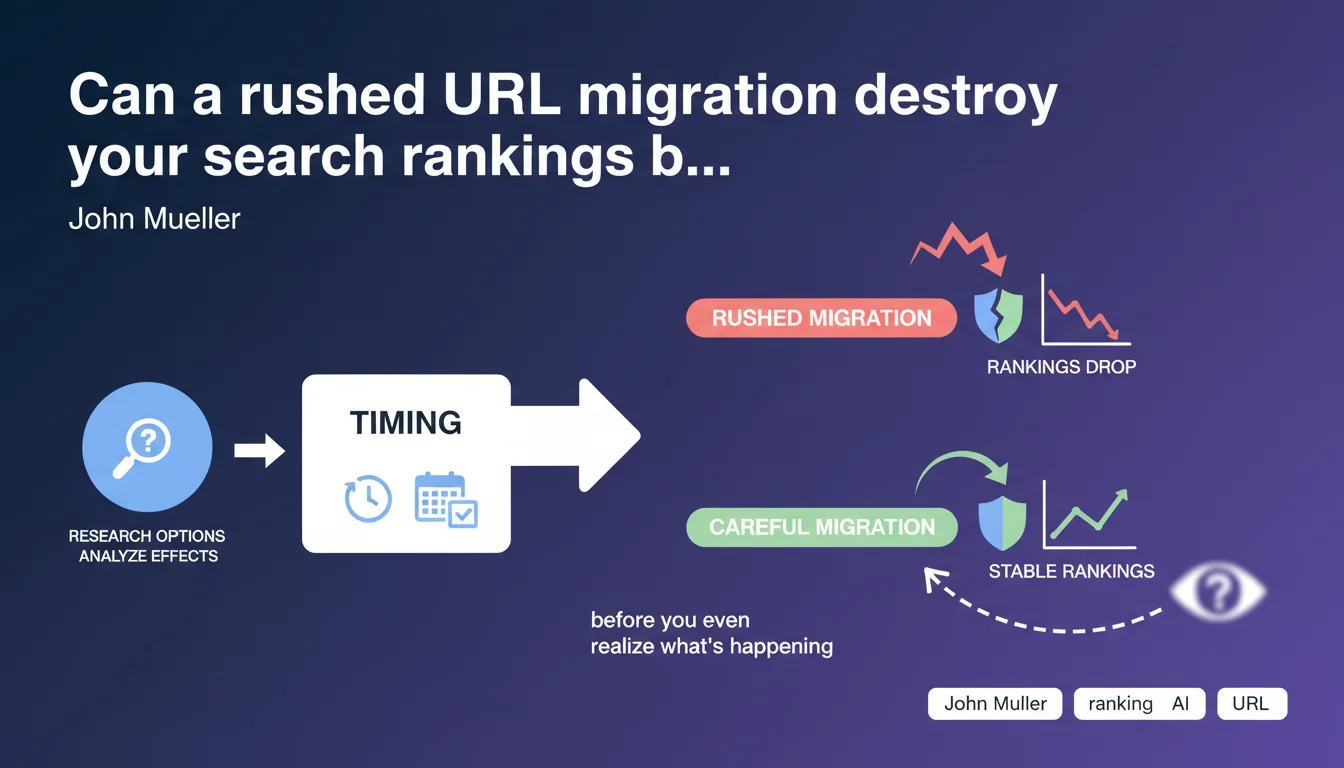
Google confirms that URL migrations directly impact rankings and demand rigorous preparation. Timing is critical: these changes take time to be processed by the algorithm. Analyzing available options and anticipating potential effects isn't optional—it's mandatory to minimize damage.
What you need to understand
What does Google really say about the impact of URL migrations?
Google establishes a simple but consequential principle here: every URL migration changes your rankings. Not "might change," but "has effects"—an important distinction. John Mueller emphasizes the temporal dimension: these changes aren't instantaneous; they require time for the engine to assimilate them.
What stands out is the explicit obligation to research and analyze before taking action. Google doesn't just recommend; it uses language that sounds like a warning. The underlying message? If you cut corners, you pay the price.
Why is timing presented as a critical factor?
The statement emphasizes the strategic importance of when you choose to migrate. In practical terms, launching a migration during peak commercial season or just before predictable traffic spikes is pure recklessness.
Google implicitly acknowledges that its system needs time to recalculate relevance signals, redistribute authority through redirects, and reindex new URLs. This unavoidable delay can stretch across several weeks, even months depending on site size.
What are the "effects on rankings" being referred to?
Google deliberately remains vague about the exact nature of impacts. We're talking about temporary fluctuations, loss of authority on certain pages, even partial deranking during the transition phase.
What Mueller doesn't explicitly say is that some well-executed migrations generate minimal disruption, while others—even if technically correct—cause sharp drops. The variance is explained by multiple factors: domain history, redirect quality, architecture consistency, etc.
- URL migrations systematically impact rankings—it's not a hypothesis, it's confirmed.
- Timing matters as much as technique—choosing the right moment can limit damage.
- Preparation must include analysis of options—not all migrations are created equal.
- Google acknowledges that its system takes time to adapt—patience is required.
SEO Expert opinion
Is this statement consistent with what we observe in the field?
Completely. Practitioners know this: a poorly executed migration means months of trouble and depressed traffic. What Google formalizes here matches exactly the patterns observed—with one nuance.
In real life, some migrations generate near-immediate effects (within 48 hours), while others drag on for entire quarters. Google generalizes by speaking of "necessary time," but provides no specific timeframe. [To verify] how much time exactly? It depends on what, precisely?
What does "research available options" concretely mean?
This is typical Google-speak: vague enough to reveal nothing technical. Which options? Migrate all at once or progressively? Use 301s, 302s, canonicals? Change domains or simply restructure the site architecture?
Mueller doesn't elaborate. My interpretation: Google expects you to evaluate whether the migration is truly necessary, and if so, which method minimizes risk. But concretely, without precise guidelines, it's real-world testing at full scale. Every site is a particular case.
In what cases does this rule not apply, or become less critical?
Let's be honest: on a 10-page site with anecdotal traffic, a migration's impact will be marginal. Google is implicitly talking about sites with solid history, substantial page volume, and established positions to protect.
For large e-commerce sites, media outlets with thousands of indexed articles, or SaaS platforms with tens of thousands of URLs, the rule is absolute. Conversely, migrating a small brochure site with no established SEO? The effects will be proportionally negligible. Risk grows exponentially with site size and authority.
Practical impact and recommendations
What must be done concretely before migrating URLs?
First step: conduct thorough due diligence on what exists. Map all indexed URLs, identify those generating organic traffic, list external backlinks pointing to your strategic pages. Without this foundation, it's impossible to anticipate what you'll lose.
Next, model the new architecture and establish precise URL-by-URL mapping. Every old URL must have a logical destination. Chained redirects or defaults to the homepage are a no-go—Google penalizes this and your traffic collapses.
What mistakes must you absolutely avoid during migration?
The most common error: underestimating stabilization delay. Many launch a migration and panic after two weeks seeing traffic drop. Except that's normal—Google recalculates, reindexes, redistributes authority. Patience is mandatory.
Another classic trap: not testing redirects before going live. Once in production, corrections become a nightmare. And a rarely mentioned final point: migrating without a rollback plan condemns you to suffer if things go wrong. Always have a technical backup solution.
How do you verify the migration is progressing correctly?
Monitor three critical metrics: the daily crawl rate in Search Console, the volume of indexed URLs (should stay stable or grow), and obviously organic traffic segmented by landing page. If certain strategic pages drop sharply, investigate as priority.
Also verify that redirects are being followed by Googlebot—Search Console alerts you to 404 errors or redirect chains. And crucially, don't touch anything for at least 4 to 6 weeks after launch. Every additional modification extends the stabilization period.
- Audit all indexed URLs and their current SEO performance
- Establish URL-by-URL mapping with permanent 301 redirects
- Test redirects in staging environment before production launch
- Choose strategic timing (avoid seasonal peaks)
- Prepare a technical rollback plan in case of major problems
- Monitor crawl, indexation, and organic traffic daily for minimum 6 weeks
- Don't modify architecture during transition period
❓ Frequently Asked Questions
Combien de temps faut-il pour qu'une migration d'URLs soit totalement digérée par Google ?
Peut-on éviter totalement la perte de trafic lors d'une migration ?
Est-il préférable de migrer progressivement ou d'un coup ?
Les redirections 301 transmettent-elles 100% de l'autorité d'une page ?
Faut-il soumettre un nouveau sitemap après une migration d'URLs ?
🎥 From the same video 9
Other SEO insights extracted from this same Google Search Central video · published on 18/01/2022
🎥 Watch the full video on YouTube →
💬 Comments (0)
Be the first to comment.