
Official statement
Other statements from this video 9 ▾
- □ Pourquoi un simple slash final déclenche-t-il une migration de site complète selon Google ?
- □ Pourquoi un changement d'URL fait-il perdre l'historique SEO d'une page ?
- □ Pourquoi la migration d'URLs peut-elle ruiner votre classement si vous précipitez les choses ?
- □ Faut-il vraiment documenter toutes les URLs lors d'une migration SEO ?
- □ Faut-il vraiment rediriger TOUTES les URLs lors d'une migration de site ?
- □ Faut-il vraiment mettre à jour TOUS les éléments internes après une migration d'URLs ?
- □ Pourquoi Google Search Console est-elle indispensable lors d'une migration de site ?
- □ Google traite-t-il vraiment toutes les URLs de manière égale lors d'une migration ?
- □ Combien de temps dure vraiment une migration d'URLs aux yeux de Google ?
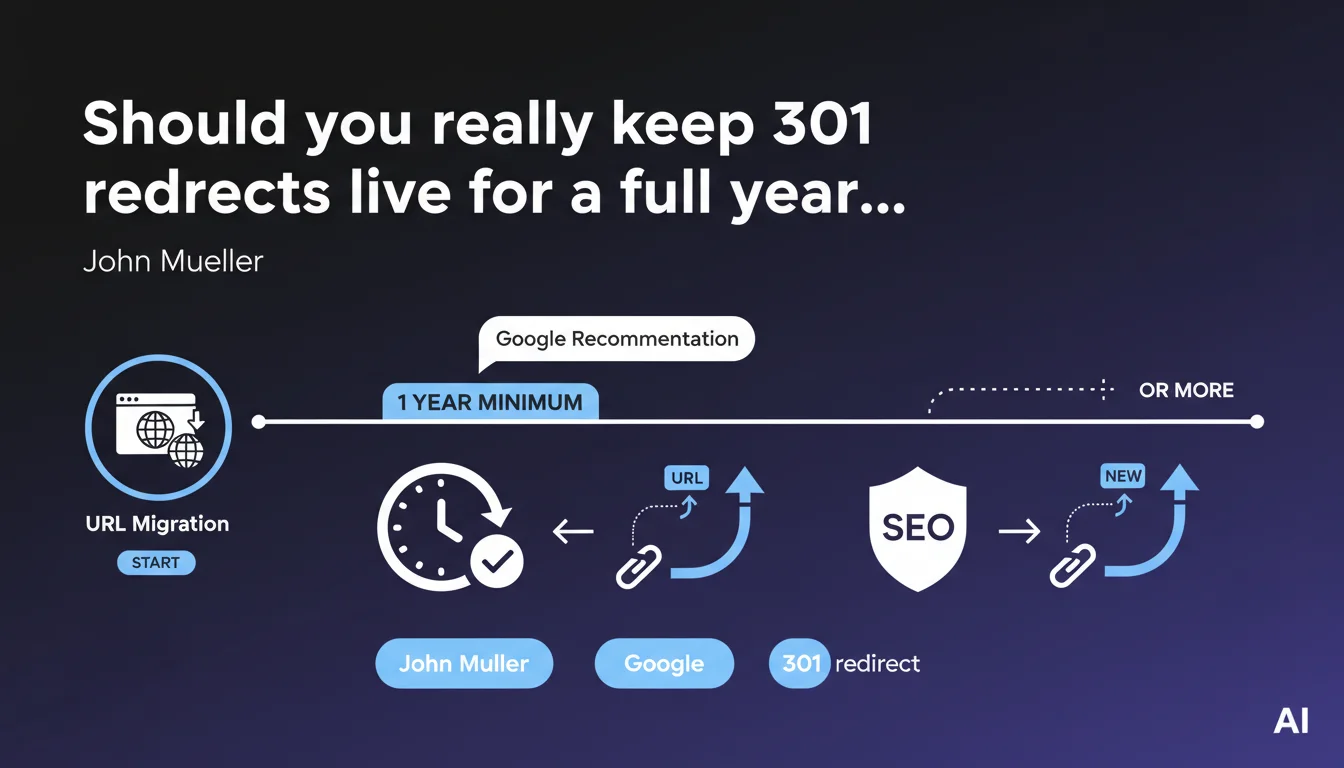
Google officially recommends keeping 301 redirects in place for at least one year following a URL migration. This timeframe ensures complete PageRank transfer, full index updates, and gradual crawler migration to new URLs. Removing them sooner puts you at risk of losing SEO equity and triggering premature 404 errors.
What you need to understand
Why does Google insist on this one-year minimum?
The answer comes down to one word: gradual progression. Google doesn't index the entire web in real-time. When redirecting from URL A to URL B using a 301, the bot must recrawl the source page, detect the redirect, visit the destination, and then progressively consolidate all signals (backlinks, mentions, history).
This process takes time — sometimes weeks for major pages, months for secondary URLs that are rarely crawled. So one year represents the minimum safety window to cover your entire site, including deep-level pages.
What happens if you remove redirects too early?
Removing a 301 before Google has fully consolidated the migration instantly transforms the old URL into a 404 error. External backlinks still pointing to the old address become broken. All accumulated PageRank is lost.
Even worse: if Google still had the old URL indexed in certain regional or secondary indexes, those pages vanish without warning. You're creating SEO technical debt that's hard to recover from.
Does this rule apply to all redirect types?
John Mueller specifically discusses 301 redirects, which signal a permanent move. 302s (temporary redirects) aren't covered by this recommendation since they aren't designed to transfer PageRank durably.
However, the one-year timeframe applies equally to large-scale migrations — site redesigns, domain changes, information architecture restructuring. The larger the volume of migrated URLs, the more critical this safety window becomes.
- 301 redirects must stay active for at least 12 months after migration
- This duration covers the time needed for complete site recrawl by Google
- Removing too early creates premature 404s and loses PageRank
- The rule applies equally to individual page migrations and full site redesigns
- 302 redirects aren't affected (temporary by nature)
SEO Expert opinion
Is this recommendation actually followed in the real world?
Let's be honest: most migrations don't respect this timeline. Many sites remove redirects after 3-6 months, sometimes as soon as Google Search Console stops reporting massive errors. Why? Hosting costs, technical complexity, or simply lack of awareness about this recommendation.
Yet real-world observations confirm that Google continues crawling old URLs well beyond 6 months. Server logs show sporadic hits on old redirected pages even 8-10 months after migration — proof the bot hasn't fully consolidated the change yet.
Are there cases where maintaining redirects for a year isn't necessary?
Yes. For a low-traffic isolated page with no external backlinks and rarely crawled, consolidation can happen faster — sometimes 2-3 months are enough. But be careful: this is the exception, not the rule.
However, for any page that drives organic traffic, has backlinks, or belongs to a strategic part of your site architecture, dropping below 12 months is a risky gamble. The cost of maintaining a redirect for one year is negligible compared to the risk of losing SEO equity built over years.
Is Google transparent about consolidation mechanics?
[To verify] Google never provides precise details about how and when a redirected URL is finally considered consolidated. Mueller gives a minimum duration, but no technical indicator to verify the transfer is complete.
We'd love to know: when does Google stop crawling the old URL? When is PageRank fully transferred? These gray areas force SEOs to navigate blind and overestimate timeframes for safety.
Practical impact and recommendations
What should you do concretely during a URL migration?
First step: plan redirect lifespan right from the migration design phase. Bake this technical constraint into your project requirements. If you're migrating 500 URLs, plan to maintain 500 redirects for at least 12 months.
Second step: document every redirect with its creation date. Use a tracking spreadsheet (Google Sheets, Airtable, or built into your CMS) listing old URL, new URL, creation date, and planned removal date. Without this documentation, you risk accidentally removing redirects.
How do you verify redirects are still working after several months?
Use Screaming Frog or equivalent crawling tools to regularly test redirect status. Crawl your old URL list every 2-3 months to confirm they're still returning 301s pointing to the correct destination.
Also check your server logs: if Google continues heavily crawling certain old URLs, that's a sign consolidation isn't complete. Definitely don't remove these redirects prematurely.
What mistakes should you absolutely avoid during this period?
Mistake #1: removing redirects as soon as Google Search Console stops reporting errors. GSC only reflects part of the index — URLs can still be crawled without appearing in error reports.
Mistake #2: creating redirect chains. If you migrate a page that's already been redirected, update the first redirect to point directly to the final destination. Chains of 301s slow down crawling and dilute PageRank.
- Plan a 12-month minimum timeframe for all 301 redirects
- Create a tracking spreadsheet with creation and planned removal dates
- Regularly crawl old URLs to verify redirects are working
- Analyze server logs to detect URLs still being crawled by Google
- Avoid redirect chains by updating existing 301s
- Never rely solely on Google Search Console reports
- Budget server resources to maintain redirects over the long term
❓ Frequently Asked Questions
Peut-on retirer les redirections 301 après seulement 6 mois si Google a bien indexé les nouvelles URLs ?
Les redirections 301 ralentissent-elles le temps de chargement des pages ?
Faut-il maintenir les redirections plus d'un an pour un site à fort trafic ?
Comment savoir si Google a définitivement consolidé une URL redirigée ?
Les redirections 302 doivent-elles aussi être maintenues un an ?
🎥 From the same video 9
Other SEO insights extracted from this same Google Search Central video · published on 18/01/2022
🎥 Watch the full video on YouTube →
💬 Comments (0)
Be the first to comment.