
Official statement
Other statements from this video 8 ▾
- □ How does Google actually discover your pages through crawling and links?
- □ How does Googlebot actually crawl and index your website?
- □ Does Google really build its index the way you think it does, and why does this change everything for your SEO strategy?
- □ How does Google really rank results for any given search query?
- □ Does Google really personalize all search results based on each user?
- □ Can you really pay Google to boost your organic search position?
- □ Does Google really make it easy to tell the difference between ads and organic search results?
- □ Are Google's official resources really enough to optimize your SEO visibility?
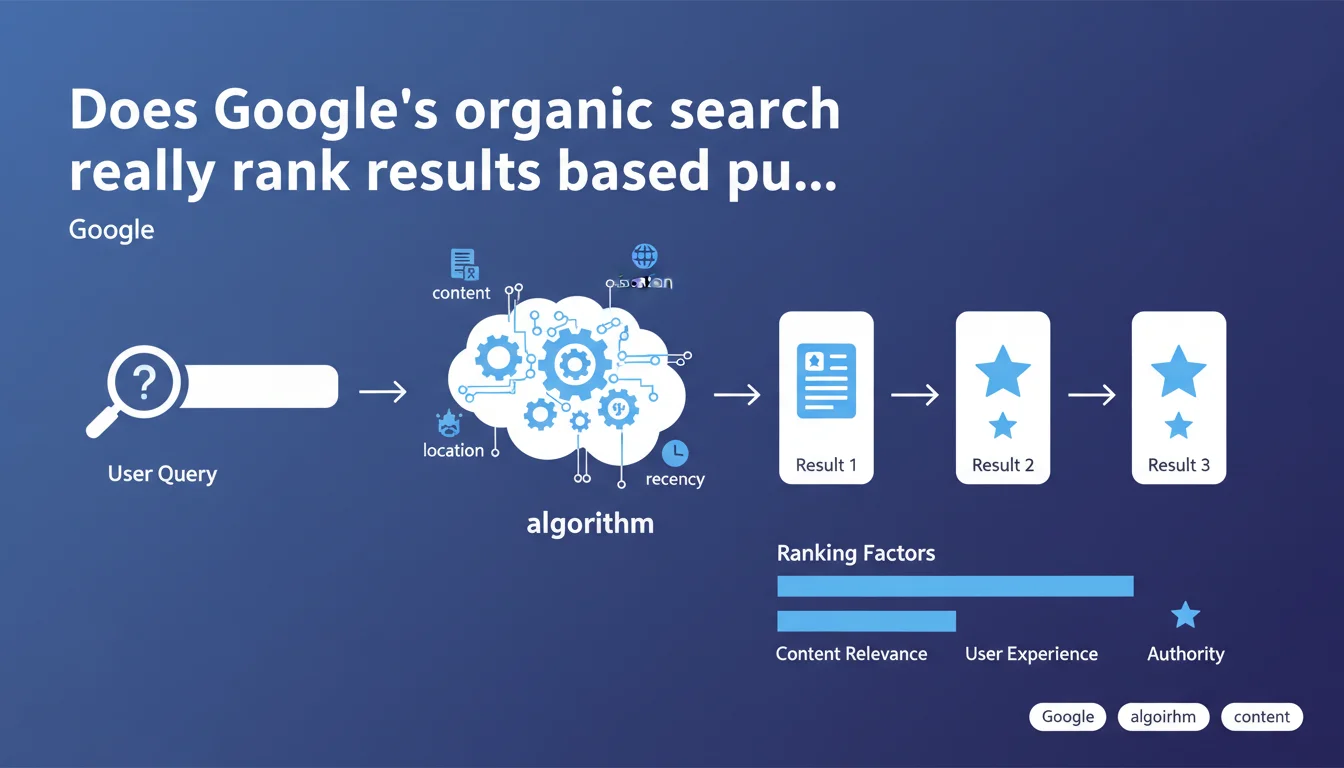
Google claims that its organic search results are based solely on content relevance to the user's query, without any commercial influence. This statement establishes a fundamental principle: algorithms instantaneously calculate relevance scores without manual intervention. In practice, the definition of "relevance" remains vague and encompasses hundreds of signals.
What you need to understand
What does "relevance" really mean to Google?
When Google talks about content relevance, it goes far beyond keyword matching. The search engine evaluates hundreds of signals: writing quality, freshness, domain authority, user experience, semantic context.
Relevance is a composite score calculated for each page against each query. This score integrates technical dimensions (crawlability, speed), editorial dimensions (depth, uniqueness) and behavioral dimensions (CTR, dwell time).
Why this emphasis on "organic" and "free from commercial influence"?
Google fiercely distinguishes between organic results and paid results (Google Ads). This statement responds to recurring suspicions that advertisers might gain indirect advantages in natural search results.
No serious study has demonstrated a correlation between advertising spending and organic rankings. The two systems operate on distinct algorithmic bases, even though paid search data can indirectly inform search trend patterns.
What does Google mean by "instantaneous calculations"?
Every search triggers a real-time evaluation of billions of indexed pages. Ranking algorithms are not pre-calculated lists but dynamic evaluation engines.
This speed relies on massively distributed infrastructure and advanced mathematical optimizations. For SEO, this means on-site modifications can impact rankings from the next crawl and subsequent search query.
- Relevance = hundreds of signals weighted according to the query
- No direct influence from advertising spending on organic ranking
- Results are calculated in real time at every search
- The organic/paid distinction is strict at the algorithmic level
- Content updates can affect rankings immediately after indexation
SEO Expert opinion
Is this statement consistent with real-world observations?
Overall, yes. Large-scale studies confirm there is no correlation between Google Ads investment and organic ranking. Sites that spend zero on advertising can dominate competitive SERPs.
However—and here's where it gets tricky—the notion of "relevance only" masks the real complexity. Content can be perfectly relevant for a query and never appear on the first page if the domain lacks authority, if UX is failing, or if Core Web Vitals are catastrophic.
What nuances should we add to this statement?
Google uses the word "relevance" as an umbrella covering technical, editorial, and behavioral factors. Mediocre content on an authoritative domain can outrank excellent content on a new site—is that "relevance"?
Content freshness plays differently across verticals: for news, it weighs heavily; for evergreen queries, less so. Personalization (location, history) also modulates results, which relativizes the idea of "absolute" relevance.
[To verify] : Google deliberately remains vague about the relative weighting of signals. Claiming it's "solely" relevance omits the fact that some sites benefit from historical trust that is difficult to overcome with simple editorial quality.
In what cases does this rule not fully apply?
YMYL (Your Money Your Life) topics undergo additional filters: expertise, authority, trustworthiness (E-A-T). Two pieces of equal relevance won't rank the same if one comes from a recognized medical site and the other from an amateur blog.
Brand queries also skew the picture: searching "Nike shoes" will naturally favor nike.com, regardless of competitors' content. Is that pure relevance, or an implicit form of ranking based on brand intent?
Practical impact and recommendations
What should you concretely do to maximize relevance?
Focus on semantic alignment: content must precisely answer search intent, not just contain keywords. Analyze competitor SERPs to identify expected formats and depth.
Optimize technical signals: loading speed, mobile-first, accessibility. Google calculates relevance by integrating user experience—perfect content on a slow site loses rankings.
Develop topical authority: a site coherent on a specific subject gains credibility. Avoid editorial scatter that dilutes sectoral relevance signals.
What mistakes should you absolutely avoid?
Don't confuse word count with relevance. A 3000-word article off-topic will be beaten by a concise, targeted answer. Information density trumps raw length.
Don't neglect behavioral signals: if users bounce immediately, Google will interpret your page as non-relevant to the query, even if the content is technically correct.
Don't bet everything on content while ignoring technical structure. A poorly crawlable site or with indexation issues will see its relevant content invisibilized.
- Analyze SERPs for each target keyword and identify winning formats
- Regularly audit Core Web Vitals and fix slowdowns
- Measure bounce rate and session time per landing page
- Check complete indexation of strategic pages via Search Console
- Build coherent topical architecture with logical internal linking
- Update evergreen content to maintain perceived freshness
- Monitor rankings after each content update to evaluate real-time impact
❓ Frequently Asked Questions
Google peut-il modifier manuellement les résultats organiques dans certains cas ?
Un site qui achète des annonces Google Ads gagne-t-il un avantage en SEO ?
La pertinence d'une page peut-elle changer sans modification du contenu ?
Pourquoi un contenu pertinent peut-il ne jamais apparaître en première page ?
Les résultats organiques sont-ils identiques pour tous les utilisateurs ?
🎥 From the same video 8
Other SEO insights extracted from this same Google Search Central video · published on 24/02/2022
🎥 Watch the full video on YouTube →
💬 Comments (0)
Be the first to comment.