
Official statement
Other statements from this video 13 ▾
- □ Does robots.txt really prevent your pages from being indexed by Google?
- □ Is the meta tag 'none' really the same as using noindex + nofollow together?
- □ Is robots.txt really ineffective at preventing your pages from being indexed by Google?
- □ Can you block indexation of entire directories using server modules instead of robots.txt?
- □ Is indexing your login pages actually hurting your user experience?
- □ Should you really use rel=canonical over noindex for aging content?
- □ Does the noarchive meta tag really prevent Google from caching your pages?
- □ Should you block snippets with nosnippet to protect your sensitive content?
- □ Should you really use max-snippet and max-image-preview to control how your content appears in search results?
- □ Why Is Google So Reluctant to Develop New Meta Robots Directives?
- □ Is the X-Robots-Tag header really the only way to keep PDFs out of Google's index?
- □ Why does robots.txt actually block images and videos but not web pages?
- □ How does Google really transform your PDFs into searchable content?
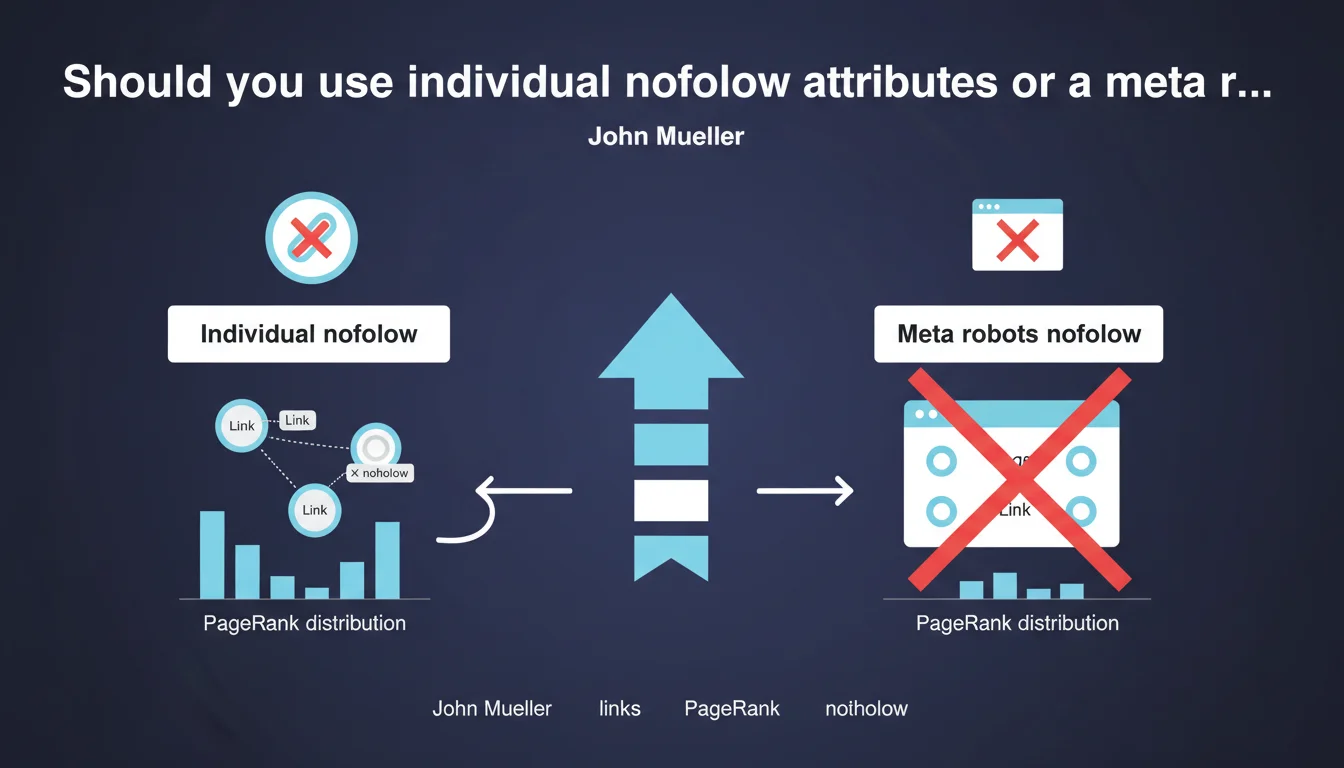
Google clearly distinguishes between two tools for managing nofollow: the attribute on a specific link (ideal for ads and sponsored content) and the meta robots tag that applies to all links on a page. The choice between the two is not trivial — it directly impacts how Google distributes PageRank and crawls your site.
What you need to understand
What is the technical difference between these two methods?
The nofollow attribute on an individual link allows surgical control. You decide, link by link, which ones should not pass PageRank or be followed by Google. This is the recommended method for commercial links, advertising, or user-generated content.
The meta robots nofollow tag acts as a general circuit breaker: it applies to all links present on the page. A single line of code in the <head>, and all links become nofollow. No distinction is possible.
Why does Google insist on this distinction?
Because the use cases are not the same. The individual attribute addresses legal obligations (declaring paid links) and the need for fine-grained control of your internal linking strategy. The meta tag, on the other hand, serves specific cases: confirmation pages, login pages, utility pages that you absolutely don't want to consume your crawl budget.
Google wants to prevent sites from applying global nofollow out of ignorance or laziness, when precise targeting would be more appropriate. It's also a way to remind people that nofollow is not an anti-SEO weapon — it's a tool for resource management.
When should you use one over the other?
- Individual nofollow attribute: sponsored links, advertising, affiliate links, user comments, external widgets, links to low-trust pages
- Meta robots nofollow tag: process pages (cart, checkout), dynamically generated pages without SEO value, test pages, admin pages accidentally accessible to the public
- Basic rule: if you're unsure between the two, start with the individual attribute — it's reversible and less drastic
- Avoid the meta nofollow on pages containing strategic internal linking — you'd kill PageRank distribution
SEO Expert opinion
Is this distinction truly respected in practice?
On paper, it's crystal clear. In the real world, it's a mess. How many sites still use rel="nofollow" on internal links to "save PageRank" when Google has clearly stated that PageRank dilutes anyway? Far too many.
Mueller's reminder is useful, but it sidesteps a central question: what happens to PageRank that isn't transmitted via nofollow? Does it disappear? Is it redistributed elsewhere? Google has remained deliberately vague on this point for years. [To verify]
Is the nofollow attribute still a strong spam signal?
Since March 2020, Google treats nofollow, sponsored, and ugc as hints rather than absolute directives. Concretely? Google can choose to follow a nofollow link if it deems it relevant. Or ignore it entirely.
This nuance changes everything. Nofollow is no longer a watertight wall — it's one signal among many. If you're counting on it to block 100% of PageRank to a given page, you're deluding yourself. In practice, we observe that Google generally respects the attribute, but with no absolute guarantee.
Can meta nofollow inadvertently harm your site?
Absolutely. Classic example: a category page with <meta name="robots" content="nofollow"> by mistake. All product links become nofollow. PageRank no longer circulates. Product pages lose authority.
Another real case: CMS systems that apply meta nofollow by default on certain templates (author pages, date-based archives). Result? Broken internal linking without anyone noticing for months.
Practical impact and recommendations
What should you audit as a priority on your site?
First priority: crawl your entire site and identify all pages with a meta robots nofollow tag. You'll be surprised at how many pages are affected by error — misconfigured WordPress templates, conflicting SEO plugins, obsolete .htaccess rules.
Next, scrutinize your commercial links. Every paid link, every visibility exchange, every partnership must carry a rel="sponsored" or rel="nofollow" attribute. No exceptions. Google severely penalizes undeclared link schemes.
What mistakes should you absolutely avoid?
- Never apply nofollow to your strategic internal links (except in very specific cases of pagination or filters)
- Don't confuse meta nofollow and meta noindex — one blocks links, the other blocks indexing
- Avoid combining meta noindex + nofollow on regularly crawled pages — you're wasting crawl budget
- Don't use meta nofollow as an easy solution to hide an architectural problem (duplicate content, unnecessary pages)
How can you verify that your implementation is correct?
Use Google Search Console, Coverage section, to detect pages crawled but excluded. If important pages appear with "Crawled, currently not indexed" and carry a meta nofollow, you have a problem.
Then compare with a Screaming Frog crawl: filter pages by robots directive. Export the list of pages with meta nofollow. Cross-reference with your internal linking plan. If strategic hubs appear, fix them immediately.
Controlling nofollow requires rigorous SEO governance: regular audits, documentation of rules applied, monitoring of template changes. These technical optimizations can quickly become time-consuming and require specialized expertise to avoid critical errors. If your team lacks resources or skills on these topics, support from a specialized SEO agency can prove essential to secure your link architecture and maximize PageRank distribution.
❓ Frequently Asked Questions
Peut-on utiliser nofollow sur des liens internes pour sculpter le PageRank ?
La balise meta nofollow empêche-t-elle l'indexation de la page ?
Faut-il mettre nofollow sur tous les liens de footer ?
Google suit-il vraiment les liens nofollow depuis mars 2020 ?
Peut-on retirer l'attribut nofollow d'un lien ancien sans risque ?
🎥 From the same video 13
Other SEO insights extracted from this same Google Search Central video · published on 30/06/2022
🎥 Watch the full video on YouTube →
💬 Comments (0)
Be the first to comment.