
Official statement
Other statements from this video 13 ▾
- □ Robots.txt bloque-t-il vraiment l'indexation de vos pages ?
- □ Robots.txt est-il vraiment inefficace pour bloquer l'indexation ?
- □ Peut-on bloquer l'indexation de répertoires entiers via des modules serveur plutôt que robots.txt ?
- □ Faut-il vraiment indexer les pages de connexion de votre site ?
- □ Faut-il vraiment préférer rel=canonical à noindex pour les contenus anciens ?
- □ La balise noarchive empêche-t-elle réellement Google d'archiver vos pages ?
- □ Faut-il bloquer les snippets avec nosnippet pour protéger son contenu sensible ?
- □ Faut-il vraiment utiliser max-snippet et max-image-preview pour contrôler l'affichage dans les SERP ?
- □ Faut-il privilégier l'attribut nofollow individuel ou la balise meta robots nofollow pour contrôler le PageRank ?
- □ Pourquoi Google refuse-t-il de créer de nouvelles balises meta robots ?
- □ Comment bloquer l'indexation de PDFs et fichiers non-HTML sans accès aux headers HTTP ?
- □ Pourquoi robots.txt bloque-t-il vraiment les images et vidéos mais pas les pages web ?
- □ Comment Google transforme-t-il vraiment vos PDFs en contenu indexable ?
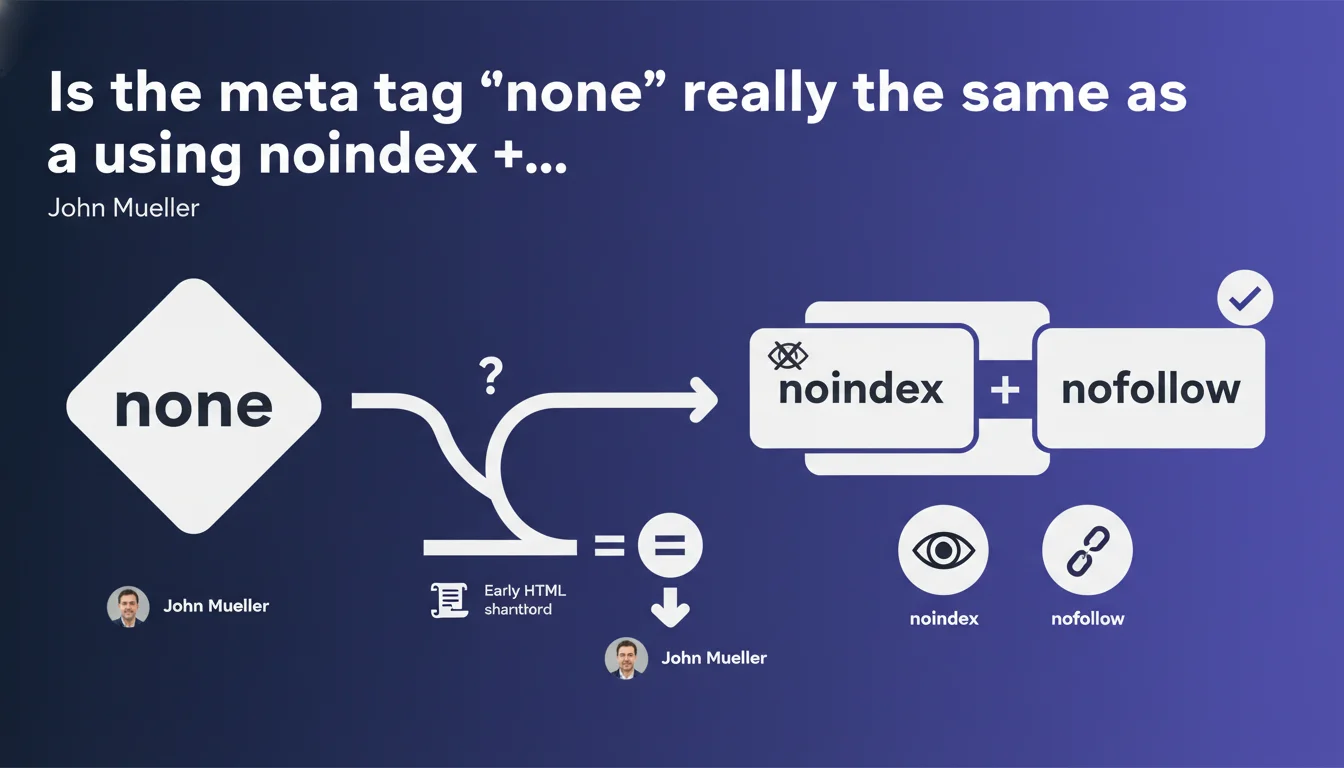
The meta robots 'none' tag combines noindex and nofollow into a single directive. This shorthand, inherited from the early days of HTML to save bytes, produces exactly the same effect as using the two directives separately. No technical difference — just abbreviated syntax.
What you need to understand
Why did Google create this 'none' tag?
In the 1990s, every byte mattered. Developers were looking to minimize HTML code size to speed up page loading on 56k connections. The meta robots 'none' tag was born from this context: rather than writing <meta name="robots" content="noindex, nofollow">, you could simply write <meta name="robots" content="none">.
Today, this character savings has no impact on performance whatsoever. But the directive remains functional and recognized by all modern search engines.
What is the technical difference between 'none' and 'noindex, nofollow'?
None. The behavior is strictly identical. Googlebot treats 'none' exactly as if it were reading 'noindex, nofollow'. The page will not be indexed, and the links it contains will not be followed or counted for PageRank.
It's simply an alias — a legacy writing convention that persists in the specifications. If you're looking for a subtle difference between the two syntaxes, you're wasting your time.
When should you use 'none' instead of 'noindex, nofollow'?
It's a matter of personal preference. Some developers appreciate the conciseness of the code, while others prefer the explicitness of 'noindex, nofollow' which makes the intention perfectly clear when reading.
In practice, if you're managing a team or working on complex sites, 'noindex, nofollow' is more readable. Someone discovering the code immediately understands what's happening. With 'none', you need to know the specification — and not everyone does.
- Meta robots 'none' = shorthand equivalent to noindex + nofollow
- No difference in how search engines treat it
- Historical legacy from HTML weight constraints in the 1990s
- The choice between the two syntaxes is a question of code readability, not SEO performance
SEO Expert opinion
Does this Mueller statement really bring anything new to the table?
No. It's a reminder of a feature documented for over 20 years. The 'none' tag has been part of the official meta robots tag specifications since the early 2000s. Mueller is simply clarifying a point that sometimes generates questions from beginner SEOs or developers who encounter this syntax in old code.
The real value of this statement? It confirms that Google continues to support this legacy syntax. No deprecation in sight, no warnings in Search Console if you use it. That's good to know for migrations of older sites.
Are there cases where 'none' doesn't behave as expected?
In my field experience, no — as long as the engine respects the standards. Googlebot, Bingbot, and major crawlers handle 'none' correctly. But let's be honest: some exotic or misconfigured crawlers might ignore this directive if they only recognize 'noindex' and 'nofollow' explicitly.
If your goal is to block indexing absolutely, doubling up with a robots.txt Disallow or HTTP authentication remains the safest practice. Meta tags are suggestions — not locks.
Should you migrate 'none' tags to 'noindex, nofollow'?
No rush. If your site already uses 'none' and everything works, there's no SEO gain to changing it. However, if you're refactoring code or updating templates, favor 'noindex, nofollow' for clarity.
Automated SEO audits typically don't flag 'none', but some less sophisticated tools might fail to detect it correctly. That's an argument for standardizing on explicit syntax — less risk of false negatives in reports.
Practical impact and recommendations
What should you check on your site right now?
Run a crawl with Screaming Frog or Oncrawl and filter pages that have a meta robots tag. Identify those using 'none' and make sure that's actually your intention — not legacy code misunderstood. A page with 'none' will neither be indexed nor pass link equity.
If you discover strategic pages with this directive when they should be indexable, you have an indexation problem to fix immediately. This happens more often than you'd think on migrated or redesigned sites without thorough auditing.
What mistakes should you avoid with robots directives?
Never combine 'none' with 'noindex, nofollow' in the same tag — it's redundant and shows a misunderstanding of the topic. Similarly, avoid mixing 'none' with other directives like 'noarchive' or 'nosnippet': it creates unnecessary confusion.
Another classic pitfall: using 'none' thinking it blocks only snippets or caching. It doesn't. If your goal is to control SERP display without blocking indexation, you want 'nosnippet' or 'noarchive', not 'none'.
How do you standardize your robots directives for greater clarity?
Establish a team convention: either everyone uses 'noindex, nofollow' explicitly, or everyone uses 'none' when both directives are needed. What matters is consistency across the site. Document this choice in your technical style guide.
If you manage multiple sites or work with outsourced teams, explicit syntax reduces misunderstanding risks. A junior developer who sees 'noindex, nofollow' immediately understands. With 'none', they might hesitate or look it up — wasted time you can avoid.
- Crawl the site to identify all pages with meta robots 'none'
- Verify that each page with 'none' is intentionally blocked (indexation + links)
- Never combine 'none' with 'noindex, nofollow' in the same directive
- Document the chosen convention (explicit vs. shorthand) in technical guidelines
- Train dev and content teams on the difference between 'none', 'noindex' alone, and 'nofollow' alone
- Audit monitoring tools to verify they correctly detect 'none'
❓ Frequently Asked Questions
Peut-on utiliser 'none' avec d'autres directives robots comme 'noarchive' ?
Est-ce que 'none' est reconnu par tous les moteurs de recherche ?
Quelle est la différence entre 'none' et 'noindex' seul ?
Faut-il supprimer les balises 'none' existantes sur un site ?
Les outils SEO détectent-ils correctement la balise 'none' ?
🎥 From the same video 13
Other SEO insights extracted from this same Google Search Central video · published on 30/06/2022
🎥 Watch the full video on YouTube →
💬 Comments (0)
Be the first to comment.