
Official statement
Other statements from this video 11 ▾
- □ Can you really rely on service workers for SEO success?
- □ Does Googlebot really ignore the service workers on your site?
- □ How can you use Search Console to uncover hidden indexation problems caused by service workers?
- □ What are Google's live testing tools really showing you about your site's rendering issues?
- □ Can the JavaScript console really uncover critical rendering issues that hurt your SEO?
- □ Is developer collaboration really the breakthrough you need to unlock indexation problems?
- □ Should you really inject console.log statements to diagnose Googlebot rendering failures?
- □ How can service workers accidentally hide your entire content from Googlebot?
- □ Should you really verify rendered HTML in Search Console to diagnose your indexation issues?
- □ Your page is indexed but invisible: is it a technical issue or simply outranked by competitors?
- □ Is your service worker secretly sabotaging your Google rankings?
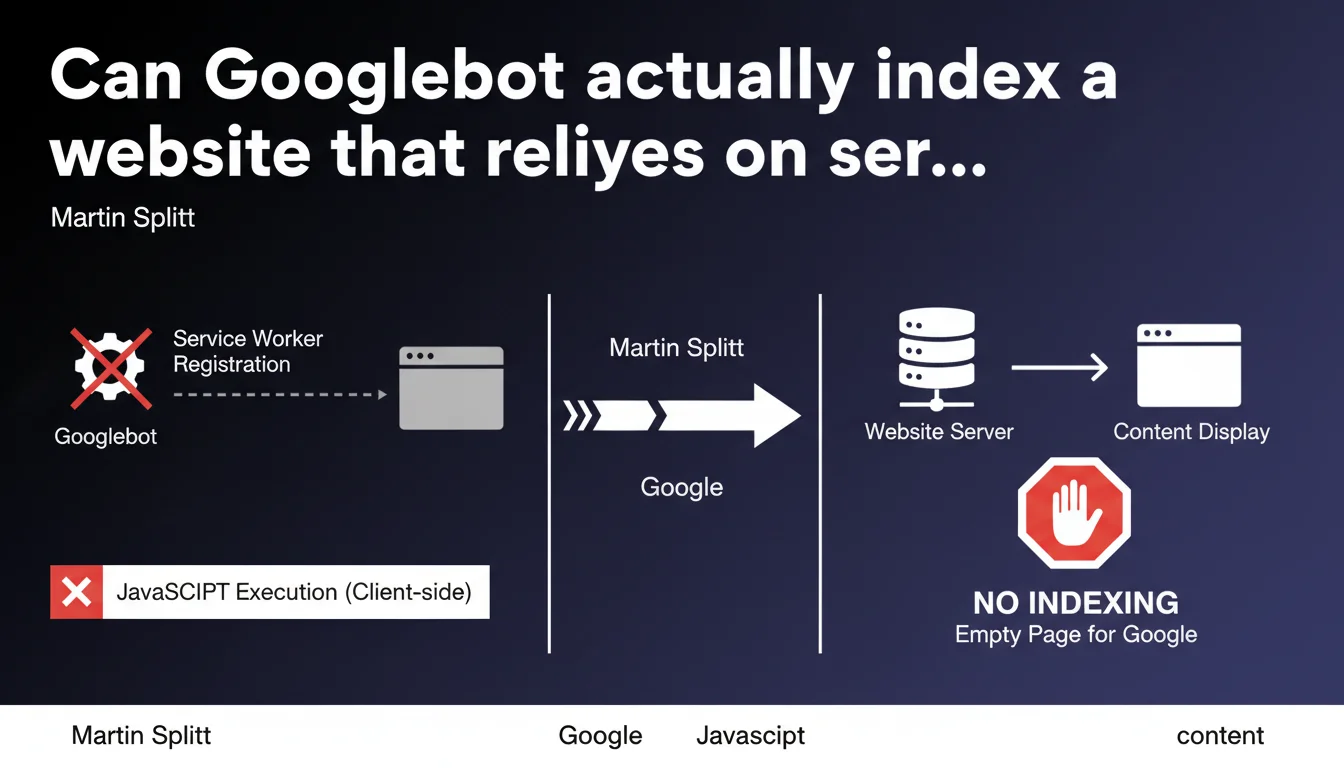
Googlebot cannot register service workers. If your site conditions the display of main content on registering a service worker via client-side JavaScript, Google will see blank pages and index nothing. It's a deadly trap for misconfigured Progressive Web Apps.
What you need to understand
This statement from Martin Splitt targets a specific technical issue that mainly affects Progressive Web Apps (PWAs) and certain advanced JavaScript architectures. A service worker is a script that runs in the background of a browser, independently of the web page itself.
It allows you to manage caching, push notifications, and offline mode. But here's the thing — Googlebot simply cannot register it.
Why does Googlebot refuse to register service workers?
Google has never publicly given a detailed technical reason. We can assume it's related to the execution complexity in a distributed crawling environment and security concerns. Service workers have access to powerful APIs — intercepting network requests, modifying responses, storing data.
In a JavaScript rendering context where Google processes billions of pages, allowing service worker registration would likely create an uncontrollable risk. Too many variables, too much potential attack surface, too much complexity for an infrastructure that needs to remain predictable.
What is the real danger for indexing?
The problem arises when a developer configures a PWA this way: first register the service worker, then load main content via JavaScript. When Googlebot arrives on the page, it cannot register the worker. The script then waits for an event that will never happen.
Result: blank page for Google. Nothing to index, nothing to rank. Your site disappears entirely from the SERPs, even if everything works perfectly for users in Chrome or Firefox.
Are all sites using service workers affected?
No. If your service worker only handles background caching or push notifications without conditioning the initial display of content, you have nothing to worry about. The danger exists only when main content depends on successful worker registration.
It's a question of architecture: if the initial HTML already contains the content (or if JavaScript loads it without waiting for the service worker), Google sees the page normally. The service worker can fail silently with no SEO impact.
- Googlebot cannot register service workers — this is a definitive technical limitation
- Content must never be conditioned on service worker registration
- PWAs must serve content in the initial HTML or via JS independent of the worker
- A service worker that handles caching/notifications in the background poses no problem
- The typical mistake: waiting for the
navigator.serviceWorker.readyevent before loading the main DOM
SEO Expert opinion
Is this limitation consistent with what we observe in the field?
Absolutely. I've seen several PWAs disappear from Google results after a technical redesign that placed the service worker at the center of the architecture. Google's testing tools (Mobile-Friendly Test, URL Inspection Tool) clearly show blank pages when this pattern is used.
What's surprising is that Google actively promotes PWAs and service workers to developers… but enforces this constraint on the crawler side. There's a communication disconnect between teams. Developers follow Google's best practices for PWAs, then discover their site is invisible to Googlebot.
What nuances should be added to this statement?
Splitt's statement is precise but doesn't detail the workarounds. In practice, you can use service workers without issues if you follow one principle: content must be accessible before the worker is involved.
Concretely, serve an SSR (Server-Side Rendering) version or static HTML with essential content. The service worker then registers in parallel to improve user experience — caching, offline, etc. — without blocking indexing. [Needs verification]: we lack official data on how Googlebot handles failed registration attempts in logs.
In which cases does this rule not apply?
If your site doesn't use service workers at all, obviously. But also if you use a modern framework (Next.js, Nuxt, SvelteKit) configured with SSR or SSG enabled by default — these tools generate complete HTML server-side, so Googlebot sees content immediately.
The trap mainly concerns custom PWAs developed from scratch or with exotic configurations. If you deploy a React/Vue/Angular app in pure SPA mode + service worker to manage everything, then yes, you're in danger.
Practical impact and recommendations
How do I verify my site is compliant?
First step: use the URL Inspection Tool in Google Search Console. Request a live test, then look at the rendering screenshot. If the page is blank or incomplete while it displays normally in your browser, you have a service worker dependency problem.
Second verification: open your site in private browsing with JavaScript disabled. If you see main content (text, headings, structure), that's a good sign — it means the initial HTML contains the essentials. If everything disappears, you probably depend too much on JS… and possibly the service worker.
What should I do concretely to fix this?
Restructure the architecture so that content is served independently of the service worker. If you use a PWA, switch to an SSR or SSG model: Next.js, Nuxt, Gatsby, Eleventy, etc. These frameworks generate complete HTML server-side or at build time.
The service worker can then register after initial loading, in progressive enhancement mode. Users benefit from caching and offline experience, but Google sees content on first HTML render. Everyone wins.
If your stack doesn't easily allow SSR, consider a hybrid solution: serve critical content in static HTML (via a Webpack/Vite build that injects content), then hydrate with JavaScript. The service worker should never block initial display.
What mistakes should I absolutely avoid?
- Never condition main content display on
navigator.serviceWorker.ready - Don't use a spinner or loading screen that waits for worker registration before showing the DOM
- Avoid default PWA configurations from certain plugins without checking their impact on initial render
- Don't rely on the service worker to inject critical content via intercepted
fetch - Systematically test Googlebot rendering in Search Console after any major technical changes
In summary: service workers are powerful for improving UX, but should never condition indexing. Serve content in initial HTML or via SSR, and let the worker handle caching in the background.
This type of technical overhaul — moving from a pure SPA to an SSR/SSG architecture compatible with SEO — can quickly become complex, especially if you have a custom stack or legacy constraints. If you're not confident you understand all the indexing and JavaScript rendering implications, it may be wise to get support from an SEO agency specializing in these issues that can audit your architecture before it damages your visibility.
❓ Frequently Asked Questions
Est-ce que tous les sites PWA sont impactés par cette limitation ?
Puis-je utiliser des service workers pour gérer le cache sans risque SEO ?
Comment tester si Googlebot voit bien mon contenu malgré le service worker ?
Quel framework choisir pour une PWA compatible SEO ?
Google prévoit-il de supporter les service workers dans Googlebot un jour ?
🎥 From the same video 11
Other SEO insights extracted from this same Google Search Central video · published on 01/11/2022
🎥 Watch the full video on YouTube →
💬 Comments (0)
Be the first to comment.