
Official statement
Other statements from this video 12 ▾
- □ Should you trust PageSpeed Insights or Search Console to measure your site's speed?
- □ Does Google really index all of your website's content?
- □ Is Googlebot Really Ignoring Your JavaScript Links If You're Not Using <a> Tags?
- □ Does Google really reject the idea of a unified SEO score for ranking?
- □ Can you safely link to HTTP websites without hurting your SEO rankings?
- □ Does Google really expect you to write 'naturally' to rank well?
- □ Should you really delete your disavow file?
- □ Is implementing Schema markup through Google Tag Manager really holding back your SEO performance?
- □ Does blocking crawl with robots.txt actually prevent deindexation?
- □ Can you safely list the same URL in multiple sitemap files without harming your SEO?
- □ How can you index embedded iframe content without indexing the source page separately?
- □ Is the HSTS preload list really a game-changer for your SEO rankings?
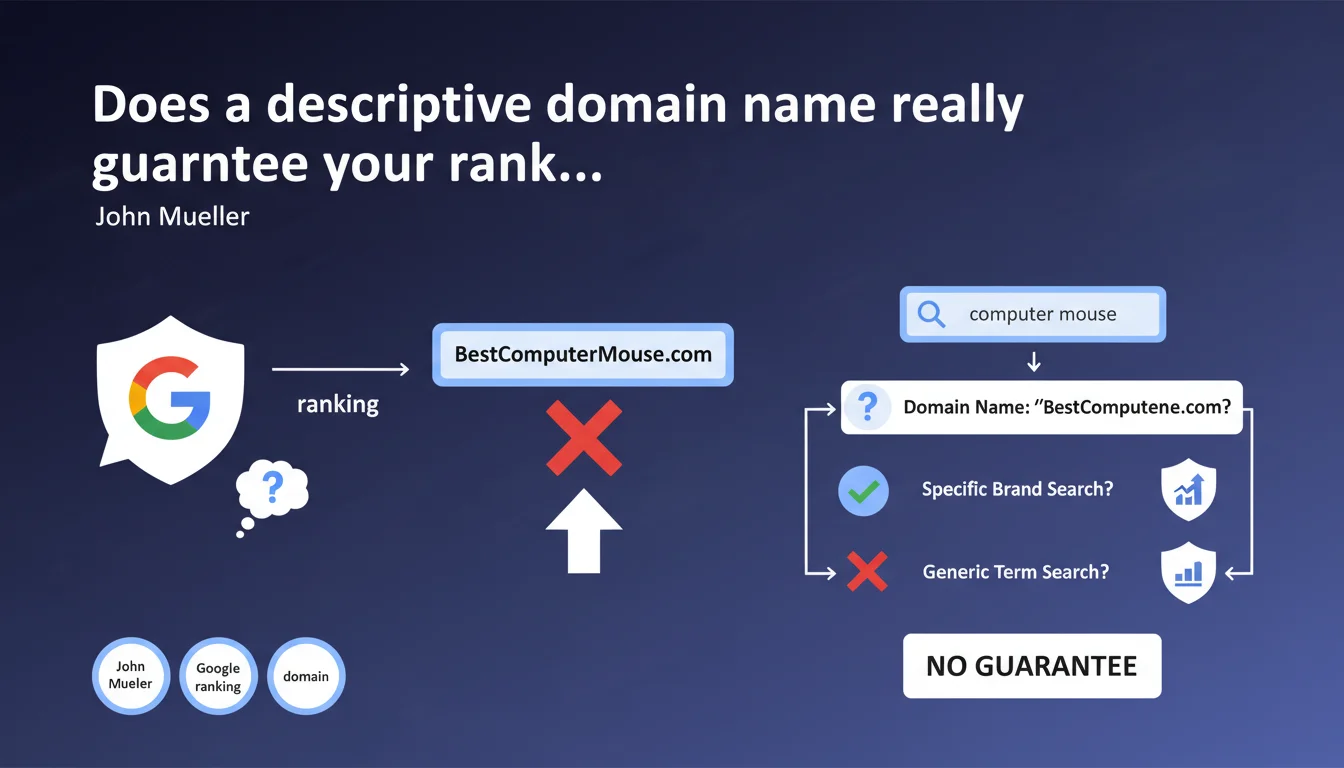
Google doesn't automatically treat generic domain names as brands. If your site is called 'BestComputerMouse.com', nothing guarantees it will appear at the top when someone searches 'best computer mouse' — Google may interpret the query as a generic informational search, not a search for your specific brand. The domain name alone doesn't make the difference.
What you need to understand
Does Google really differentiate between brand searches and generic searches?
Yes, and it's a crucial point. Google analyzes the intent behind each query to determine whether the user is looking for a specific brand or a generic answer to a need. When someone types 'Nike', the intent is clear — they're looking for the brand. But if the query is 'best running shoes', Google assumes a generic search, even if a site is called BestRunningShoes.com.
The engine relies on a set of behavioral and contextual signals: browsing history, location, brand popularity, search volume including the exact site name. If no one actively searches for 'BestComputerMouse' as a distinct entity, Google has no reason to treat that term as a brand.
What triggers 'brand' treatment in Google?
Google's brand recognition is based on several concrete factors. First, the volume of direct searches on the exact site or company name. Second, mentions of the brand across the web — articles, forums, social media — which create an identifiable entity in the Knowledge Graph.
User signals also play a role: click-through rate on your site when the name appears in SERPs, direct navigation to your URL, visitor loyalty. A generic domain name without these signals remains invisible as a brand in Google's eyes. That's why ManoMano does better than 'CheaperTools.fr' — one is recognized as a brand, the other isn't.
What are the concrete pitfalls of a generic domain name?
- Cannibalization by the generic SERP: You're fighting against Amazon, buying guides, comparison sites on your own domain name
- No branded protection: No 'safe zone' at position 1 when someone types your URL or name
- Difficulty building brand awareness: Impossible to stand out in users' memory with a bland descriptive name
- Risk of penalties: Generic EMDs (Exact Match Domains) more easily attract the attention of anti-spam filters
- No benefit for long-tail searches: Contrary to what you might think, the name doesn't 'boost' query variations
SEO Expert opinion
Is this statement consistent with real-world observations?
Totally. I've seen dozens of sites with descriptive EMDs struggle to rank on their own domain name. BestCarInsurance.com can easily be absent from the first page on 'best car insurance' if its authority and brand signals are weak. Google killed the EMD advantage back in 2012 with the EMD Update, but many still believe in the myth.
What matters today is brand recognition as an entity. Look at Wirecutter — a completely abstract name, but dominant position on thousands of 'best X' queries. Conversely, sites like BestProducts.com (premium descriptive domain) have to fight ferociously without any guarantee of leadership on their target query.
What nuances should be made to this rule?
First point: an EMD can still help marginally if everything else is solid — authority, backlinks, content. It guarantees nothing, but it doesn't harm either if accompanied by a real brand strategy. The problem is that 90% of sites with generic EMDs don't have that strategy.
Second nuance: certain very low-competition niche markets still allow an EMD to stand out, simply because no one else is seriously targeting the query. But as soon as a competitor with a real brand arrives, the EMD crashes.
Third point — and this is where it gets tricky: [To verify] Google claims it doesn't guarantee ranking, but remains vague on the precise criteria that trigger 'brand' treatment. Search volume on the exact name? Threshold of external mentions? Knowledge Graph presence? No clear public metrics. We're navigating blind.
In what cases does this rule not apply?
Let's be honest: there are exceptions, but they're rare. A site like Booking.com managed to transform a generic name into a global brand thanks to colossal marketing investments and real product differentiation. But for 99% of sites, that's not replicable.
Another edge case: legacy sites with 10-15 years of history and massive backlinks. Some old EMDs continue to dominate their SERPs through inertia, but they're losing ground every year against new distinctive brands. Their advantage is inherited, not structural.
Practical impact and recommendations
What should you do if your site has a generic name?
Building strong brand identity becomes your absolute priority. That means a memorable logo, consistent visual identity, recognizable tone of voice in your content. The goal: users remember you as an entity, not as a generic result.
Invest in external mentions and digital PR. Get cited in articles, appear on podcasts, create linkable content. Every mention of your name on a third-party site strengthens your entity status with Google. Backlinks with exact anchor text on your brand are particularly valuable.
Push direct searches on your name through non-Google channels: newsletters, social media, display advertising focused on awareness. The more Google sees people typing your exact name in the search bar, the more it recognizes you as a brand. Branded search campaigns can also help create this signal.
What mistakes should you absolutely avoid with a generic domain name?
Don't bet everything on keyword stuffing in content thinking your EMD will give you a boost. That hasn't worked in over a decade, and it can even trigger quality filters. Focus on real value and differentiation.
Avoid creating multiple generic subdomains or subdirectories (best-laptops.yoursite.com, yoursite.com/best-phones, etc.). That dilutes your identity even more and Google won't magically position you on every variation. One clear architecture around a central brand is better.
Don't neglect the Knowledge Panel and Google Business Profile. Even if you're an e-commerce or media site, claim your entity everywhere Google allows. Schema.org Organization, Wikipedia presence if possible, verified social profiles — all of this helps solidify your brand status.
How do you audit the impact of your domain name on your performance?
- Analyze search volume for your exact name via Google Trends and Search Console — if it's nearly zero, you're not recognized as a brand
- Check your position on your own domain name in private browsing — if you're not first, that's a red flag
- Compare your CTR on queries where your brand appears vs generic queries — a small gap indicates little brand recognition
- Test whether Google displays a Knowledge Panel or sitelinks for your name — their absence confirms you're not treated as an entity
- Examine your direct navigation rate and recurring sessions in Analytics — a strong brand generates recurring traffic
- Audit your unlinked brand mentions via monitoring tools — they count toward brand recognition
In summary: A generic domain name doesn't condemn you, but it imposes considerable extra work to build brand recognition. If you're starting from scratch, favor a distinctive name. If you're already stuck with a generic EMD, invest heavily in off-site branding and behavioral signals.
These optimizations — brand perception audit, external mention strategy, coherent semantic architecture — require specialized expertise and time. Many companies underestimate the complexity of transforming a generic name into a brand recognized by Google. Partnering with an SEO agency specialized in branding and authority can accelerate this process by avoiding costly mistakes and prioritizing levers that genuinely work for your specific context.
❓ Frequently Asked Questions
Un nom de domaine EMD a-t-il encore un avantage SEO en 2025 ?
Comment Google détermine-t-il qu'un site est une 'marque' ?
Dois-je changer mon nom de domaine générique pour un nom de marque ?
Les sous-domaines ou sous-dossiers avec mots-clés sont-ils une alternative viable ?
Un Knowledge Panel garantit-il le traitement 'marque' par Google ?
🎥 From the same video 12
Other SEO insights extracted from this same Google Search Central video · published on 04/07/2022
🎥 Watch the full video on YouTube →
💬 Comments (0)
Be the first to comment.