
Official statement
Other statements from this video 11 ▾
- □ Have site migrations really become less risky for SEO now?
- □ Are Meta Refresh Redirects Destroying Your SEO Migration Strategy?
- □ Do you really need to panic if your site traffic hasn't recovered a year after migration?
- □ Are you hiding redirects from Googlebot and killing your site migration?
- □ Can changing your HTML structure really impact your Google rankings?
- □ Should you really migrate a complex website in phases rather than all at once?
- □ Should you really verify a domain's history before SEO migration?
- □ Can a domain with a problematic past secretly tank your SEO performance for an entire year?
- □ Are HTTPS migrations really as trouble-free as Google claims?
- □ Is a comprehensive URL mapping really the single most critical factor that makes or breaks an SEO migration?
- □ Does a properly executed SEO migration really guarantee zero traffic loss?
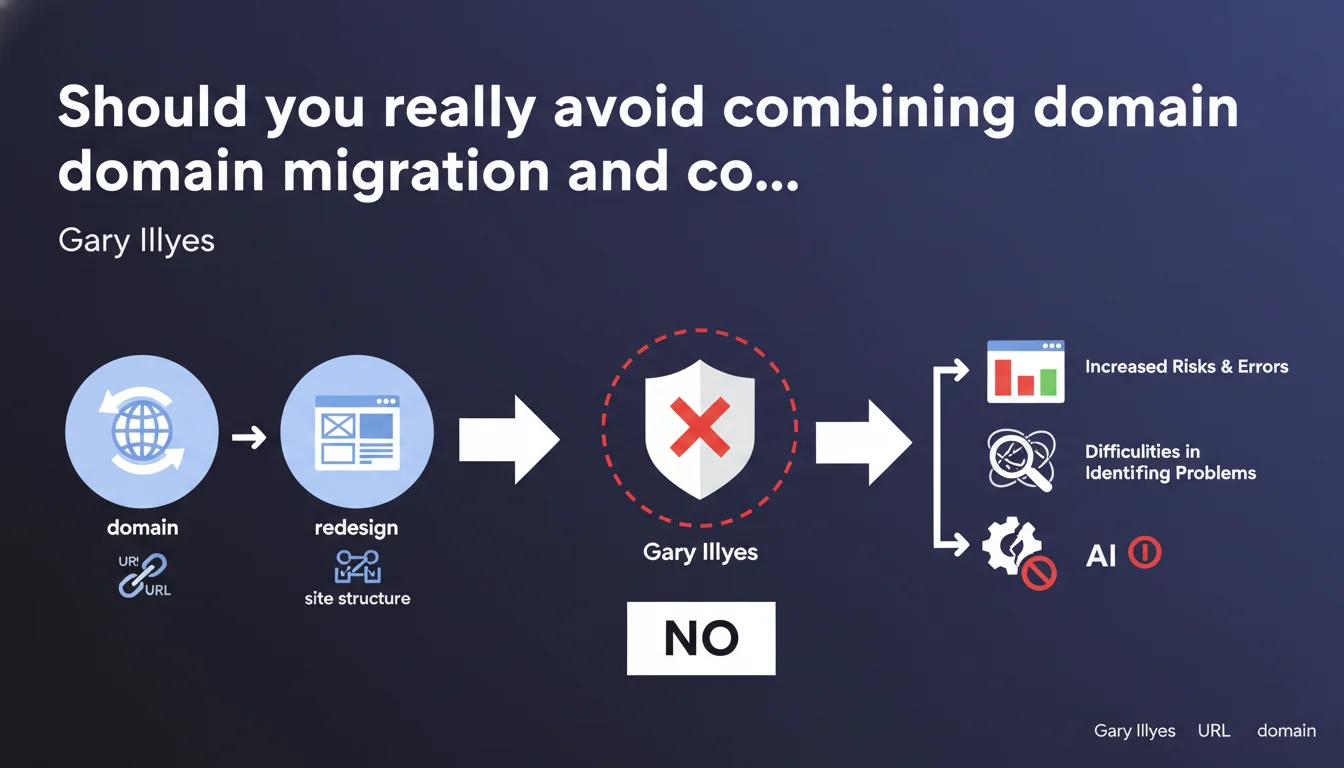
Google strongly advises against combining domain migration, graphic redesign, and URL restructuring in a single operation. The more changes are simultaneous, the more complex diagnosing problems becomes and the greater the risk of critical errors. The recommendation: sequence your projects to maintain control.
What you need to understand
Why does Google insist on separating these projects?
The reason is straightforward: each type of modification generates its own technical signals and can cause traffic fluctuations. When you combine migration, redesign, and URL restructuring, you create an analytical fog that makes it impossible to identify the source of a problem.
Imagine a traffic drop post-launch. Is it the migration that failed? A redirect configuration issue? A drop in relevance linked to the new content? With three simultaneous projects, you spend weeks sorting things out — while your site bleeds traffic.
What are the concrete technical risks?
301 redirects misconfigured during a migration can already generate crawl budget and link equity losses. Add a new site architecture with restructured URLs, and you multiply potential failure points. Redirect chains become a nightmare to audit.
On the redesign side, modifications to HTML structure, internal linking, and page load times directly impact crawl and indexing. If Googlebot struggles to navigate the new site while you're resolving DNS issues related to the migration, you lose precious time.
- Impossible diagnosis: unable to isolate the cause of a performance drop
- Multiplied errors: redirects, canonical tags, robots.txt, sitemap — each layer adds risks
- Diluted resources: your technical team runs in all directions instead of focusing
- Extended recovery time: every day counts when traffic drops, and you lose weeks debugging
Does this recommendation apply to all types of sites?
For a small site with 50 pages and modest traffic, the impact remains manageable — though the recommendation still stands. However, for an e-commerce site with thousands of pages or high-traffic media outlet, combining these three projects amounts to SEO suicide.
Sites with strong seasonality are even more exposed. If you launch everything during peak season and it breaks, you can't roll back without breaking everything again. The cost of an error then amounts to hundreds of thousands of euros in lost revenue.
SEO Expert opinion
Is this statement consistent with real-world observations?
Absolutely, and it's even an understatement. I've seen sites lose 60 to 70% of their organic traffic by poorly coordinating migration and redesign. The worst part is that in most cases, marketing or technical management underestimates the complexity — "let's do everything at once to save time."
Except that this imagined time savings transforms into a multi-month nightmare. A well-prepared migration alone typically stabilizes within 4 to 6 weeks. With simultaneous redesign and URL restructuring, some sites never recover their original traffic levels.
What nuances should be added to this advice?
Site size changes everything. A 20-page brochure website can technically do everything simultaneously if the team is meticulous and testing is exhaustive. But for sites beyond 500 pages with significant traffic, it's a disproportionate risk.
Another nuance: if the redesign only impacts the front-end (React/Vue SPA with properly configured server-side pre-rendering) without touching URLs or content, the risk is lower. But how many redesigns truly limit themselves to visual changes without modifying HTML structure, internal linking, or important tags?
[To verify] — Google provides no specific timeline between projects. Some experts recommend 3 to 6 months between each to give the algorithm time to digest. Others believe 6 to 8 weeks suffice if the first project has stabilized. In reality? It depends on the site's crawl capacity and trust history.
In what cases can you consider combining them anyway?
If the existing site is so broken that there's nothing worth preserving, you might as well rebuild everything. Typically: an old site with 90% 404 errors, no logical architecture, obsolete content, and 2000s design that drives visitors away.
In this specific case, you have nothing to lose. But even then, you must document everything — complete URL mapping, redirect audits, crawl tests — to limit damage. And above all, accept that recovery will take time.
Practical impact and recommendations
What should you do concretely to sequence these projects?
First step: prioritize based on business urgency. If the current domain poses legal or brand issues, migration takes priority. If conversion rates are plummeting, UX/UI redesign may take precedence — but without touching URLs.
Next, plan each project with a breathing period between them. Ideally, wait until crawl metrics, indexation, and traffic stabilize before launching the next one. Concretely, this means monitoring Google Search Console, server logs, and organic rankings for 4 to 8 weeks.
What errors must you avoid?
Never launch a migration or redesign without exhaustive prior audit. Many teams charge ahead without mapping the existing state — strategic URLs, backlinks, indexed pages, current performance. Result: they lose entire traffic segments without understanding why.
Another classic mistake: underestimating post-launch monitoring. A migration or redesign isn't "launch and forget." You must monitor daily during the first weeks, fix errors as they appear, and stay reactive. Too many projects fail because the team moves on as soon as the site goes live.
How do you verify everything is going well after a project?
Build a tracking dashboard with critical KPIs: overall organic traffic and by segment, indexation rate, 4xx/5xx errors, server response time, rankings on strategic keywords. Google Search Console and server logs are your best friends.
Systematically compare before/after data over equivalent periods (same day of week, same seasonality). A temporary 10-15% drop is normal with a well-executed migration. Beyond that, or if it doesn't recover after 3-4 weeks, there's a structural problem to fix.
- Conduct a complete SEO audit before any project (crawl, backlinks, strategic content, performance)
- Establish an exhaustive URL mapping if migration or restructuring is planned
- Plan projects with a stabilization period between each (minimum 4 to 8 weeks)
- Set up real-time monitoring of critical KPIs (traffic, indexation, server errors)
- Prepare a reactive technical team for the first 4 weeks post-launch
- Test all redirects, canonical tags, sitemap, and robots.txt before going live
- Never launch a major project during peak seasonality periods
❓ Frequently Asked Questions
Combien de temps attendre entre une migration et une refonte ?
Peut-on au moins changer le design sans toucher aux URLs lors d'une migration ?
Que faire si la migration et la refonte sont déjà lancées simultanément ?
Les redirections 301 suffisent-elles pour sécuriser une migration ?
Un petit site peut-il tout faire en même temps sans risque ?
🎥 From the same video 11
Other SEO insights extracted from this same Google Search Central video · published on 23/02/2023
🎥 Watch the full video on YouTube →
💬 Comments (0)
Be the first to comment.