
Official statement
Other statements from this video 11 ▾
- □ Les migrations de site sont-elles vraiment devenues moins risquées pour le référencement ?
- □ Pourquoi les redirections meta refresh peuvent-elles ruiner votre migration SEO ?
- □ Faut-il vraiment attendre un an après une migration de site pour paniquer ?
- □ Pourquoi masquer des redirections à Googlebot peut ruiner votre migration de site ?
- □ Faut-il vraiment éviter de cumuler migration et refonte complète ?
- □ Faut-il vraiment migrer son site complexe par étapes plutôt que d'un seul coup ?
- □ Faut-il vraiment vérifier l'historique d'un nom de domaine avant migration SEO ?
- □ Pourquoi un domaine à historique problématique peut-il saborder vos performances SEO pendant un an ?
- □ Les migrations HTTPS sont-elles vraiment aussi simples que Google le prétend ?
- □ Pourquoi la carte de mapping des URLs est-elle l'élément le plus critique d'une migration SEO ?
- □ Une migration SEO bien faite génère-t-elle vraiment zéro perte de trafic ?
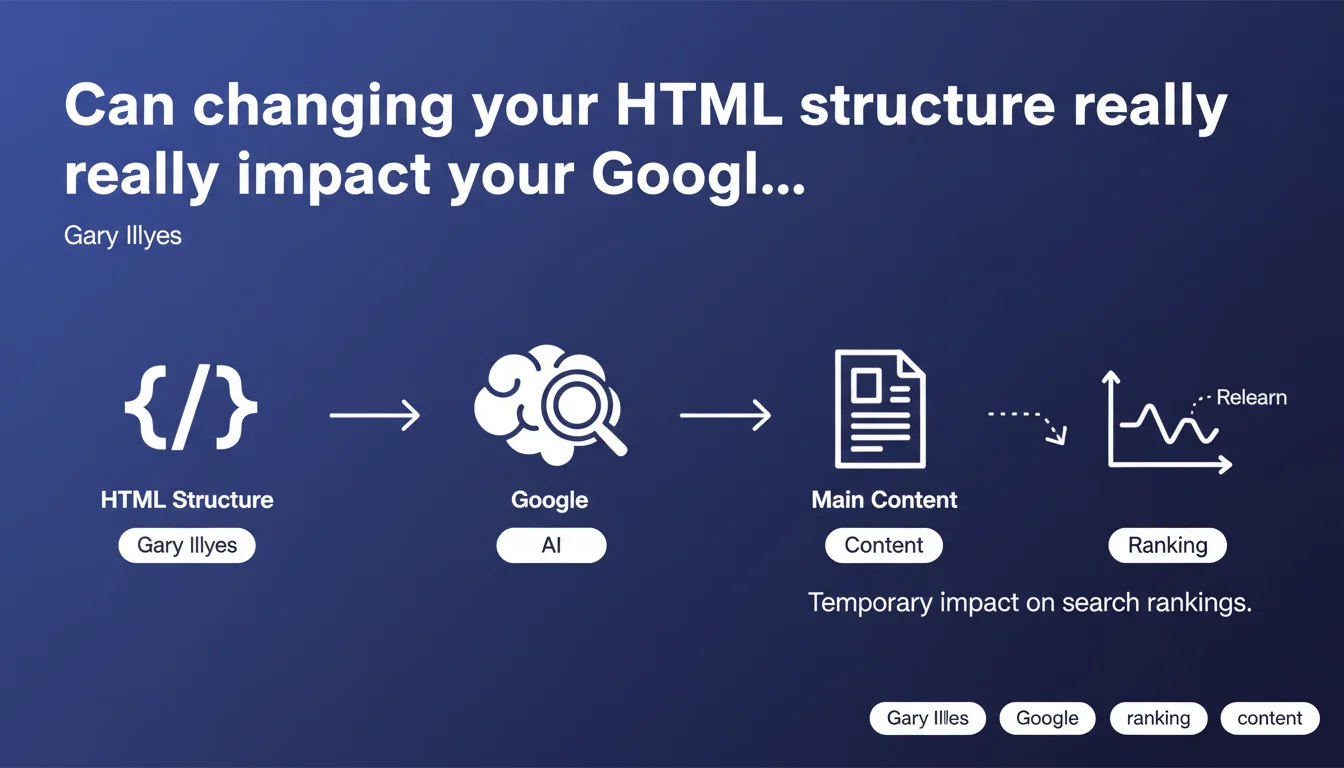
Google states that any modification to a page's HTML structure forces its engine to relearn how to extract the main content. This relearning phase can cause temporary ranking fluctuations. The takeaway: change your HTML carefully, even if it's meant to improve things.
What you need to understand
What exactly happens when you modify the HTML structure?
Google uses content extraction algorithms that learn to identify what constitutes a page's main content versus peripheral elements (navigation, sidebar, footer). When you change your HTML — tags, element order, DOM structure — these algorithms must recalibrate their understanding.
This relearning isn't instantaneous. The engine must recrawl the page, analyze the new patterns, and adjust its interpretation. During this transition period, content extraction can become less reliable.
Why is this statement coming out now?
Gary Illyes is likely responding to field observations: sites that overhaul their HTML and notice unexplained traffic fluctuations. This isn't a penalty — it's a consequence of Google's internal mechanics.
The subtext: Google operates with learning models based on your pages' current structure. Break that structure, and you disrupt the consistency of their models.
Which HTML changes are affected?
Anything touching semantic organization: moving from <div> to <article>, reorganizing sections, changing heading hierarchy, shifting main content around in the DOM.
Cosmetic modifications (CSS, classes) probably have less impact. But the moment you touch the logical structure of the page — where main content begins and ends — Google must recalculate.
- Technical overhaul: CMS migration, transition to a new framework
- Semantic optimization: adding structured HTML5 tags
- Content reorganization: moving entire blocks within the DOM
- Template modifications: new page architecture
SEO Expert opinion
Is this statement consistent with real-world observations?
Yes and no. We do observe fluctuations after major HTML overhauls — but their duration and amplitude vary enormously. Some sites recover in days, others drag on for weeks. [To verify]: Google doesn't specify how long this "relearning" lasts.
The problem is that this catch-all explanation can mask other issues: content actually degraded by the overhaul, implementation errors, site slowdown. Don't blame everything on "relearning" without investigating first.
What nuances should we add?
Gary Illyes says "temporarily" without giving a timeframe. It's deliberately vague. In practice, if your rankings don't recover after 2-3 weeks of intensive crawling, the problem probably isn't just an adaptation delay — you may have broken something.
Another nuance: not all HTML changes are equal. Moving from <div class="content"> to <main> should improve extraction, not complicate it. If Google struggles with standard HTML5 tags, there's likely an issue with its parsing.
In what cases doesn't this rule apply?
If your HTML is already chaotic and poorly structured, an overhaul toward clean structure can immediately improve your SEO — not temporarily degrade it. Google prefers a clean structure, even if new, over persistent chaos.
Similarly, minor and gradual changes (A/B testing a block, tweaking a section) shouldn't trigger this kind of disruption. The "relearning" concerns massive, sudden changes to overall structure.
Practical impact and recommendations
What should you do concretely before modifying your HTML?
Before any major technical overhaul, document your current state: take HTML screenshots (via "Inspect" on your key pages), export your rankings for priority queries, and keep a backup of your old template.
Test your changes on a limited sample of pages first. If you overhaul 10,000 URLs at once, you won't be able to isolate what causes a potential drop. Roll out in waves: 10% of the site, then 30%, then 100%.
What errors should you avoid during HTML migration?
Don't change HTML structure at the same time as text content, URLs, or hosting. Isolate variables. If you modify everything simultaneously, you'll never know what caused a fluctuation.
Another trap: don't remove structural elements without replacing them. If you strip out an <article> tag without an equivalent replacement, Google can lose track of your main content. Replace, don't delete into a void.
- Audit your current HTML structure with a crawl tool (Screaming Frog, OnCrawl)
- Identify current structural tags (
<main>,<article>,<section>) - Plan the new structure while preserving clear semantic logic
- Test the new structure on 5-10% of pages first
- Monitor Search Console: coverage, error messages, content extraction
- Measure ranking variations across a panel of key queries
- Allow 2-3 weeks of stabilization before assessing results
- If persistent drop, compare rendered HTML (via "Inspect URL") before/after
How can you accelerate Google's relearning?
Force an intensive recrawl of modified pages: submit them individually via Search Console if volume is manageable, or temporarily increase your crawl budget by optimizing server response time and cleaning unnecessary pages from the crawl.
Ensure your XML sitemap is up to date and modified pages show a recent lastmod date. Google prioritizes pages it detects as freshly updated.
❓ Frequently Asked Questions
Combien de temps dure cette phase de réapprentissage ?
Tous les changements HTML causent-ils ce problème ?
Peut-on éviter complètement ces fluctuations lors d'une refonte ?
Le rendu JavaScript complique-t-il ce réapprentissage ?
Faut-il prévenir Google d'une refonte HTML ?
🎥 From the same video 11
Other SEO insights extracted from this same Google Search Central video · published on 23/02/2023
🎥 Watch the full video on YouTube →
💬 Comments (0)
Be the first to comment.