
Official statement
Other statements from this video 11 ▾
- □ Les migrations de site sont-elles vraiment devenues moins risquées pour le référencement ?
- □ Pourquoi les redirections meta refresh peuvent-elles ruiner votre migration SEO ?
- □ Pourquoi masquer des redirections à Googlebot peut ruiner votre migration de site ?
- □ Faut-il vraiment éviter de cumuler migration et refonte complète ?
- □ Modifier votre HTML peut-il vraiment impacter votre référencement Google ?
- □ Faut-il vraiment migrer son site complexe par étapes plutôt que d'un seul coup ?
- □ Faut-il vraiment vérifier l'historique d'un nom de domaine avant migration SEO ?
- □ Pourquoi un domaine à historique problématique peut-il saborder vos performances SEO pendant un an ?
- □ Les migrations HTTPS sont-elles vraiment aussi simples que Google le prétend ?
- □ Pourquoi la carte de mapping des URLs est-elle l'élément le plus critique d'une migration SEO ?
- □ Une migration SEO bien faite génère-t-elle vraiment zéro perte de trafic ?
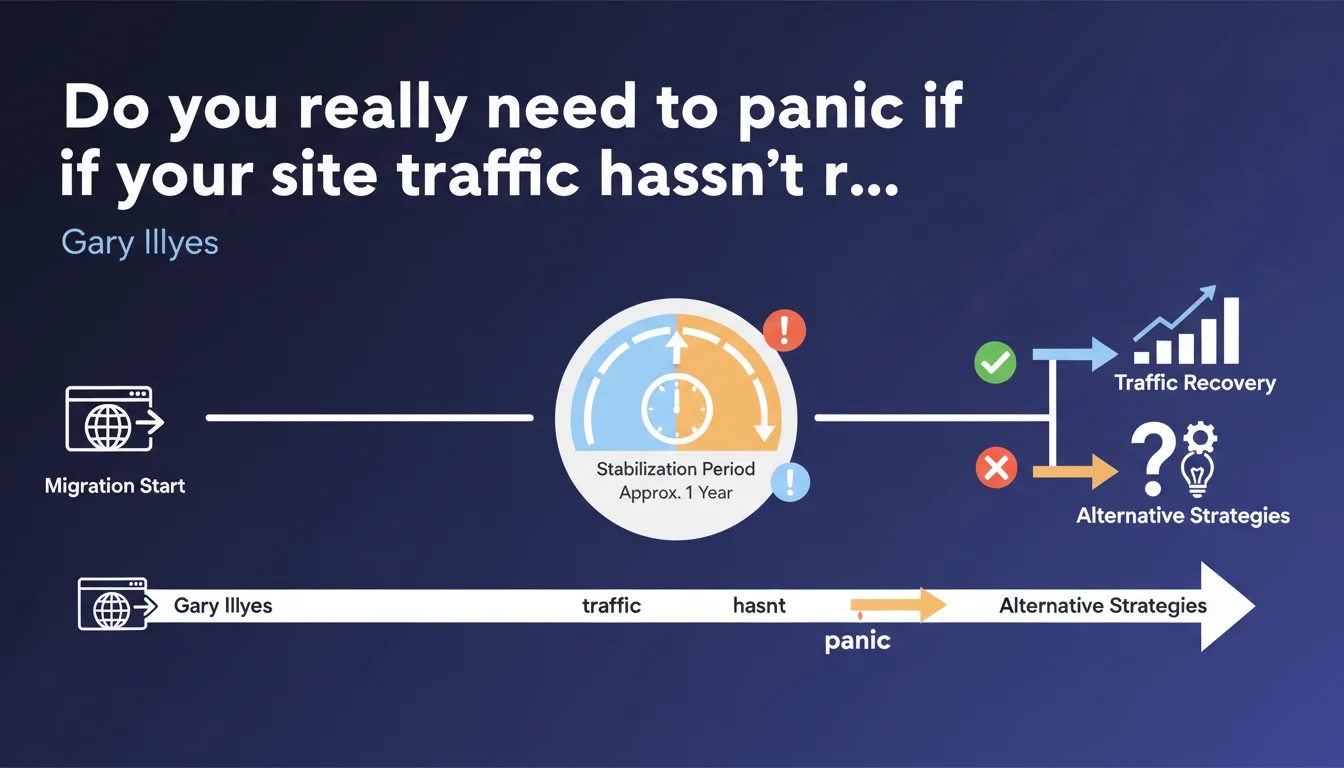
Google states that a site migration can take up to one year to fully stabilize. If after 12 months traffic still hasn't returned, that's the signal to switch strategies. This timeframe remains an approximate estimate, not an absolute rule.
What you need to understand
Gary Illyes establishes here a temporal benchmark that applies to any site migration — domain change, redesign, HTTPS migration, URL structure modification. The central information: one year maximum to observe traffic stabilization.
This timing is not a precise counter. It's an observation window that allows you to distinguish normal post-migration fluctuations from structural issues requiring intervention.
Why such a long timeframe?
A migration triggers several processes on Google's end. Crawling of new URLs, transfer of ranking signals, trust reevaluation if the domain changes, assimilation of 301 redirects.
These operations aren't instantaneous. Even with a technically perfect migration, Google takes time to redistribute the authority accumulated on old URLs to new ones. The delay varies based on site size, crawl frequency, and complexity of changes.
What does "stabilization" mean concretely?
Stabilization is when organic traffic fluctuations return to a pattern consistent with pre-migration history. Not necessarily a return to 100% of initial traffic — some sites gain, others lose.
If after 12 months traffic remains significantly below baseline without an upward trend, Illyes suggests investigating elsewhere. Content issues, increased competition, URL cannibalization, failing technical structure.
- One year is the maximum timeframe observed by Google for migration stabilization
- It's not a guaranteed timeframe — some migrations stabilize in weeks, others take 6-8 months
- Beyond this period, if traffic hasn't returned, the problem is probably not related to migration timing
- "Stabilization" doesn't necessarily mean a return to 100% of pre-migration traffic
SEO Expert opinion
Is this statement consistent with field observations?
Broadly yes, but with significant variations depending on context. On sites with a few hundred pages and frequent crawling, stabilization is often observed in 2-3 months. On large sites with millions of URLs, the timeframe can indeed reach 8-12 months.
The problem with this statement — and it's typical of Google — is that it remains extremely vague. What influences this timeframe? Site size? Quality of redirects? Crawl budget? No specifics. [To verify] what precise criteria Google bases this one-year estimate on.
What nuances should be added?
Passively waiting a year thinking "this is normal" would be a strategic mistake. A well-executed migration shows positive signals from the first weeks: active crawling of new URLs, progressive ranking transfer, properly followed 301 redirects.
If after 2-3 months traffic is in free fall with no recovery signs, there's probably a structural problem that won't resolve itself with time. Forgotten noindex, redirect chains, duplicate content, backlink loss… Waiting a year in this case just makes things worse.
In which cases doesn't this rule apply?
For minor migrations — URL changes on a limited section, HTTPS migration of an already well-crawled site — stabilization can be nearly instantaneous. We're talking days to weeks.
Conversely, some sites with complex history (multiple successive migrations, expired then reactivated old domains, past manual penalties) may take over a year. But at that point, you're stepping outside the "normal" migration framework into pathological territory.
Practical impact and recommendations
What should you do concretely during this period?
Don't sit idle waiting for "it to pass." Actively monitor the health signals of your migration from week one. Search Console, server logs, analytics — everything needs monitoring.
Verify that 301 redirects are being followed, that new URLs are being crawled, that indexation is progressing. If after one month you spot persistent anomalies, diagnose and correct immediately.
- Monitor crawl rates and indexation daily in Search Console during the first 4 weeks
- Verify that all 301 redirects are in place and functional (no chains, no loops)
- Track organic traffic evolution by segment (branded, generic, long-tail)
- Compare average positions of key pages before/after migration
- Analyze server logs to identify URLs that are no longer being crawled
- Verify that backlinks point to new URLs (or are correctly redirected)
- Audit any duplicate content generated by the new structure
What critical mistakes should you avoid?
The worst mistake: treating a migration as something that "takes time" and doing nothing for 6 months. A successful migration shows quick recovery signs. If that's not happening, you have a problem.
Another trap: making multiple post-migration changes to "speed up" the process. Changing URL structure a second time, massively modifying titles, deleting entire sections… You're just complicating Google's work and delaying stabilization even more.
How do you know if the migration is on track?
Look at crawl metrics. If Google is actively crawling your new URLs and progressively indexing content, that's a good sign. If old URLs are progressively disappearing from the index in favor of new ones, you're on the right trajectory.
On the traffic side, an initial 10-30% drop is common, followed by progressive recovery over 8-12 weeks. If after 3 months you're still at -50% without an upward trend, there's a structural problem to identify.
A site migration is a critical project requiring meticulous preparation, flawless execution, and rigorous monitoring over several months. The stakes are considerable: loss of traffic, rankings, revenue.
These technical optimizations and post-migration monitoring require deep expertise and dedicated resources. If you're planning a migration or if your current migration isn't delivering expected results, consulting a specialized SEO agency for personalized support may be wise to avoid costly mistakes.
❓ Frequently Asked Questions
Si mon trafic n'est pas revenu après un an, dois-je abandonner la migration et revenir en arrière ?
Est-ce que toutes les migrations prennent un an pour se stabiliser ?
Comment savoir si ma migration est en train de se stabiliser ou si elle a échoué ?
Peut-on accélérer le processus de stabilisation d'une migration ?
Une migration réussie peut-elle récupérer 100% du trafic d'origine ?
🎥 From the same video 11
Other SEO insights extracted from this same Google Search Central video · published on 23/02/2023
🎥 Watch the full video on YouTube →
💬 Comments (0)
Be the first to comment.