
Official statement
Other statements from this video 11 ▾
- □ Les migrations de site sont-elles vraiment devenues moins risquées pour le référencement ?
- □ Pourquoi les redirections meta refresh peuvent-elles ruiner votre migration SEO ?
- □ Faut-il vraiment attendre un an après une migration de site pour paniquer ?
- □ Pourquoi masquer des redirections à Googlebot peut ruiner votre migration de site ?
- □ Faut-il vraiment éviter de cumuler migration et refonte complète ?
- □ Modifier votre HTML peut-il vraiment impacter votre référencement Google ?
- □ Faut-il vraiment migrer son site complexe par étapes plutôt que d'un seul coup ?
- □ Faut-il vraiment vérifier l'historique d'un nom de domaine avant migration SEO ?
- □ Les migrations HTTPS sont-elles vraiment aussi simples que Google le prétend ?
- □ Pourquoi la carte de mapping des URLs est-elle l'élément le plus critique d'une migration SEO ?
- □ Une migration SEO bien faite génère-t-elle vraiment zéro perte de trafic ?
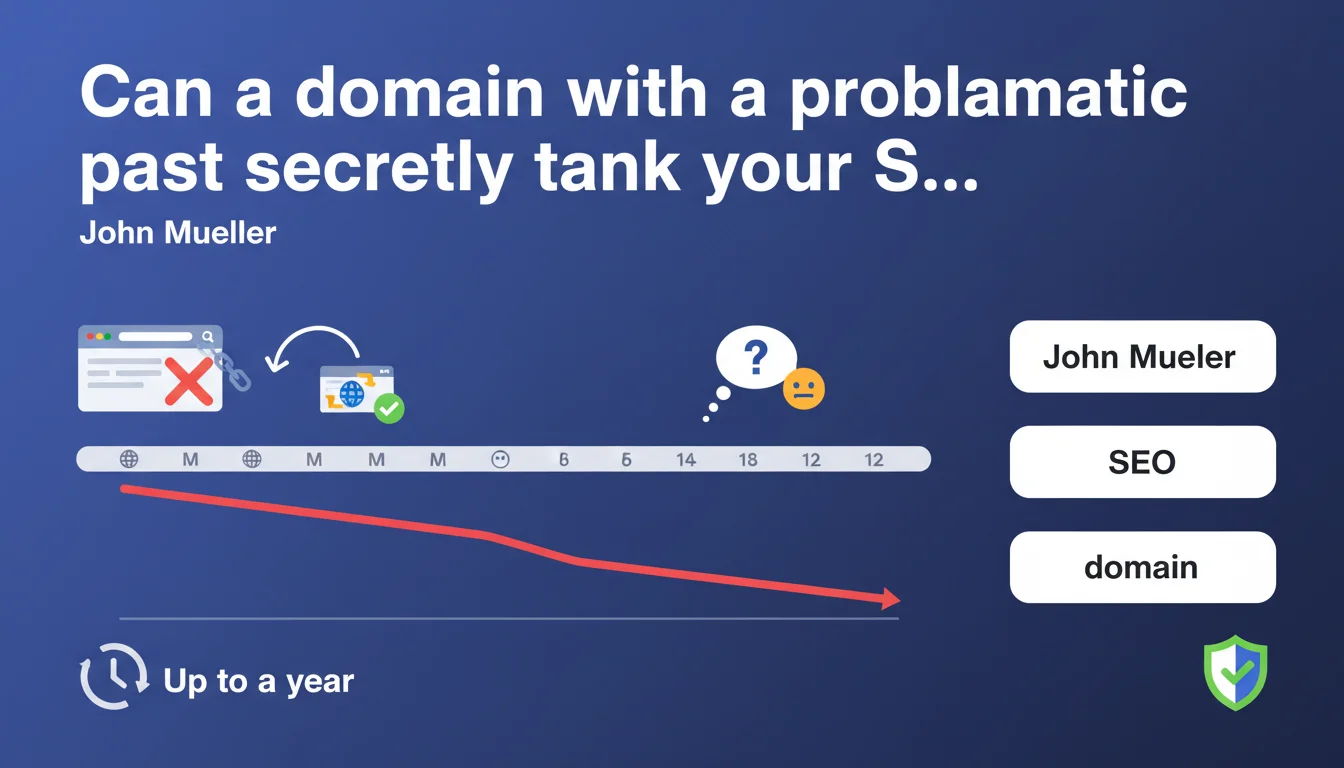
Google confirms that migrating to a domain with a spam or penalized past requires up to 12 months before complete stabilization in the SERPs, even if the technical migration is flawless. The search engine must relearn how to trust the domain — there's no way to artificially accelerate this process. It's a non-negotiable timeframe tied to the algorithmic evaluation of domain reputation.
What you need to understand
What exactly is a domain with problematic history?
A domain with problematic history refers to a domain name that was previously used for practices that violate Google's guidelines: massive spam, link networks, phishing, malware, or that suffered a manual action. Even if the domain was later abandoned and then repurchased, Google retains a memory of its past.
The search engine doesn't instantly wipe the slate clean. It maintains negative reputation signals associated with the domain for an extended period. This toxic baggage directly impacts SEO performance, regardless of the quality of the new content.
Why is this one-year delay so long?
Google applies an algorithmic probation logic. The search engine must observe over time that the domain doesn't slip back into its old habits: content stability, clean link profile, positive user signals, absence of spam.
This period also helps prevent abuse from repurchasing expired domains with strong authority but historically compromised. By imposing a non-negotiable timeframe, Google discourages manipulation based on acquiring old but polluted domains.
Is a perfect technical migration enough to bypass this delay?
No. This is precisely what Mueller clarifies. You can execute a migration that is technically flawless — perfect 301 redirects, optimized crawling, smooth indexing — it won't change the timeline for domain rehabilitation.
The technical dimension and the domain reputation dimension are two distinct layers. The latter operates at a deeper algorithmic level, beyond the reach of standard optimizations.
- Spam history/penalty: trace retained by Google for a minimum of 12 months
- Non-negotiable delay: no technical optimization can circumvent this period
- Algorithmic relearning: Google must observe site stability over time
- Underestimated risk: verifying a domain's history before acquisition becomes critical
SEO Expert opinion
Is this statement consistent with real-world observations?
Absolutely. Documented cases of migrations to repurchased domains consistently show a non-negotiable latency period. Even with a technical audit validating all green signals, performance remains throttled for 6 to 12 months.
The bottleneck: Google provides no visible indicator of this reputational penalty. No message in Search Console, no clear signal. The site suffers an invisible limitation, which makes diagnosis complex for anyone unaware of the domain's history.
What nuances should be applied to this rule?
First point — the severity of the history matters. A domain that hosted light spam for a few months probably doesn't face the same treatment as a hardcore node in a pyramidal link network. [To verify]: Google never quantifies severity, but experience suggests a gradation.
Second nuance: the one-year delay appears to be a maximum observed, not an absolute rule. Some domains with moderate history return to a normal trajectory after 4-6 months. Let's be honest, it's case-by-case — and impossible to predict without testing.
In what cases does this rule not apply?
If you migrate to a brand new domain or a domain with a clean history, this constraint disappears. The migration can produce results within weeks, even days if properly executed technically.
Another probable exception: a domain that received an officially lifted manual action by Google after correction. The algorithmic rehabilitation delay may be reduced, though Mueller doesn't explicitly confirm it here.
Practical impact and recommendations
What should you do before acquiring a domain for migration?
Verify the domain's complete history via Wayback Machine, analyze historical backlinks with Ahrefs or Majestic, and consult Google Search Console if you can gain temporary access. Search for traces of spam, adult content, link farms.
Use tools like SpamZilla or ExpiredDomains.net to identify red flags: brutal traffic variations, suspicious backlink spikes, radical thematic shifts. If any doubt remains, abandon that domain — the risk is never worth the reward.
What if you've already migrated to a domain with problematic history?
Be patient. No technical action will shorten the delay. Focus on building positive signals: quality content, clean link profile, solid user experience, strong brand signals.
Aggressively disavow toxic backlinks inherited from the previous owner. Document each step in Search Console to establish a clear break between the domain's former use and your project.
How do you avoid this pitfall before any migration?
Systematically prioritize a brand new domain or a domain whose complete history you control. If you absolutely must use an expired domain for branding reasons, ensure it was never used or has been inactive for at least 2-3 years with a clean profile.
Include a contractual clause in any domain purchase stipulating the absence of spam history. Should you discover problematic history post-purchase, you must be able to cancel the transaction.
- Complete domain history audit via Wayback Machine and SEO tools
- Verification of historical backlinks to detect spam
- Search for manual penalties or past actions via public records
- Test domain reputation in anti-spam databases (SpamHaus, etc.)
- If problematic history detected: immediate domain abandonment
- If migration already completed: aggressive disavowal + forced patience of 6-12 months
- Building positive signals without forcing: content, UX, brand
❓ Frequently Asked Questions
Combien de temps faut-il attendre avant que Google réhabilite complètement un domaine à historique spam ?
Une migration techniquement irréprochable peut-elle accélérer la réhabilitation d'un domaine pénalisé ?
Comment savoir si un domaine a un historique problématique avant de l'acheter ?
Google informe-t-il explicitement qu'un domaine est sous période de probation ?
Peut-on désavouer les backlinks toxiques hérités pour accélérer la réhabilitation ?
🎥 From the same video 11
Other SEO insights extracted from this same Google Search Central video · published on 23/02/2023
🎥 Watch the full video on YouTube →
💬 Comments (0)
Be the first to comment.