
Official statement
Other statements from this video 11 ▾
- □ Pourquoi les redirections meta refresh peuvent-elles ruiner votre migration SEO ?
- □ Faut-il vraiment attendre un an après une migration de site pour paniquer ?
- □ Pourquoi masquer des redirections à Googlebot peut ruiner votre migration de site ?
- □ Faut-il vraiment éviter de cumuler migration et refonte complète ?
- □ Modifier votre HTML peut-il vraiment impacter votre référencement Google ?
- □ Faut-il vraiment migrer son site complexe par étapes plutôt que d'un seul coup ?
- □ Faut-il vraiment vérifier l'historique d'un nom de domaine avant migration SEO ?
- □ Pourquoi un domaine à historique problématique peut-il saborder vos performances SEO pendant un an ?
- □ Les migrations HTTPS sont-elles vraiment aussi simples que Google le prétend ?
- □ Pourquoi la carte de mapping des URLs est-elle l'élément le plus critique d'une migration SEO ?
- □ Une migration SEO bien faite génère-t-elle vraiment zéro perte de trafic ?
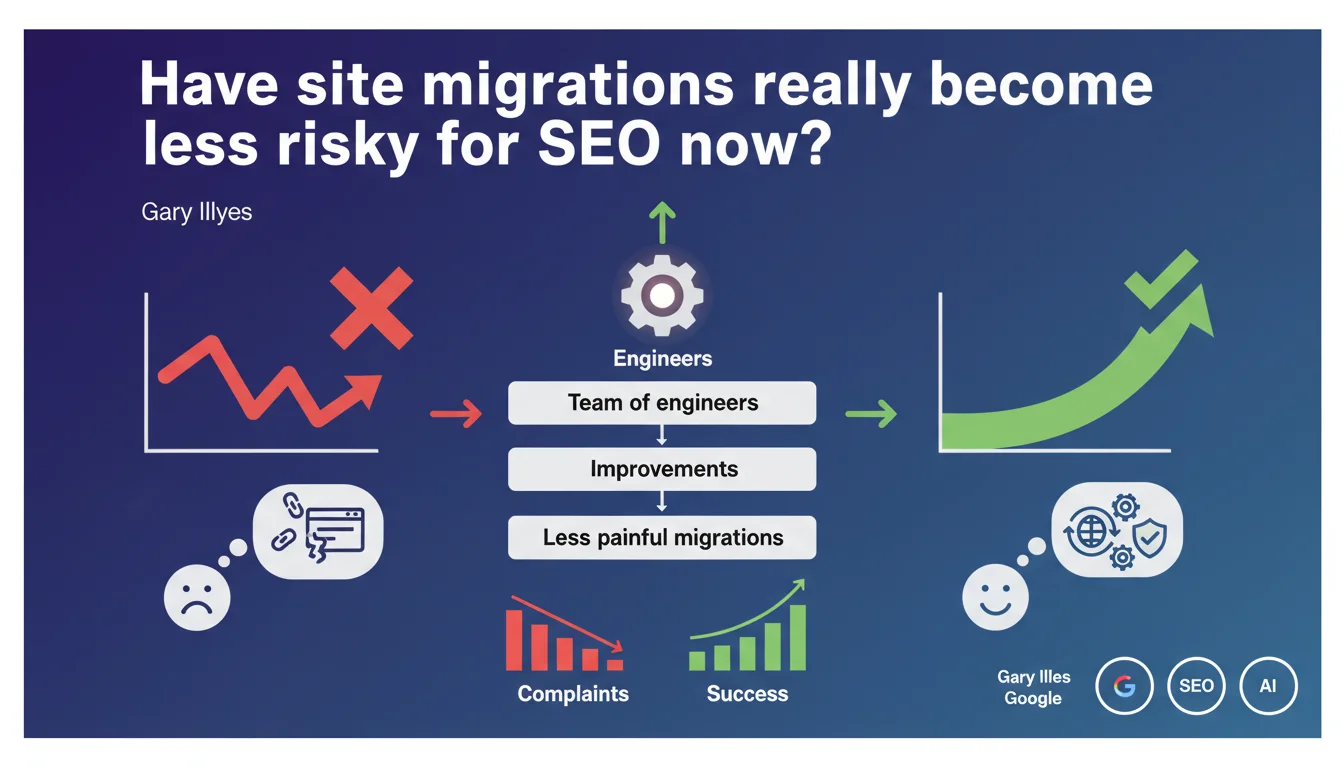
Google claims that site migrations cause fewer issues than before thanks to their engineers' work. The decrease in complaints suggests the process is now smoother. However, it remains to be verified whether this improvement holds true across all types of migrations.
What you need to understand
Why is Google mentioning a drop in migration complaints?
Gary Illyes mentions that a dedicated engineering team focused specifically on optimizing the migration process. The goal: reduce ranking volatility and speed up how quickly changes are processed (redirects, domain changes, structural overhauls).
In practical terms, this means Google has likely improved how its algorithms detect and handle migration signals — recognizing redirect patterns, consolidating ranking signals between old and new URLs, and transferring link popularity.
Which types of migrations are covered by this improvement?
The statement remains vague on the exact scope. We can assume it covers domain migrations (example.fr → new-example.fr), shifts from HTTP to HTTPS, and structural overhauls involving URL changes.
International migrations (consolidating ccTLDs into subdirectories, for example) or site mergers/acquisitions likely fall into this category too. However, Google doesn't clarify whether certain configurations remain more problematic than others.
What signals does Google track when evaluating a migration?
The main indicators a search engine monitors during migration include: the 301 redirect plan, internal linking consistency post-migration, crawl budget stability, and backlink preservation.
Google also needs to verify that quality signals (content, E-E-A-T, user experience) transfer correctly. A poorly managed migration fragments these signals and causes traffic drops.
- Fewer complaints doesn't mean zero risk — migration remains a sensitive technical event
- Google's improvements likely concern the speed of redirect recognition and signal consolidation
- The statement lacks concrete metrics: what's the average recovery timeframe? What percentage of migrations go smoothly?
- Certain migration types (multi-country, multi-language, complex mergers) remain potentially riskier
SEO Expert opinion
Does this improvement align with real-world observations?
In recent years, we've indeed noticed that well-prepared migrations recover their rankings faster than before. Average recovery times have shifted from several months to a few weeks in many cases — but this heavily depends on site complexity.
Be careful though: this improvement doesn't compensate for fundamental mistakes. A migration without a complete redirect plan, with simultaneous content changes or broken internal linking will remain disastrous. [To verify] whether this "improvement" truly covers all scenarios or just simple cases.
What nuances should we add to this statement?
When Gary Illyes mentions "fewer complaints," it could also mean that SEOs are simply better prepared than before. Best practices (1-to-1 redirects, maintaining structure, GSC monitoring) are now widely known.
Furthermore, Google says nothing about recovery duration or the percentage of traffic preserved. A migration losing 15% visibility instead of 40% is certainly "better," but far from neutral.
In which cases doesn't this improvement apply?
Sites with complex architectures (multi-domain, multi-language, heavy pagination, facets) still encounter difficulties. Migrations involving a CMS change, major UX overhaul, or content model modification stack multiple risk factors.
And let's be honest: if your redirect plan is flawed, if you change your URL structure and content simultaneously, or if you neglect post-migration monitoring, no algorithmic improvement from Google will save you.
Practical impact and recommendations
What should you do concretely before and during migration?
Even if Google handles migrations better, preparation remains decisive. A comprehensive audit of your existing setup (crawl, URL inventory, backlink mapping) is essential. Each URL must have a 301 redirect to its new version or the most semantically relevant page.
Next, test the new version in staging: verify that internal linking works, that canonical tags point correctly, that robots.txt and XML sitemap are consistent. An HTTPS migration gone wrong or poor subdomain management can blow everything up.
What errors should you avoid during a site migration?
Never migrate by stacking multiple changes simultaneously: domain + URL structure + content overhaul = impossible equation if something goes wrong. Separate operations over time if possible.
Another classic pitfall: neglecting post-migration monitoring. Google Search Console must be closely watched the first few weeks (4xx/5xx errors, indexation coverage, Core Web Vitals). If key URLs aren't recrawled quickly, force their submission.
How do you verify the migration is going well after launch?
Monitor three major indicators: the crawl rate (should remain stable or temporarily increase), positions on strategic keywords (normal volatility first 2-3 weeks), and overall organic traffic (worst-case acceptable drop of 5-10%, recovery in 4-6 weeks).
Keep old redirects active for at least 6 months, ideally 1 year. Some backlinks take time to be recrawled, and Google consolidates signals progressively.
- Perform a complete technical audit before any migration (crawl, backlinks, performance)
- Map each old URL to a relevant new URL (1-to-1 redirects)
- Test the new version in staging (linking, canonicals, sitemaps)
- Never stack multiple structural changes simultaneously
- Monitor GSC daily the first 4 weeks post-migration
- Keep 301 redirects active for at least 6 months
- Track organic traffic evolution and key position changes
❓ Frequently Asked Questions
Combien de temps faut-il pour qu'une migration de site soit pleinement prise en compte par Google ?
Faut-il garder les redirections 301 indéfiniment après une migration ?
Une migration HTTPS est-elle considérée comme moins risquée qu'une migration de domaine ?
Peut-on migrer un site par étapes ou faut-il tout basculer d'un coup ?
Que faire si le trafic chute fortement après une migration malgré toutes les précautions ?
🎥 From the same video 11
Other SEO insights extracted from this same Google Search Central video · published on 23/02/2023
🎥 Watch the full video on YouTube →
💬 Comments (0)
Be the first to comment.