
Official statement
Other statements from this video 11 ▾
- □ Have site migrations really become less risky for SEO now?
- □ Are Meta Refresh Redirects Destroying Your SEO Migration Strategy?
- □ Do you really need to panic if your site traffic hasn't recovered a year after migration?
- □ Are you hiding redirects from Googlebot and killing your site migration?
- □ Should you really avoid combining domain migration and complete redesign at the same time?
- □ Can changing your HTML structure really impact your Google rankings?
- □ Should you really migrate a complex website in phases rather than all at once?
- □ Should you really verify a domain's history before SEO migration?
- □ Can a domain with a problematic past secretly tank your SEO performance for an entire year?
- □ Are HTTPS migrations really as trouble-free as Google claims?
- □ Is a comprehensive URL mapping really the single most critical factor that makes or breaks an SEO migration?
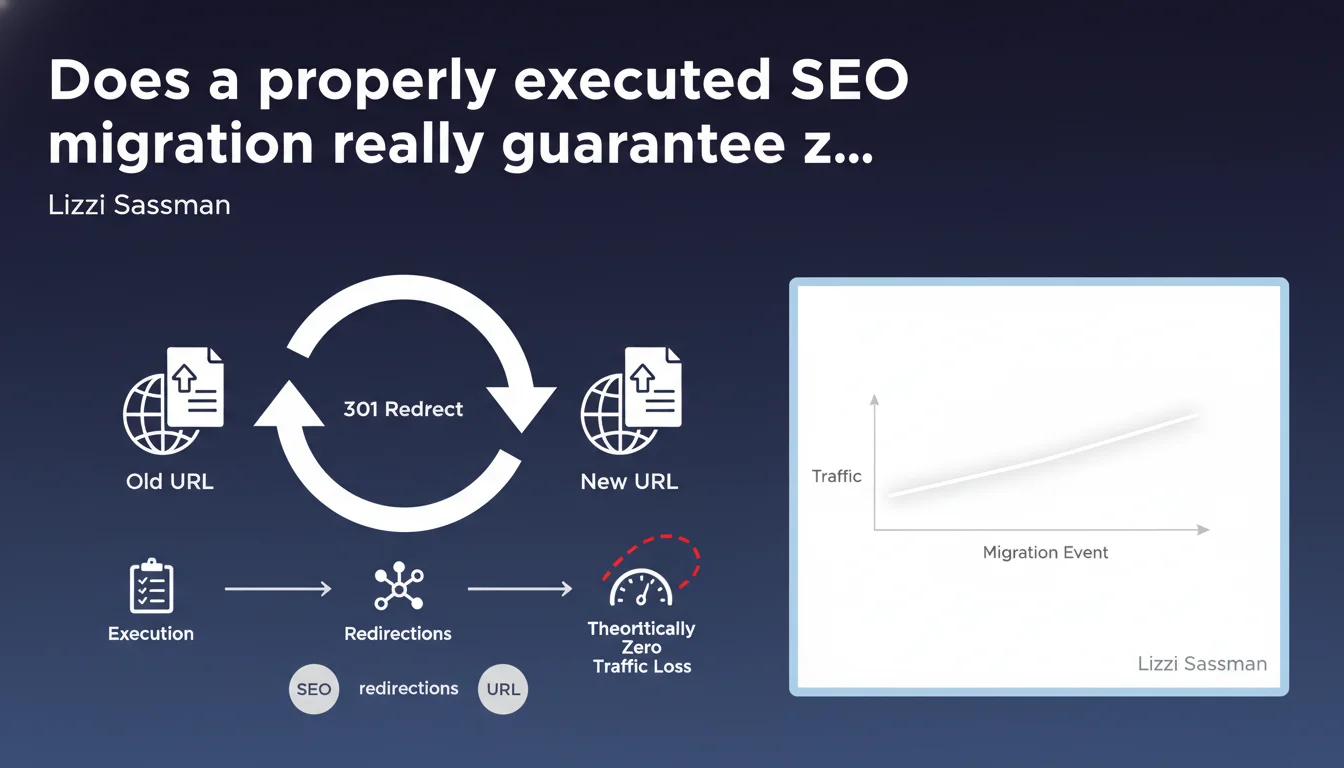
Google claims that a correctly executed migration with appropriate redirections should generate no traffic loss. According to Lizzi Sassman, it's simply about redirecting one URL to another. But this theoretical vision hides a far more nuanced on-the-ground reality.
What you need to understand
What does "correctly executed migration" really mean?
Google takes a clear stance here: flawless technical migration should not impact traffic. The underlying idea is that 301 redirects transfer the entirety of "SEO juice" from an old URL to the new one.
Lizzi Sassman's message rests on a simple principle — technically, Googlebot follows redirects and reassigns ranking signals to the new URL. If the mapping is 1:1 and the redirects are clean, the search engine treats the new address as a simple change of label.
Why does Google use the word "theoretically"?
This small adverb changes everything. Google implicitly acknowledges that theory and practice often diverge. In an ideal world, yes, a redirect works without friction. But on the ground? Dozens of variables come into play.
The word "theoretically" leaves a door open for all cases where things don't go as smoothly. And let's be honest — these cases represent the majority of real-world migrations.
What are the conditions for a migration to be "correct" according to Google?
Google doesn't detail the checklist precisely, but we can deduce the fundamentals: 301 permanent redirects (not 302s), coherent URL mapping (not redirecting everything to the homepage), preservation of content's semantic structure.
You also need new pages to be crawlable, indexable, and delivering equivalent or superior content. If you radically change the architecture or remove content, you step outside the "simply redirecting" framework.
- 301 redirects must be correctly configured on all old URLs
- URL mapping must be 1:1 or logically coherent (old product page → new product page)
- New pages must be accessible and indexable immediately after migration
- The content and HTML structure of new pages must be equivalent or better
- Canonical tags must not contradict the redirects
- The XML sitemap must point to new URLs only
SEO Expert opinion
Does this statement truly reflect what we observe in the field?
No. Frankly, this vision is too idealized. Across hundreds of tracked migrations, even the most carefully executed ones experience temporary traffic fluctuation. Rarely overnight, but Google needs time to recrawl, re-evaluate, and reassign signals.
Traffic drops of 10-20% over 2-4 weeks are common, even when everything is "done right". Some sites recover and exceed their initial levels, others plateau. Saying there's "theoretically no loss" understates the actual complexity. [To verify] on large-scale migrations with several hundred thousand URLs.
What factors escape redirect control?
Redirects only solve part of the problem. If you migrate to a new CMS, loading speed may change. If you redesign, user experience evolves — and with it, the behavioral metrics Google observes.
Recrawl timing is also unpredictable. Googlebot doesn't instantly revisit all your pages. During this phase, some URLs remain duplicated in the index, others disappear before being replaced. That's where things get stuck.
In which cases does this rule clearly not apply?
As soon as you modify information structure or consolidate content, you step outside the "simply redirecting" framework. Merging 10 old product sheets into 5 new ones? Google must re-evaluate relevance. Changing your category tree? Same thing.
Subdomain to subdirectory migrations (or vice versa) can also generate variations, even with perfect redirects. Google treats these structures differently, and the trust accorded to the subdomain doesn't always transfer in a linear fashion.
Practical impact and recommendations
How do you prepare a migration to minimize losses as much as possible?
Start with a complete audit of the existing state: list all URLs generating SEO traffic, identify pages receiving backlinks, spot those ranking on your strategic queries. This mapping must be exhaustive — not just main pages.
Test your redirects in a staging environment before switching live. Verify that no redirect chains form (A→B→C), that HTTP codes are proper 301s, and that new pages return a clean 200. Use Screaming Frog or similar tools to crawl the test environment.
What critical mistakes should you absolutely avoid?
Never massively redirect to the homepage or a few generic pages. That's a guarantee of outright position loss. Each old URL must point to its logically closest equivalent, even if it's not a perfect match.
Avoid launching a migration during your peak seasonality periods. If you're in e-commerce and December represents 40% of your revenue, don't migrate in November. Give yourself room to fix unexpected issues without immediate commercial pressure.
What should you monitor in the days and weeks that follow?
Monitor 4xx and 5xx errors in Search Console — they often spike right after migration. Also watch your crawl rate: if it drops sharply, Googlebot may have hit obstacles (misconfigured robots.txt, overloaded server).
Track your positions on strategic queries day by day for at least 3-4 weeks. Some variation is normal, but a sudden drop across a cluster of keywords can signal a specific problem (modified content, changed heading tags, etc.).
- Map all URLs with organic traffic and backlinks before migration
- Configure 301 permanent redirects in 1:1 correspondence
- Test redirects and crawl in a staging environment
- Verify absence of multiple redirect chains
- Update XML sitemap with new URLs only
- Submit the new sitemap via Search Console immediately after migration
- Monitor 4xx/5xx errors and crawl rate daily
- Track positions on strategic queries for minimum 4 weeks
- Keep old redirects active for at least 12 months
❓ Frequently Asked Questions
Combien de temps faut-il à Google pour traiter complètement une migration ?
Faut-il garder les redirections 301 actives indéfiniment ?
Peut-on utiliser des redirections 302 temporaires pour tester une migration ?
Une migration HTTPS seule peut-elle causer une perte de trafic ?
Que faire si le trafic chute malgré une migration bien préparée ?
🎥 From the same video 11
Other SEO insights extracted from this same Google Search Central video · published on 23/02/2023
🎥 Watch the full video on YouTube →
💬 Comments (0)
Be the first to comment.