
Official statement
Other statements from this video 8 ▾
- □ Local domains, subdomains, or subdirectories: which structure should you choose for an international website?
- □ Are you losing international traffic? Here's how to properly implement hreflang
- □ Can poorly formatted hreflang codes really damage your international indexation?
- □ Does Google really require all your hreflang versions to link to each other bidirectionally?
- □ Should you really include a self-referential hreflang link on every page?
- □ Should you really create visible links between language versions for SEO?
- □ Does limiting the number of language versions on your website really help you rank better?
- □ Should you really create different content for each local market or is translation enough?
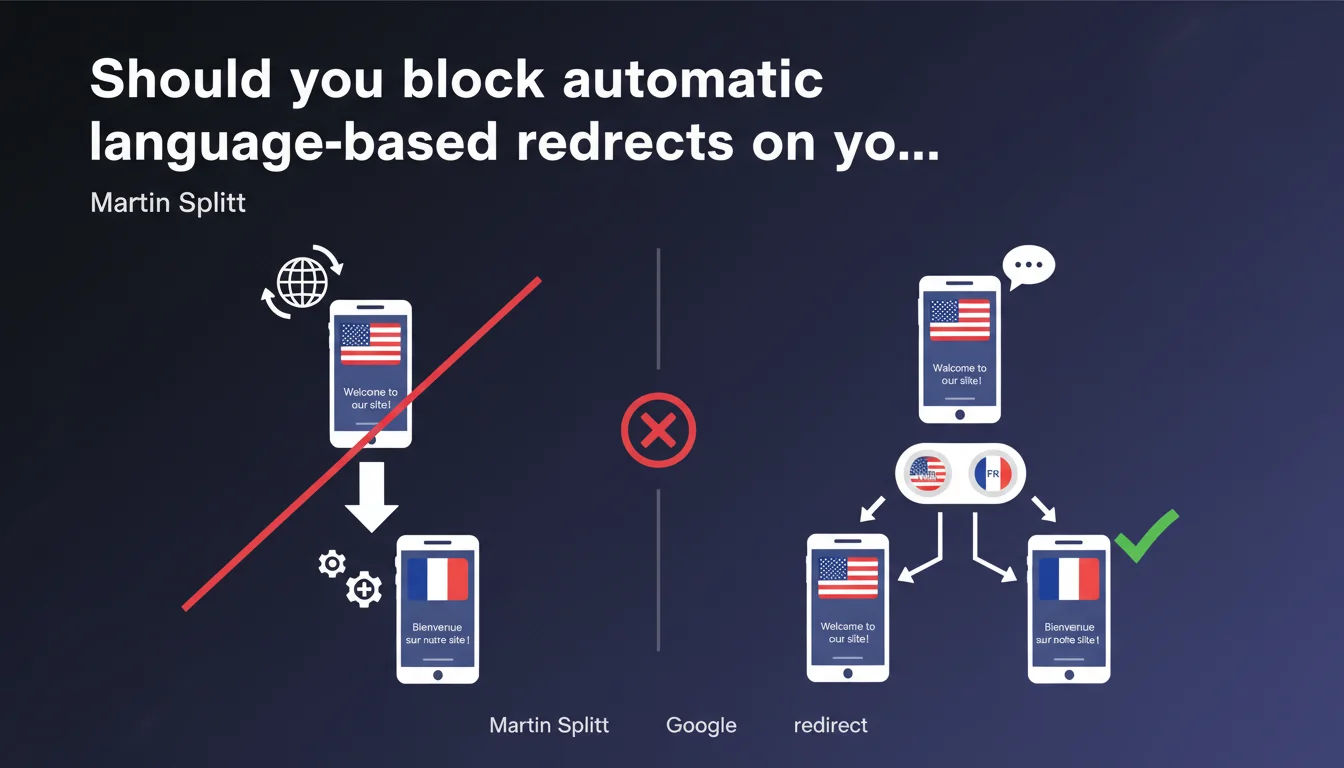
Google formally advises against automatic redirects based on language or geolocation detection. Users must be able to choose their preferred version. This guideline aims to preserve user experience, but raises concrete questions about navigation and indexing of international sites.
What you need to understand
Why does Google oppose automatic language-based redirects?
Google prioritizes user autonomy. A forced redirect to a language version based on IP or browser preferences can create frustration: a French person on vacation in Japan may not necessarily want to view a site in Japanese.
This position also reflects a technical concern. Automatic redirects disrupt Googlebot's crawling, which may be systematically redirected to a single language version, preventing proper indexing of other variants.
Concretely, what does Google expect from multilingual sites?
The official recommendation: provide a visible language selector allowing users to manually switch between versions. The initial URL remains accessible, even if it doesn't match the detected language.
Google suggests using hreflang tags to indicate available language variants. These tags allow the search engine to display the appropriate version in search results, without forcing anyone on the navigation side.
What exceptions does Google tolerate in this rule?
Martin Splitt does not explicitly mention exceptions, but practice shows that Google distinguishes suggestion from constraint. Displaying a banner proposing to switch to another language remains acceptable, as long as users can decline.
The nuance lies in implementation: a non-intrusive pop-in with explicit choice works better than an automatic and permanent 301/302 redirect.
- Automatic redirects by language/geolocation are discouraged by Google
- Users must retain control over the language version they consult
- Hreflang tags remain the recommended method for signaling variants
- A visible language selector improves experience without constraining users
- Googlebot must be able to crawl all versions without being redirected
SEO Expert opinion
Is this recommendation consistent with practices observed in the field?
Yes and no. Many international e-commerce sites or media outlets continue to implement automatic redirects — and perform well in SERPs. The inconsistency stems from the fact that Google does not actively penalize this practice, even though it officially discourages it.
The real question: does Google tolerate a gap between rhetoric and reality? Field observations show that as long as crawling remains functional and hreflang tags are properly configured, automatic redirects do not systematically harm SEO. [To be verified] on sites with high international organic traffic.
What nuances should be added to this directive?
Google speaks of user experience but deliberately ignores business constraints. A site managing multiple currencies, local inventory, or specific regulations cannot always offer free access to all versions.
Concrete example: a French user on a US site may see prices in dollars, prohibitive shipping fees, or products unavailable in their country. The redirect to the FR version then becomes a business necessity, not a technical whim.
In what cases does this rule truly not apply?
Sites with strict legal or geographic restrictions cannot always leave the choice open. Content subject to territorial licensing, regulated financial sites, online gaming platforms — all cases where forced redirect stems from regulatory compliance.
In these situations, priority is not Google's opinion but compliance with legal obligations. SEO adapts, not the reverse.
Practical impact and recommendations
What should you do concretely if you already use automatic redirects?
First step: audit your crawl behavior via Search Console. Verify that all language versions are indexed correctly and that Googlebot is not trapped in a redirect loop toward a single language.
If your hreflang tags are properly configured and indexing remains healthy, you can maintain your current system by adjusting it slightly. Offer a clear exit option: a visible link to the language selector, or preference storage via cookie.
How to implement a compliant solution without sacrificing UX?
Favor a progressive approach: display a banner suggesting to switch to the detected local version, with two explicit buttons (accept/decline). Remember the preference for future visits.
On the technical side, ensure each URL remains directly accessible without 3xx redirect. Hreflang tags must point to correct variants, and the language selector must be crawlable (not solely in client-side JavaScript).
What errors must be avoided absolutely in this configuration?
Never redirect Googlebot to a single version. Some sites detect the Google user-agent and systematically redirect it to /en/, preventing indexing of other languages. Fatal error for international SEO.
Another trap: redirect chains (FR → EN → DE based on multiple detected criteria). Google follows maximum 5 redirects — beyond that, the page becomes orphaned. Simplify your redirect rules.
- Audit your current crawl to identify language-based blockages
- Verify that all language versions are indexed in Search Console
- Implement a visible and functional language selector on all pages
- Properly configure your hreflang tags (self-reference included)
- Test direct access to each URL without automatic redirect
- Propose a suggestion banner rather than forced redirect
- Remember user choice via cookie to avoid repeated suggestions
- Exclude Googlebot from any automatic geolocation-based redirect rules
❓ Frequently Asked Questions
Peut-on rediriger les utilisateurs mobiles vers une version spécifique ?
Les redirections 302 temporaires sont-elles mieux tolérées que les 301 ?
Que se passe-t-il si je ne propose pas de sélecteur de langue visible ?
Les balises hreflang suffisent-elles sans sélecteur de langue ?
Comment gérer les utilisateurs avec VPN ou proxy masquant leur vraie localisation ?
🎥 From the same video 8
Other SEO insights extracted from this same Google Search Central video · published on 15/10/2024
🎥 Watch the full video on YouTube →
💬 Comments (0)
Be the first to comment.