
Official statement
Other statements from this video 11 ▾
- □ Does Google really remove search features based on clicks alone?
- □ Should you really optimize invisible or rarely-clicked elements on a page?
- □ Does Google really prioritize user satisfaction, or is maximizing ad revenue the hidden agenda?
- □ Does Google really measure your page's satisfaction through repeated searches?
- □ How does Google decide which features are worth evaluating in its algorithm?
- □ Does Google really sacrifice SEO features just to cut infrastructure costs?
- □ Is Google really demanding more and more work from website owners indefinitely?
- □ Should you really be happy when Google removes SEO features?
- □ Does Google really roll out algorithm changes all at once, or are they tested gradually on live traffic?
- □ Does Google really have to publicly announce every SEO feature it removes?
- □ Does Google really limit search results to just one per domain?
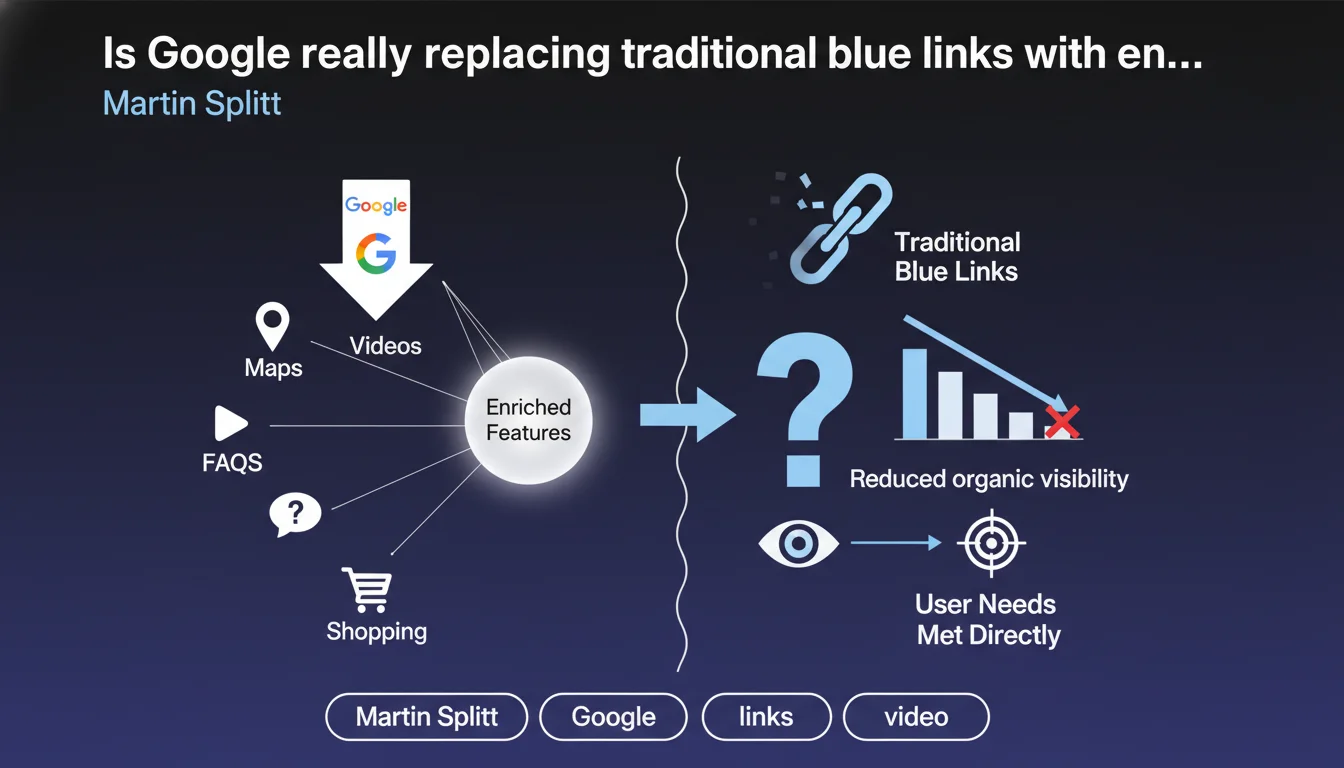
Google is massively diversifying its search results (maps, videos, FAQs, shopping, etc.) to provide direct answers without requiring additional clicks. This strategy improves user experience but complicates SEO work, forcing professionals to target multiple formats simultaneously to maintain organic visibility.
What you need to understand
What does this multiplication of features actually mean in practice?
Google is gradually transforming its SERP into an instant answer platform rather than a simple directory of links. Featured snippets, People Also Ask (PAA), embedded videos, shopping carousels, and local packs now occupy a considerable portion of the visible space above the fold.
This evolution is not merely cosmetic. It fundamentally redistributes organic traffic in favor of content optimized for these specific formats. A site that ignores this reality mechanically loses visibility, even if it maintains its traditional positions in the "blue links."
Why is Google making this strategic choice?
The stated objective: reduce user search time by helping them avoid navigating between multiple sites. To be honest—it's also a way to keep the user in the Google ecosystem longer, with all the advertising implications that entails.
Behavioral data shows that users embrace these quick answers. Google is responding to genuine user demand, but in doing so, it shifts the paradigm: the click is no longer the sole success metric. Visibility and perceived authority now matter just as much.
Which features have the most impact on SEO?
- Featured snippets: answer highlighted in position zero, capturing a major share of clicks on certain informational queries
- People Also Ask (PAA): expandable question-answer blocks that push organic results further down the page
- Local Pack: geolocated results with maps for queries with local intent, often monopolizing the top of the page
- Embedded videos: YouTube carousels particularly visible on tutorial and demonstration queries
- Shopping: sponsored and organic products for transactional queries, with detailed product cards
- Knowledge Graph: information panels on the right side of desktop results, aggregating data from Wikipedia, social networks, etc.
SEO Expert opinion
Is this statement consistent with real-world practices observed in the field?
Yes, and that's even understating it. SERP analyses show that on certain informational queries, featured snippets and PAA occupy up to 60-70% of visible space without scrolling. The "10 blue links" have become an exception rather than the norm.
What's interesting—and what Google doesn't mention—is that this diversification creates cannibalization of organic traffic. A site can win a featured snippet and see its overall CTR decline because the user gets their answer without clicking. Google presents this as a service to users, but for publishers, it's more nuanced.
What nuances should be added to this official narrative?
Martin Splitt presents this as an evolution beneficial to all, but [To be verified]—aggregated CTR data suggests a constant decline in clicks to third-party sites on queries covered by these enriched features. "Zero-click" searches are becoming the norm on many verticals.
Another point: Google says it wants to "help users" but never mentions the monetization aspect. Google Shopping ads, for example, are visually integrated into organic shopping results, creating deliberate confusion between paid and organic results.
In which cases does this strategy create problems for SEOs?
When your business model depends on qualified traffic to your site, being cited in an enriched answer without receiving a click becomes problematic. You're contributing to Google's content without direct measurable return—except in terms of brand visibility, which is difficult to quantify.
Content publishers are particularly affected. A site that produced encyclopedic content finds itself competing with the Knowledge Graph, which aggregates their own data…without sufficient attribution or compensation. The legal debate is actually open in several jurisdictions.
Practical impact and recommendations
What should you actually do to adapt to this diversification?
First step: audit the SERP for your strategic queries. Identify which features appear, how frequently, and who currently occupies them. Don't just track your traditional rankings—they no longer tell the complete story.
Next, optimize your content for each dominant format on your priority keywords. Featured snippet? Structure a concise answer of 40-60 words at the beginning of a paragraph. PAA? Integrate an FAQ section with real user questions. Video? Produce YouTube-optimized content and also host it on your site with transcripts.
What mistakes should you avoid in this multi-format approach?
Don't sacrifice the depth of your content to prioritize only short-form snippet formats. Google still values in-depth expertise—the winning combination is complete content plus snippet optimization.
Common mistake: trying to target all formats simultaneously without prioritizing. Focus on the features that actually appear on your strategic queries and match your content creation capabilities. A B2B site doesn't need to optimize for Google Shopping.
How do you measure the effectiveness of these optimizations?
Metrics are evolving. CTR by position becomes less relevant—instead track your overall "share of voice": what portion of visibility are you capturing on a given SERP across all formats? Tools like SEMrush and Ahrefs are beginning to integrate these measurements.
Also track impressions without clicks in Search Console. They reveal your presence in featured snippets or other formats where users see your content without visiting your site. It's a form of visibility with its own value for branding, even if it doesn't generate immediate traffic.
- Map the features present on my 50 priority queries
- Structure my content with schema.org tags (FAQPage, HowTo, Product as appropriate)
- Create concise, direct answers at the beginning of sections to optimize for featured snippets
- Optimize my images for visual carousels (naming, alt text, compression)
- Implement structured product data if e-commerce (Price, Availability, Reviews)
- Develop a video strategy for queries where YouTube dominates the SERP
- Monitor the evolution of my overall share of voice, not just traditional rankings
- Analyze my impressions without clicks monthly in Search Console
❓ Frequently Asked Questions
Un featured snippet remplace-t-il vraiment un bon positionnement classique ?
Les données structurées garantissent-elles l'apparition dans ces fonctionnalités enrichies ?
Comment récupérer le trafic perdu à cause des réponses directes de Google ?
Faut-il optimiser différemment selon que l'utilisateur est sur mobile ou desktop ?
Les PAA peuvent-ils cannibaliser mon propre trafic si je les cible ?
🎥 From the same video 11
Other SEO insights extracted from this same Google Search Central video · published on 07/11/2023
🎥 Watch the full video on YouTube →
💬 Comments (0)
Be the first to comment.