
Official statement
Other statements from this video 10 ▾
- □ Pourquoi vos données Search Console ne correspondent-elles jamais à votre fuseau horaire ?
- □ Pourquoi Search Console vous cache-t-elle vos données les plus récentes par défaut ?
- □ Pourquoi vérifier vos performances uniquement sur l'onglet Web classique vous fait passer à côté de 40% de votre trafic potentiel ?
- □ Pourquoi faut-il absolument séparer les requêtes branded et non-branded dans Search Console ?
- □ Pourquoi vos requêtes cibles n'apparaissent-elles pas dans la Search Console ?
- □ Pourquoi vos pages stratégiques n'apparaissent-elles pas dans Search Console ?
- □ Pourquoi les annotations personnalisées dans Search Console peuvent-elles transformer votre analyse SEO ?
- □ Les annotations Search Console sont-elles vraiment privées ou visibles par tous vos prestataires ?
- □ Pourquoi le rapport Discover reste invisible dans Search Console malgré du trafic ?
- □ Pourquoi votre rapport Google News reste-t-il invisible dans Search Console ?
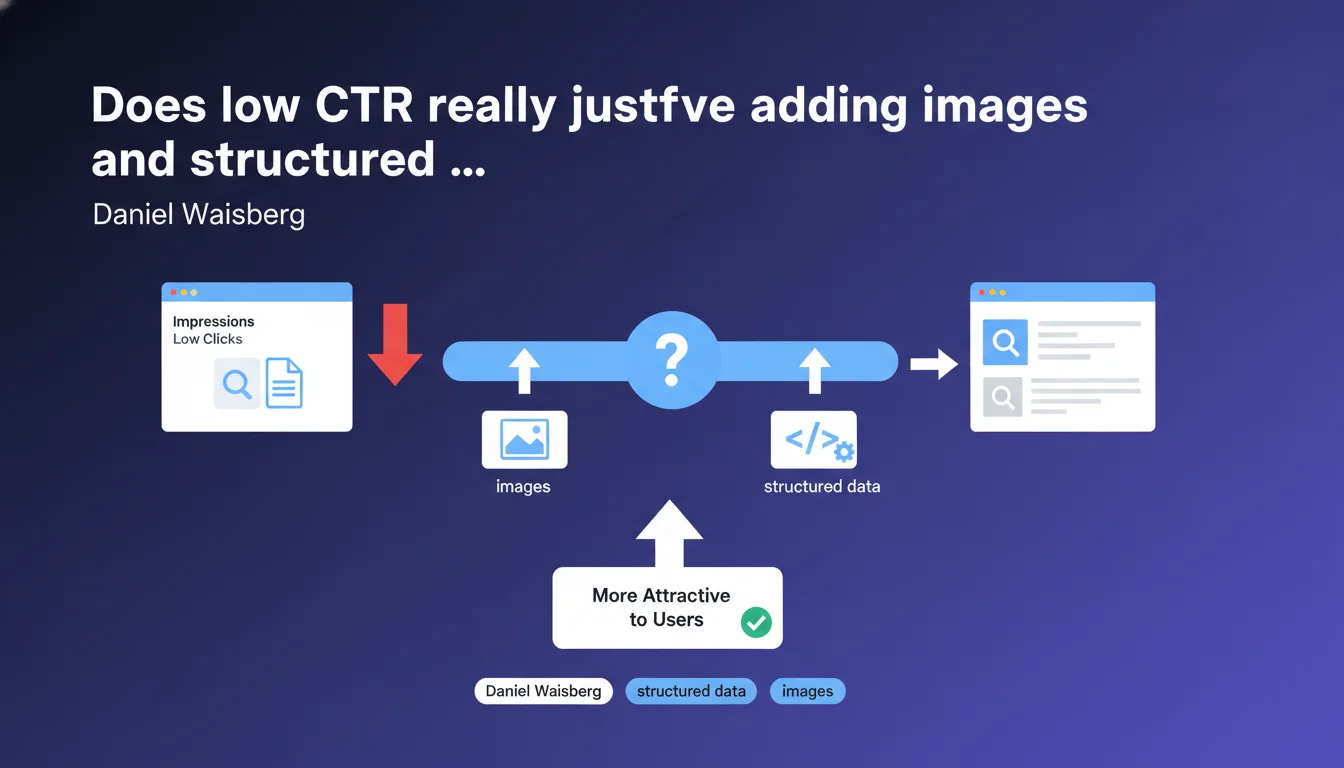
Google suggests enriching your pages with images and structured data if your CTR is abnormally low despite a high volume of impressions. The goal: make your search results more visually attractive in the SERPs. This recommendation is based on the assumption that the problem lies in presentation, not in the content itself.
What you need to understand
Why does Google link low CTR to visual enrichment?
The logic is straightforward: if your pages appear frequently in search results (high impressions) but generate few clicks (low CTR), something is wrong with their presentation. Google assumes your ranking position isn't the issue — you're visible — but that your search result lacks appeal.
Adding images or structured data aims to enrich your snippet: review stars, prices, availability, thumbnails… anything that can catch the eye and differentiate your result from competitors. It's a purely cosmetic approach, but it can work.
What structured data formats are we talking about?
Google is obviously thinking of rich snippets: Product, Recipe, Review, Event, FAQ, HowTo, JobPosting, LocalBusiness… All these formats that allow displaying additional information directly in the SERPs.
For images, it's about optimizing their presence so they appear in Google Images or in visual carousels integrated into standard search results. The idea is to multiply entry points and display formats.
Does this recommendation apply to all industries?
No, and that's where it gets complicated. Structured data works well for e-commerce, recipes, events, local reviews. But for pure editorial content, corporate pages, or complex B2B, the impact is often marginal.
Images have broader potential — provided your audience actually searches for visual content. For certain highly technical informational queries, an image won't change CTR at all.
- Low CTR + high impressions = your ranking position is correct, but your presentation isn't converting
- Google recommends enriching your snippets visually via images and structured data
- Effectiveness depends heavily on query type and industry sector
- Rich snippets are not guaranteed: Google decides unilaterally whether to display them or not
- This approach treats the symptom (low CTR) without necessarily diagnosing the real cause
SEO Expert opinion
Is this recommendation really the solution to the problem?
Let's be honest: Google oversimplifies. Low CTR can have 50 different causes, and adding an image or schema.org is just one answer among many. Sometimes, the real problem is that your title is unreadable, your meta description doesn't sell anything, or you're ranking for queries that don't match users' actual intent.
Visual enrichment can help, sure — but it will never replace a well-written, relevant snippet that directly answers what the user is looking for. And that's where Waisberg's statement shows its limits: it assumes the problem is always cosmetic.
In what cases might this approach fail to help?
Let's take a concrete example. You're ranked 7th on an ultra-competitive query, your top three competitors already have FAQ schema, stars, images. Adding the same enrichments changes nothing: you'll just be one enriched snippet among many others.
Another case: your CTR is low because the query itself generates few clicks — featured snippet answering directly, knowledge panel, heavy ad presence… You can enrich all you want, it won't budge. The problem isn't your presentation, it's the SERP structure.
Are there industries where this recommendation actually works?
Yes, absolutely. In e-commerce, displaying price, availability, reviews — that changes the game. Studies show CTR gains of 15-30% when a product snippet is well-enriched. Same for recipes: prep time, calories, rating… it all catches attention.
For local SEO, LocalBusiness structured data with hours, photos, reviews can boost visibility in local packs. And for events, displaying the date and location directly in the snippet prevents wasted clicks — but attracts those who are truly interested.
Practical impact and recommendations
How do you diagnose if your CTR is really too low?
First step: Google Search Console. Identify pages with an unbalanced impressions-to-clicks ratio. Caution: low CTR isn't necessarily a problem — it depends on average position. At 8th position, 2% CTR can be normal.
Compare your CTR to benchmarks by position. If you're at 3rd position with 5% CTR when your industry average is 12%, then yes, there's an issue. Otherwise, you risk optimizing for nothing.
What should you do concretely to enrich your snippets?
Start by auditing your content: do you have relevant, optimized images? Are they present in your image sitemap? Then identify which structured data types apply to your industry.
Implement the appropriate schema.org — JSON-LD preferably. Test with Google's Rich Results Test. But don't just validate technically: verify in real conditions whether Google actually displays your enrichments.
- Extract from Search Console pages with high impressions + low CTR
- Compare your CTR against position benchmarks to confirm the anomaly
- Check if your titles and meta descriptions are truly optimized — that's often the real problem
- Audit the presence and quality of images on these pages
- Identify schema.org types relevant to your content
- Implement structured data in JSON-LD and validate with Rich Results Test
- Monitor CTR evolution over 4 to 6 weeks — effects aren't immediate
- Analyze whether Google actually displays your enrichments or ignores them
🎥 From the same video 10
Other SEO insights extracted from this same Google Search Central video · published on 04/12/2025
🎥 Watch the full video on YouTube →
💬 Comments (0)
Be the first to comment.