
Official statement
Other statements from this video 10 ▾
- □ Pourquoi vos données Search Console ne correspondent-elles jamais à votre fuseau horaire ?
- □ Pourquoi Search Console vous cache-t-elle vos données les plus récentes par défaut ?
- □ Pourquoi vérifier vos performances uniquement sur l'onglet Web classique vous fait passer à côté de 40% de votre trafic potentiel ?
- □ Pourquoi faut-il absolument séparer les requêtes branded et non-branded dans Search Console ?
- □ Pourquoi vos pages stratégiques n'apparaissent-elles pas dans Search Console ?
- □ Un CTR faible justifie-t-il vraiment d'ajouter images et données structurées ?
- □ Pourquoi les annotations personnalisées dans Search Console peuvent-elles transformer votre analyse SEO ?
- □ Les annotations Search Console sont-elles vraiment privées ou visibles par tous vos prestataires ?
- □ Pourquoi le rapport Discover reste invisible dans Search Console malgré du trafic ?
- □ Pourquoi votre rapport Google News reste-t-il invisible dans Search Console ?
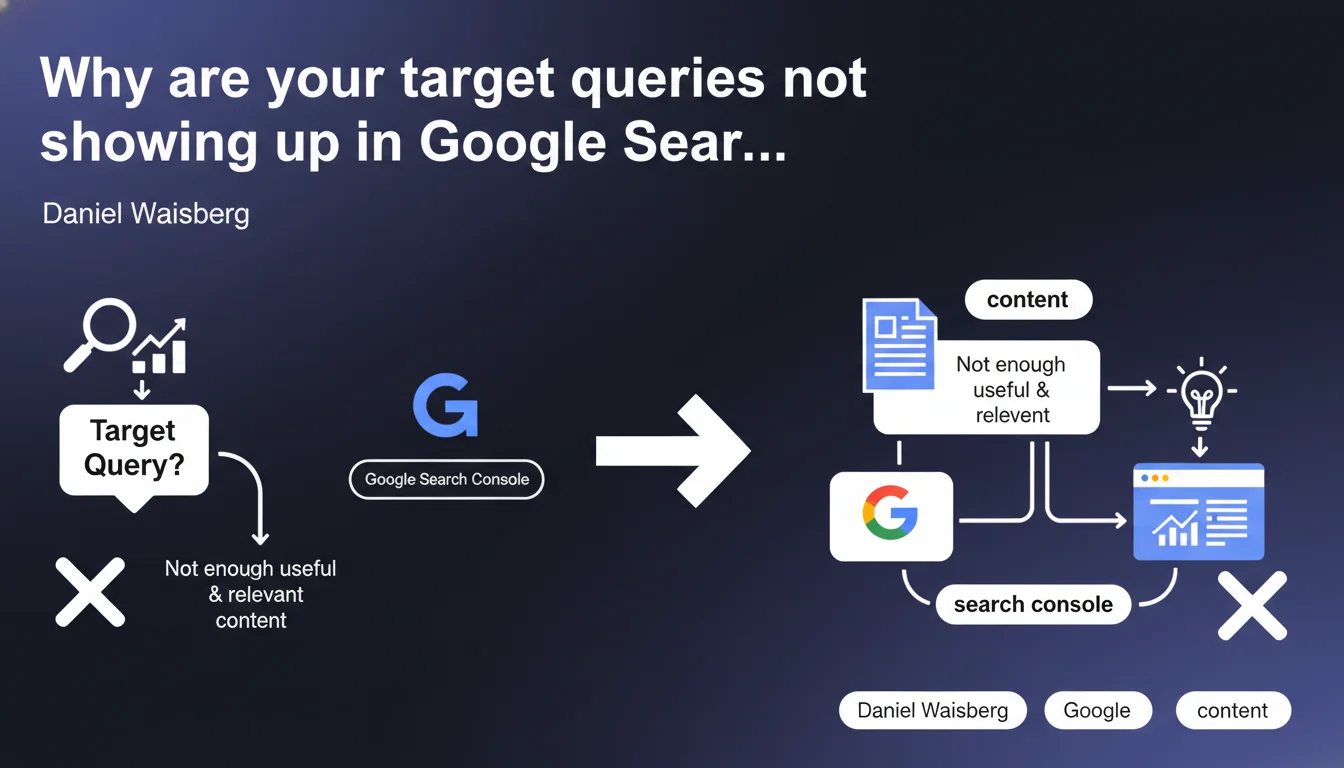
Google delivers an unambiguous diagnosis: if the queries you're targeting don't appear in your Search Console reports, your content probably isn't relevant or comprehensive enough for those terms. This statement from Daniel Waisberg reverses the burden of proof — it's not Google missing your content, it's your content that doesn't deserve to be displayed.
What you need to understand
What does this absence of queries actually mean in practical terms?
You've optimized a page for "advanced technical SEO training", but this query doesn't appear anywhere in your Search Console reports. Not at position 100, not with low impressions — nowhere at all.
Google states that this void isn't a data reporting bug. It's an explicit signal: your page doesn't meet the minimum threshold of semantic relevance to be considered as a candidate for this query. It's not even in the race.
How does this statement differ from Google's usual messaging?
Usually, Google talks to us about content quality in vague terms. Here, Waisberg sets a binary criterion: presence or absence in the reports.
It's not "your content could be better" — it's "your content isn't in the game". The distinction is brutal. This amounts to saying that Google has entry thresholds, likely tied to semantic coverage and the depth of subject treatment.
What are the probable underlying mechanisms?
Google analyzes your content to determine its semantic coverage field. If this field doesn't sufficiently overlap with the field of your target query, your page simply isn't indexed for that intent.
Concretely? If you write 300 words on "technical SEO training" without addressing crawls, JavaScript rendering, server logs, or crawl budget, Google considers you're not really treating the subject. You're just skimming the surface.
- The complete absence of a query from Search Console signals a relevance deficit, not a ranking problem
- Google applies semantic thresholds before even considering a page as a candidate for a query
- This mechanism explains why some pages never rank, even with proper backlinks
- The depth of subject treatment becomes an eligibility criterion, not just a ranking factor
SEO Expert opinion
Does this explanation hold up against real-world observations?
Yes — and it's remarkably consistent. For years, we've observed pages that disappear completely for certain queries after content updates. Not a drop in rankings: a complete evaporation.
Semantic enrichment tests consistently show reappearances in reports for terms previously absent. This isn't improved ranking — it's an eligibility reactivation. Waisberg's statement provides an official framework for what we were observing empirically.
What nuances should we add to this diagnosis?
First point: absence can also signal search volume that's too low to appear in reports. Google filters impressions below certain privacy thresholds. Before overhauling all your content, verify that the query has sufficient volume.
Second nuance — and this one is tricky: sometimes your content is relevant but Google has decided that your site lacks the authority to cover this topic. The absence then isn't purely a content issue, but a question of the domain's perceived legitimacy on this subject.
In what cases is this signal misleading?
On recent sites or new thematic sections, absence may simply reflect temporary lack of trust from Google. The content is there, relevant, but Google is testing you first on adjacent, less competitive queries.
Another case: queries with strong intent ambiguity. If your page targets "python" in a programming context but Google detects a possible confusion with the snake, the absence may stem from poor disambiguation rather than a content deficit.
Practical impact and recommendations
How do you diagnose this problem on your site?
Create a list of the 10-15 strategic queries you're targeting on each important page. Not what you're already ranking for — what you want to rank for.
Open Search Console, filter by the URL in question, and check for the presence of each of these queries. Even 1 impression counts. If a strategic query is absent despite documented search volume, you have a semantic coverage problem.
- List your priority target queries per strategic page
- Verify their presence (or absence) in Search Console reports over a 3-month rolling period
- Identify complete absences despite confirmed search volume
- Analyze the semantic field covered by your content vs. pages that are ranking
What should you do concretely when facing these absences?
First action: aggressive semantic enrichment. Analyze the top 5 ranking pages for your absent query. Extract the sub-topics, questions covered, and co-occurring terms. Your content must cover at least 70% of this spectrum to hope to enter the competition.
Second lever — often overlooked: internal structure. A page in isolation without links to supporting content has less chance of being perceived as legitimate on a topic. Create a thematic cluster with satellite pages that strengthen your pillar page's semantic authority.
Third point, and this is where it gets tricky: verify that your domain has perceived legitimacy on this topic. If you're an e-commerce site wanting to rank on complex informational queries without a history of expert content, Google may simply ignore you. In this case, you must first build thematic credibility on adjacent, less competitive queries.
What mistakes should you avoid when making corrections?
Don't fall into semantic keyword stuffing. Mechanically adding all competitor terms without editorial coherence produces diluted content that Google immediately detects. Enrichment should answer real user questions.
Another common mistake: trying to cover everything on a single page. If your target query requires treating 15 sub-aspects, an 8000-word page becomes unreadable. Better to architect as a cluster: one synthetic pillar page and focused satellite pages, intelligently linked together.
The absence of expected queries in Search Console isn't a bug — it's a diagnosis. Google is explicitly telling you that your content doesn't meet the minimum relevance threshold to enter the competition on these terms.
Correction requires rigorous semantic audit, structured content enrichment, and often a redesign of your site's thematic architecture. These optimizations touch multiple dimensions — semantic, linking structure, domain authority — that interweave in complex ways.
Facing this complexity, support from an SEO agency that masters these analysis and optimization mechanisms can make the difference between content that remains invisible and content that finally enters the search results game.
🎥 From the same video 10
Other SEO insights extracted from this same Google Search Central video · published on 04/12/2025
🎥 Watch the full video on YouTube →
💬 Comments (0)
Be the first to comment.