
Official statement
Other statements from this video 9 ▾
- □ Why doesn't a well-designed website generate any traffic without a discoverability strategy?
- □ Does Google Really Index Modern JavaScript Properly? Here's What You Need to Know
- □ Is Shadow DOM really holding back your multi-search engine visibility?
- □ Are SEO technical fundamentals really as critical as everyone claims they are?
- □ Is your technical SEO slowly degrading without ongoing maintenance?
- □ Does Google really penalize you for breaking heading hierarchy, and why does it matter?
- □ Does Google really believe SEO and accessibility are one and the same thing?
- □ Does Google really always reward superior content in rankings eventually?
- □ Should you really prioritize user experience over technical SEO optimization?
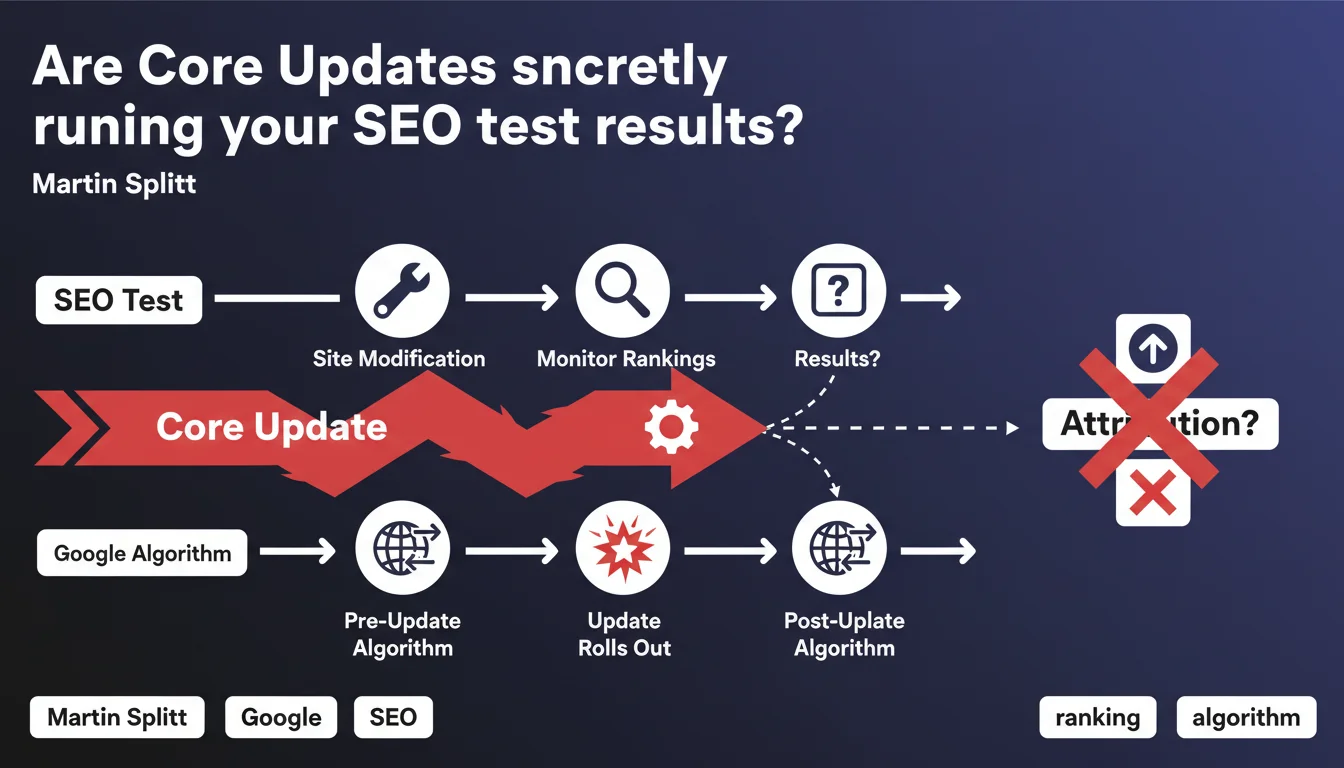
Google's Core Updates interfere with ongoing SEO tests, making it impossible to reliably attribute ranking changes to specific site modifications. Martin Splitt confirms: it's a structural reality of the ecosystem, not a bug — which seriously complicates SEO hypothesis validation.
What you need to understand
What does Martin Splitt mean by Core Updates 'interfering' with testing?
When you launch a controlled SEO test — modifying title tags, restructuring architecture, tweaking internal linking — you expect a clear signal: does it go up, down, or stay flat?
The problem? If a Core Update rolls out during your testing window, it reshuffles the deck for thousands of sites simultaneously. Your site can gain or lose positions for reasons completely independent of your modification. Result: you have no idea whether your change was good, bad, or neutral.
Why can't Google 'neutralize' this effect for testers?
Because Core Updates aren't one-off technical tweaks — they recalculate the perceived quality of millions of pages across hundreds of signals. It's not a switch you flip on or off for a particular site.
The ecosystem evolves continuously. Google constantly re-evaluates who deserves to rank for what. If your competitor gains authority during your test, your ranking drop has nothing to do with your modification — but you won't know it.
Can you still run reliable SEO tests?
Yes, but with strict methodological precautions. You need to monitor sector-wide fluctuations, use control groups, and accept an inherent margin of uncertainty.
Splitt isn't saying 'stop testing.' He's saying: embrace the ambiguity. Correlations will always be approximate as long as a Core Update can arrive without warning.
- Core Updates massively redistribute rankings independent of site modifications
- Strict causal attribution ('this change caused this result') becomes impossible during a Core Update
- Google cannot isolate your site from the global effects of an algorithmic update
- SEO tests remain possible, but require robust protocols and control groups
SEO Expert opinion
Is this statement consistent with what we observe in the field?
Completely. Any SEO who has run large-scale A/B tests has lived this nightmare: you deploy a promising optimization, and two days later a Core Update lands. Impossible to untangle what's your doing and what's algorithmic re-evaluation.
What's more interesting — and what Splitt doesn't explicitly say — is that it also applies to Product Reviews Updates, Helpful Content Updates, and Spam Updates. Any targeted update can pollute your data.
Why is Google communicating about this now?
Because more and more tools (SearchPilot, SplitSignal, etc.) promise statistically significant SEO tests. Google is setting a boundary: yes, test, but don't overestimate the precision of your conclusions.
It's also an elegant way of saying: 'If your rankings tank after a change, it might not be your fault.' It lets Google off the hook for false positives — [To verify] whether this is genuinely to help SEOs or to cover themselves legally.
What are the limitations of this excuse?
If Google rolls out Core Updates every 2-3 months, it becomes almost impossible to validate anything with certainty. At some point, it sounds like an admission: 'Our algo is too unstable for you to optimize rationally.'
Let's be honest — an environment where experimentation becomes unverifiable is an environment where cargo cult SEO thrives. You do stuff, you hope, you cross your fingers. That's not ideal.
Practical impact and recommendations
How do you run SEO tests despite Core Updates?
Prioritize fast-deployment tests: the shorter your observation window, the lower the risk of a Core Update scrambling everything. Ideally, aim for 2-4 weeks max between deployment and first results review.
Use control groups: test on 50% of your pages, keep 50% unchanged. If both segments move the same way, it's probably algorithmic. If only the test group moves, your modification had an effect — but stay cautious about the magnitude.
What mistakes must you avoid at all costs?
Don't launch a major structural test (site architecture overhaul, HTTPS migration, massive content reshuffle) right before or during an announced Core Update. You'll never know if it was you or Google that broke things.
Avoid jumping to conclusions. If you see a spike or drop in the 72 hours following a change, wait 10-15 days before validating or rolling back — unless there's a critical emergency. Post-Core Update fluctuations can take two weeks to stabilize.
How do you verify a fluctuation is tied to a Core Update?
Check sector-wide trackers (SEMrush Sensor, Moz Cast, Algoroo). If everyone's dancing, it's probably not your test. Also compare your direct competitors: if they're moving as much as you, it's algorithmic.
Systematically document your tests with deployment dates, known Core Updates, and control metrics. A simple spreadsheet works — the key is being able to cross-reference events afterward.
- Limit your test exposure duration (2-4 weeks max)
- Implement control groups to isolate effects
- Monitor official Core Update announcements via @searchliaison
- Don't deploy major changes during a known Core Update
- Cross-check your data with sector trackers before concluding
- Document every test with algorithmic context and control metrics
- Wait 10-15 days post-change before validating or canceling
❓ Frequently Asked Questions
Google annonce-t-il toujours les Core Updates à l'avance ?
Combien de temps faut-il pour qu'une Core Update se stabilise ?
Peut-on utiliser des outils d'A/B testing SEO pendant une Core Update ?
Les Spam Updates ont-elles le même effet que les Core Updates sur les tests ?
Faut-il arrêter de tester pendant les Core Updates ?
🎥 From the same video 9
Other SEO insights extracted from this same Google Search Central video · published on 09/02/2022
🎥 Watch the full video on YouTube →
💬 Comments (0)
Be the first to comment.