
Official statement
Other statements from this video 9 ▾
- □ Why doesn't a well-designed website generate any traffic without a discoverability strategy?
- □ Does Google Really Index Modern JavaScript Properly? Here's What You Need to Know
- □ Is Shadow DOM really holding back your multi-search engine visibility?
- □ Are SEO technical fundamentals really as critical as everyone claims they are?
- □ Is your technical SEO slowly degrading without ongoing maintenance?
- □ Does Google really penalize you for breaking heading hierarchy, and why does it matter?
- □ Does Google really always reward superior content in rankings eventually?
- □ Are Core Updates secretly ruining your SEO test results?
- □ Should you really prioritize user experience over technical SEO optimization?
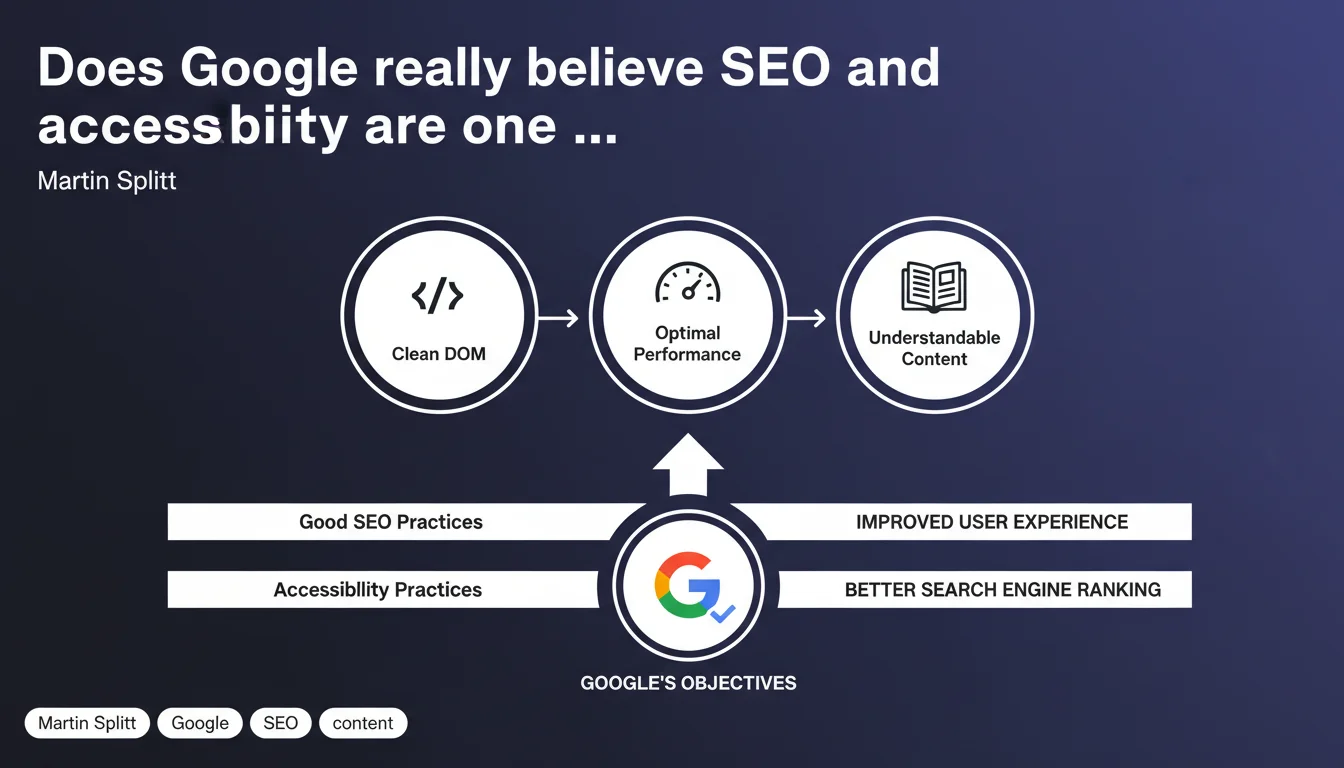
Google claims that SEO and accessibility pursue the same technical objectives: clean DOM, optimal performance, understandable content. Optimizing for search engines would automatically improve user experience and accessibility. This statement reflects a trend toward unified evaluation criteria, but masks certain important field nuances.
What you need to understand
What does this SEO/accessibility convergence concretely mean?
Martin Splitt highlights a methodological synchronization: the technical foundations that facilitate crawling and indexation also serve assistive technologies. A well-structured DOM allows screen readers to navigate efficiently, just as it helps Googlebot understand content hierarchy.
Performance constitutes the second pillar of this convergence. Core Web Vitals penalize excessive loading times — exactly what frustrates a user in situations of cognitive disability or using limited connectivity. Decoupling is no longer possible: optimizing for one means optimizing for the other.
What common practices has Google identified?
Understandable content represents the third axis. Descriptive alt attributes on images, semantic HTML5 structure (nav, main, article), hierarchical headings (H1-H6): these elements serve both SEO and WCAG 2.1 accessibility simultaneously.
Google rarely mentions accessibility by chance — it's a signal that their semantic understanding algorithms are gradually aligning with ARIA standards and accessibility guidelines. Machine learning requires the same structural clarity as a visually impaired user.
- Clean DOM: semantic structure exploitable by crawlers and assistive technologies
- Optimal performance: Core Web Vitals and loading times impact both SEO and UX for disabled users
- Understandable content: alt attributes, hierarchy, ARIA labels benefit both audiences
- Alignment of Google's technical criteria with WCAG standards
Why is Google now emphasizing this alignment?
Two likely reasons. First, growing legal obligations (ADA in the USA, European digital accessibility directive) are pushing sites to comply — might as well capitalize on this momentum. Second, the convergence simplifies Google's messaging: one set of best practices instead of two parallel frameworks.
This communication also serves to legitimize certain ranking criteria under the guise of accessibility. It's hard to contest a factor presented as beneficial for disabled users.
SEO Expert opinion
Does this statement hold up in practice?
Let's be honest: Splitt's claim works in 80% of cases, but hides significant gray areas. A site perfectly accessible according to WCAG 2.1 AA can underperform in SEO if the URL structure is catastrophic or internal linking is non-existent. Conversely, technically Google-optimized sites regularly neglect color contrasts or video transcriptions.
The convergence exists, but it is neither total nor automatic. Poorly implemented ARIA attributes generally don't impact ranking — Google often ignores them. Conversely, excessive JavaScript can explode Core Web Vitals while remaining technically accessible if progressive rendering is well managed.
What nuances does Google deliberately omit?
Google's discourse on « content comprehension » remains vague. Concretely, their algorithms favor certain signals (links, EAT, freshness) that have nothing to do with accessibility. A site loaded with quality backlinks will rank better than a more accessible competitor with weaker authority — the convergence stops there.
Moreover, certain SEO optimizations degrade accessibility: hidden text with display:none to manage rich snippets, duplicate content to target multiple intents, keyword over-optimization that harms natural readability. [To verify]: Google claims to ignore masked text, but tests show they sometimes index it depending on context.
In which cases does this rule not apply?
Complex e-commerce sites illustrate the limits well. Optimizing facet filters for crawling (crawl budget, URL parameters) often contradicts keyboard-accessible navigation. Mega menus pose the same problem: excellent for internal linking, nightmare for screen readers if poorly structured.
Media-rich content (videos, interactive infographics) requires compromises. Optimizing for Google demands indexable transcriptions, but accessibility requires synchronized audio descriptions — two distinct efforts, not automatic convergence.
Practical impact and recommendations
What should you concretely do to capitalize on this convergence?
Start with a semantic HTML audit. Verify that your tags respect hierarchy (single H1, logical H2-H6 structure) and that HTML5 elements (header, nav, main, aside, footer) are correctly used. These foundations serve both crawling and assistive technologies simultaneously.
Next, test your pages with automated accessibility tools (Axe, WAVE, Lighthouse) and cross-reference with your Core Web Vitals data. Contrast errors, links without descriptive text, forms without labels — all negative UX signals that Google can detect through behavioral metrics.
- Audit HTML structure with Screaming Frog or Sitebulb (verify H1-H6 hierarchy)
- Test each template with Axe DevTools and correct critical errors
- Implement descriptive alt attributes (not just keywords) on all images
- Verify keyboard navigation on interactive elements (menus, filters, modals)
- Add text transcriptions for audio/video content
- Optimize Core Web Vitals (LCP < 2.5s, FID < 100ms, CLS < 0.1)
- Validate color contrasts (minimum WCAG AA: 4.5:1 for text)
- Structure data with Schema.org to enhance semantic comprehension
What errors should you avoid in this process?
Don't sacrifice crawl budget under the pretext of accessibility. Some developers overload the DOM with redundant ARIA attributes or multiple navigation structures « for screen readers ». Google wastes time crawling unnecessary code — simplify the structure instead.
Also avoid the « cosmetic SEO » trap: stuffing image alts with keywords harms real accessibility and resembles keyword stuffing. Google detects these patterns. An alt should describe the image for someone who can't see it, period.
How do you measure the impact of these optimizations?
Cross-reference three data sources. First, Search Console metrics: monitor the evolution of click-through rate and positions after corrections. Next, Core Web Vitals in PageSpeed Insights — improvements should be measurable on the 75th percentile.
Finally, install behavioral tracking (heatmaps, session recordings) to observe if users navigate more efficiently. A drop in bounce rate or increase in session time validates that your optimizations truly improve UX, not just technical compliance.
❓ Frequently Asked Questions
L'accessibilité est-elle devenue un facteur de ranking direct ?
Faut-il prioriser l'accessibilité ou le SEO technique en cas de budget limité ?
Les attributs ARIA mal implémentés peuvent-ils pénaliser mon SEO ?
Un site accessible sans backlinks peut-il bien ranker ?
Comment vérifier que mes optimisations bénéficient réellement au SEO et à l'accessibilité ?
🎥 From the same video 9
Other SEO insights extracted from this same Google Search Central video · published on 09/02/2022
🎥 Watch the full video on YouTube →
💬 Comments (0)
Be the first to comment.