
Official statement
Other statements from this video 9 ▾
- □ Pourquoi un site web bien conçu ne génère-t-il aucun trafic sans stratégie de découvrabilité ?
- □ JavaScript moderne : Google peut-il vraiment tout indexer ?
- □ Le Shadow DOM est-il un frein au référencement multi-moteurs ?
- □ Les fondamentaux techniques du SEO sont-ils vraiment aussi critiques qu'on le prétend ?
- □ Pourquoi votre SEO technique se dégrade-t-il sans maintenance continue ?
- □ Faut-il vraiment respecter la hiérarchie des balises Hn pour le SEO ?
- □ SEO et accessibilité : pourquoi Google insiste-t-il sur leur convergence ?
- □ Pourquoi les Core Updates sabotent-elles vos tests SEO ?
- □ Faut-il vraiment privilégier l'utilisateur plutôt que l'optimisation technique en SEO ?
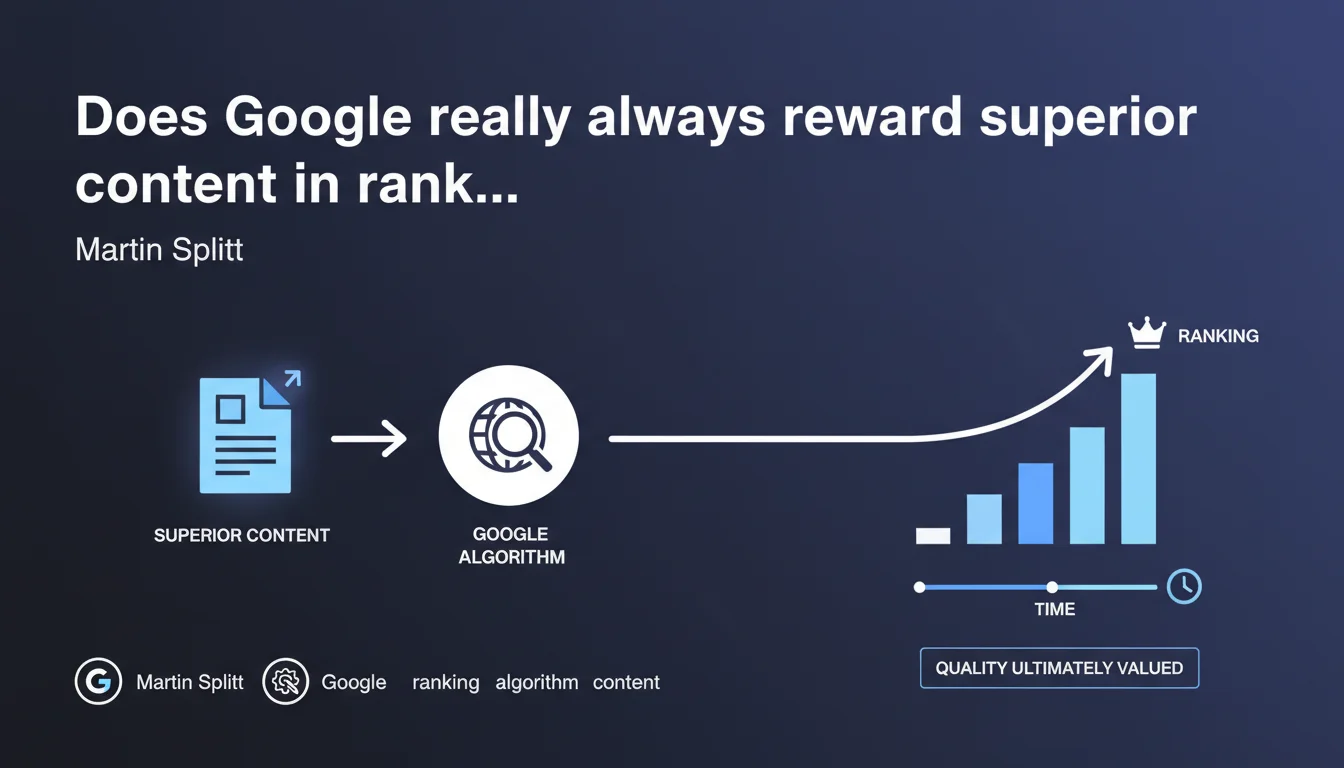
Google claims that genuinely superior content always ends up being recognized and rewarded in rankings, even if the process takes time. This statement implies that patience is a SEO virtue and that the race for technical optimizations comes after the intrinsic quality of content.
What you need to understand
What does Google mean by "genuinely better" content?
Google refers to content that is objectively superior to everything already existing on a given topic. In practical terms, this means more comprehensive, better researched, more useful to the end user. Not just "different" or "equivalent," but genuinely above the competition.
The problem? Google never defines the precise criteria for this superiority. Depth of coverage, data freshness, user experience, author authority—all of this probably plays a role, but the weightings remain opaque.
Why does Google say this process takes "time"?
The algorithm doesn't react instantly. Quality signals need to accumulate: time on page, bounce rate, social shares, natural backlinks. These metrics don't build overnight.
Google also suggests that its system goes through successive evaluation phases. New content is first tested on low-competition queries, then gradually exposed if performance is good. This ramp-up is gradual—and not guaranteed.
Does this mean technical optimizations matter less?
No. That would be an oversimplification of Splitt's statement. Google isn't saying technique doesn't matter; it's saying that quality ultimately takes priority in the long run. That's a nuance.
In reality, exceptional content that is poorly crawled or technically handicapped will never break through. Quality is a necessary condition but not sufficient. Technical foundations remain essential for the algorithm to be able to recognize that quality.
- Google values content that is superior to existing competition, not just "good"
- The recognition process can take weeks, even months
- Quality signals must accumulate gradually (engagement, backlinks)
- Technique remains a prerequisite—without it, even the best content remains invisible
- No precise quantitative criteria are given by Google to measure this "quality"
SEO Expert opinion
Is this statement consistent with real-world observations?
Yes and no. On low-competition niches, we do observe that truly solid content eventually climbs naturally. But on ultra-competitive verticals (finance, health, real estate), the reality is far harsher.
In these sectors, "better" content without domain authority, without high-quality backlinks, and without advanced optimizations simply never takes off. Quality alone isn't enough. [To verify]: how long do you really need to wait? Google remains vague on this point, and real-world feedback ranges from a few weeks to several quarters.
What nuances should be added to this claim?
Splitt talks about "eventual" recognition, which is a non-guarantee. "Will eventually" doesn't mean "systematically" or "within a predictable timeframe." It's a classic rhetorical escape hatch from Google.
Furthermore, the definition of "better than anything else out there" is subjective. Who judges? The algorithm, certainly, but based on what exact signals? Google never says precisely. Content can be objectively more comprehensive but lose to a competitor better optimized for actual search intent.
In what cases does this rule not apply?
On commercial queries with high financial stakes, Google often favors established sites, even if their content is weaker. Domain trust, age, E-E-A-T signals carry heavy weight—sometimes more than raw content quality.
Similarly, on YMYL (Your Money Your Life) topics, Google prioritizes institutional or recognized sources. An excellent health article on a personal blog will struggle to dethrone WebMD or a certified medical site, regardless of its intrinsic quality.
Practical impact and recommendations
What should you do concretely to accelerate this recognition?
Don't rely solely on patience. Create quality content, yes, but also activate the signals that allow Google to recognize it quickly. This involves link building, active promotion, and user engagement optimization.
Work on distribution: social media, newsletters, specialized forums. The more your content generates real usage signals quickly, the more data Google will have to evaluate its relevance. The algorithm doesn't work in a vacuum—it needs proof.
What mistakes should you avoid regarding this statement?
Don't fall into the "publish and pray" trap. Publishing excellent content and passively waiting for Google to discover it is a losing strategy. Quality doesn't stand alone, especially in the first months.
Also avoid neglecting technical fundamentals under the assumption that "quality ultimately wins." If your crawl budget is poorly managed, if your Core Web Vitals are mediocre, if your internal structure is chaotic, even the best content will be handicapped.
- Produce content that is objectively superior to competitors (depth, data, usefulness)
- Optimize distribution from day one of publication (social, newsletters, partnerships)
- Activate link building to accelerate authority recognition
- Monitor engagement metrics (time on page, bounce rate, shares)
- Don't neglect technical optimizations (crawlability, speed, structure)
- Track rankings regularly but don't panic if growth is slow
- Refresh content periodically to maintain relevance
❓ Frequently Asked Questions
Combien de temps faut-il attendre avant que Google reconnaisse un contenu de qualité ?
La qualité du contenu suffit-elle à garantir un bon classement ?
Comment Google mesure-t-il qu'un contenu est « meilleur que tout ce qui existe » ?
Cette règle s'applique-t-elle sur les requêtes YMYL ?
Faut-il attendre passivement que Google reconnaisse la qualité de mon contenu ?
🎥 From the same video 9
Other SEO insights extracted from this same Google Search Central video · published on 09/02/2022
🎥 Watch the full video on YouTube →
💬 Comments (0)
Be the first to comment.