
Official statement
Other statements from this video 9 ▾
- □ Why doesn't a well-designed website generate any traffic without a discoverability strategy?
- □ Does Google Really Index Modern JavaScript Properly? Here's What You Need to Know
- □ Is Shadow DOM really holding back your multi-search engine visibility?
- □ Are SEO technical fundamentals really as critical as everyone claims they are?
- □ Is your technical SEO slowly degrading without ongoing maintenance?
- □ Does Google really penalize you for breaking heading hierarchy, and why does it matter?
- □ Does Google really believe SEO and accessibility are one and the same thing?
- □ Does Google really always reward superior content in rankings eventually?
- □ Are Core Updates secretly ruining your SEO test results?
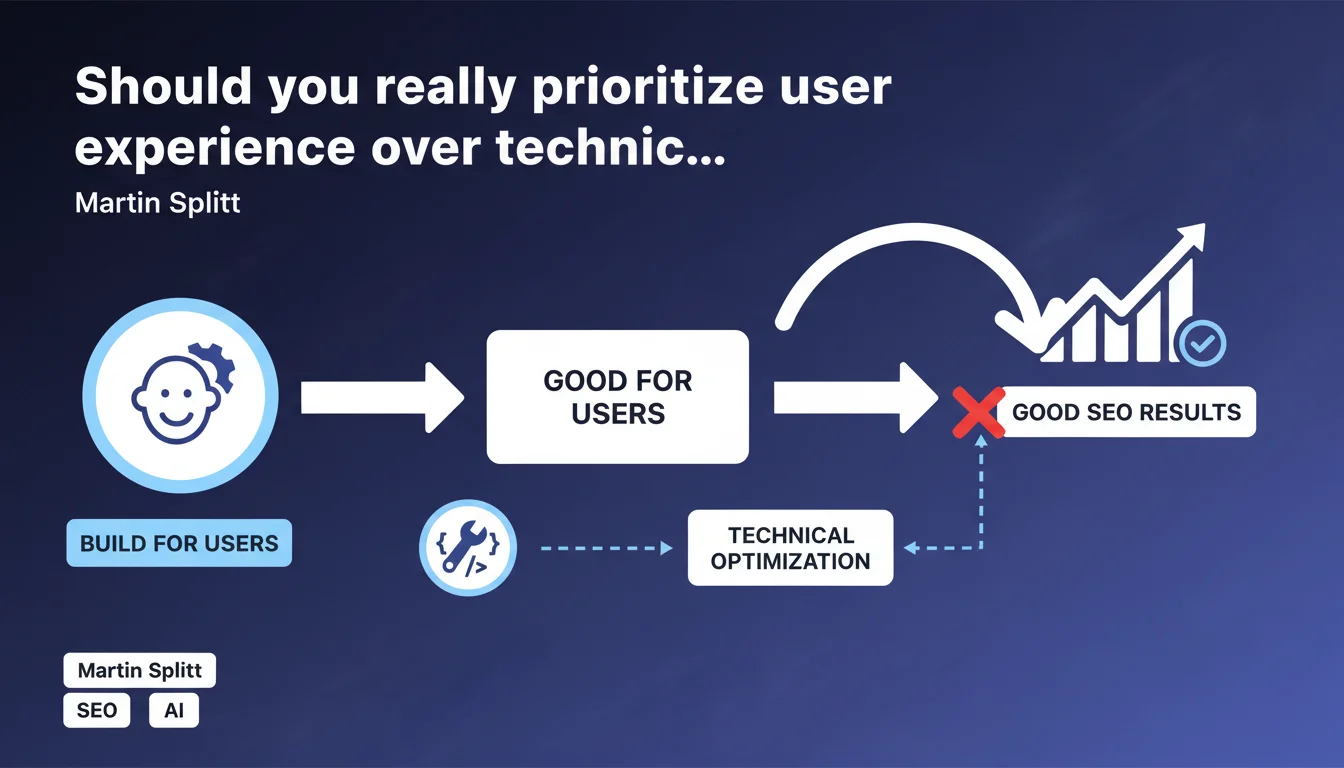
Google claims that building for users rather than for machines naturally leads to good SEO results. A statement that advocates for a user experience-centered approach, while acknowledging the existence of technical aspects to optimize. The message: UX before algorithm.
What you need to understand
Does this statement challenge technical SEO optimization?
Not at all. Martin Splitt explicitly acknowledges the existence of technical aspects to optimize. What he's saying is that strategic priority should go to the user.
Concretely — and this is crucial — it's not about ignoring title tags, heading structure, or internal linking. It's about not sacrificing user experience on the altar of micro-algorithmic optimizations.
What does "building for users" really mean in SEO?
The formula is deliberately vague. Google is talking here about search intent, content quality, ease of navigation. In short, everything that makes a visitor quickly find what they're looking for and remain satisfied.
In practice, this translates into concrete choices: preferring structured and readable content to keyword stuffing, prioritizing actual loading speed rather than simple Lighthouse scores, designing a site architecture that is logical for humans before being optimal for crawlers.
Is Google really playing by these rules?
This is where it gets complicated. Yes, Google values sites offering a good user experience — Core Web Vitals are proof of this. But the algorithm remains a machine that analyzes technical signals.
The problem: a site perfect for users but technically flawed (blocked crawl, missing tags, flat structure) will never rank. The reverse exists too, but increasingly rarely. Google is pushing toward a convergence between technique and UX, not a binary choice.
- Strategic priority: users first, but without neglecting technical optimization
- Technical aspects remain essential for enabling Google to understand and index content
- UX/SEO convergence: speed, mobile-first, accessibility benefit both
- Search intent: understanding what the user really seeks beats mechanical optimization
SEO Expert opinion
Is Google's position consistent with practices observed in the field?
Yes and no. On typical informational or commercial queries, we indeed observe that sites offering the best user experience — comprehensive content, clear navigation, reduced load time — tend to rank better.
But on highly competitive queries, reality is more nuanced. Technically sound sites with a strong backlink profile regularly outperform more "user-friendly" content that's less optimized. Splitt's statement works mainly when other factors (authority, semantic relevance) are at comparable levels.
What nuances should be added to this claim?
First, "what's good for users" remains a subjective and vague notion. A 3,000-word long-form piece can be excellent for some, unpalatable for others. Google itself struggles to objectively evaluate user experience — hence its dependence on indirect signals (bounce rate, session duration, repeated clicks).
Second, some technical aspects have no direct link to user experience yet remain critical: crawl budget on large sites, URL parameter management, fine-grained robots.txt control. Neglecting these "user-first" points is a mistake.
Finally — let's be honest — many of Google's "user-first" decisions are debatable. Featured snippets that cannibalize organic traffic, the proliferation of SERP features at the expense of the traditional 10 blue links, local results that overshadow national sites... hard to believe the user is always the absolute priority.
In which cases doesn't this rule fully apply?
On sites with very high page volume (e-commerce, classifieds, aggregators), technical optimization takes the lead. Selective indexing, consolidation of similar pages, crawl budget optimization become major levers — and it doesn't matter if UX is perfect if Google only indexes 30% of the site.
Same goes for international or multilingual sites: managing hreflang tags, URL structure, server geolocation... all complex technical points that have nothing to do with user experience but condition SEO success.
Practical impact and recommendations
What should you do concretely to align technical SEO with user experience?
Start by auditing search intent behind your target keywords. Is a visitor looking for a definition, comparison, tutorial, or product? Adapt your page structure accordingly — avoid generic content that tries to cover everything.
Next, optimize perceived speed as much as actual speed. A page skeleton that displays instantly, even if full content takes 2 seconds to load, improves the experience. Lazy loading, critical CSS, above-the-fold prioritization: these techniques serve both users and SEO.
Finally, test your pages with real users, not just tools. Heatmaps, session recordings, A/B tests reveal friction invisible in technical metrics. A high bounce rate on a fast, well-structured page signals an underlying issue — often a mismatch between promise (title/meta) and actual content.
What mistakes should you avoid to not fall into the over-optimization trap?
Stop keyword stuffing your content at the expense of readability. Text that reads poorly to place an exact keyword variant drives users away — and Google detects this through behavioral signals.
Don't sacrifice navigation clarity to create artificial internal linking. Over-optimized anchors, forced contextual links in every paragraph, invasive "related articles" blocks... all degrade UX without delivering measurable SEO gain.
Also beware of intrusive pop-ups, advertising interstitials, layouts that shift during loading (CLS). Google has penalized these practices for years, yet many sites continue — often for short-term business reasons.
How can you verify your site respects this UX/SEO balance?
- Analyze Core Web Vitals under real conditions (not just lab) via Search Console
- Compare bounce rate and session duration between similar pages to identify problematic content
- Conduct user testing (even informal) to validate that navigation is intuitive
- Verify that technical tags (title, meta, Hn, schema) accurately reflect actual page content
- Audit internal linking to ensure it logically guides users (not just crawlers)
- Check that calls to action are visible and relevant without being aggressive
- Measure accessibility (contrast, text size, keyboard navigation) that benefits all users
❓ Frequently Asked Questions
Faut-il ignorer les optimisations techniques si on se concentre sur l'utilisateur ?
Comment Google mesure-t-il concrètement qu'un site est « bon pour les utilisateurs » ?
Un site rapide avec un mauvais contenu peut-il bien ranker grâce aux Core Web Vitals ?
Cette approche s'applique-t-elle de la même façon aux sites e-commerce et aux blogs ?
Le maillage interne agressif est-il incompatible avec une approche centrée utilisateur ?
🎥 From the same video 9
Other SEO insights extracted from this same Google Search Central video · published on 09/02/2022
🎥 Watch the full video on YouTube →
💬 Comments (0)
Be the first to comment.