
Official statement
Other statements from this video 9 ▾
- □ Why doesn't a well-designed website generate any traffic without a discoverability strategy?
- □ Does Google Really Index Modern JavaScript Properly? Here's What You Need to Know
- □ Is Shadow DOM really holding back your multi-search engine visibility?
- □ Are SEO technical fundamentals really as critical as everyone claims they are?
- □ Does Google really penalize you for breaking heading hierarchy, and why does it matter?
- □ Does Google really believe SEO and accessibility are one and the same thing?
- □ Does Google really always reward superior content in rankings eventually?
- □ Are Core Updates secretly ruining your SEO test results?
- □ Should you really prioritize user experience over technical SEO optimization?
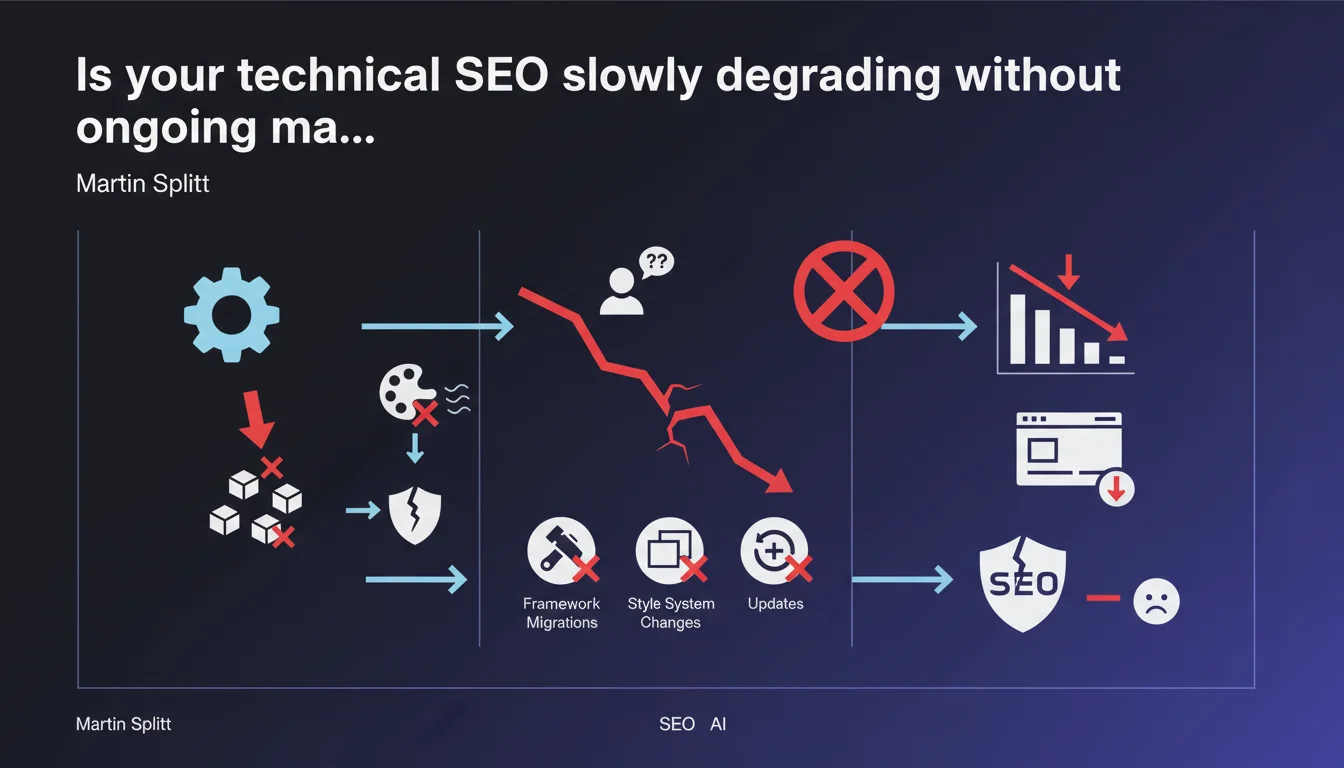
Martin Splitt confirms that technical SEO naturally deteriorates over time if left unattended. Framework migrations, style system changes, or updates can break SEO configurations if developers don't understand their importance. In practical terms: without active monitoring and maintenance, your site gradually loses its SEO gains.
What you need to understand
Is technical SEO really as fragile as people think?
Yes, and Splitt's statement confirms what many observe in the field. Technical SEO is not a stable state — it's a dynamic balance that breaks as soon as you stop paying attention to it.
Code modifications, even minor ones, can have cascading repercussions. A developer optimizing CSS without understanding the importance of lazy loading can break image indexation. A poorly anticipated migration from React to Next.js can transform a perfectly crawlable site into a JavaScript rendering nightmare.
What are the main friction points between development and SEO?
The central problem? Developers aren't trained in SEO, and SEOs aren't always up to date on technical evolutions. This asymmetry creates blind spots.
When a dev updates a framework or changes a templating system, they think about "performance" or "maintainability." Rarely about "crawlability" or "semantic structure." Result: canonical tags that disappear, redirects that multiply, outdated sitemaps pointing to dead URLs.
Why does Google insist so much on this point?
Because Google sees thousands of sites that suddenly lose traffic after a technical redesign. And often, nobody understands why for several weeks.
Splitt points to a blind spot: if developers don't understand the importance of SEO configurations, they won't preserve them. It's that simple. Not malice, just ignorance — and SEO pays the price.
- Technical SEO naturally degrades without active maintenance
- Technical migrations are critical moments when SEO can break silently
- Developer training in SEO is an investment, not a luxury
- Continuous technical monitoring is essential to anticipate regressions
- Automated SEO tests should be part of your deployment pipeline
SEO Expert opinion
Is this statement consistent with real-world observations?
Completely. I've seen too many sites lose 30-40% of organic traffic after a "technical" migration that seemed harmless. A CDN change, asset reorganization, a switch to HTTP/2 — each modification can have side effects.
Let's be honest: most web agencies don't test SEO impact before pushing to production. They verify the site displays correctly, forms work, checkout functions. But nobody runs a Screaming Frog crawl to verify that structures haven't shifted.
What nuances should we add to this statement?
Splitt talks about "natural degradation," but that's not quite right. The problem isn't that SEO "rots" on its own — it's that tech teams modify the site without understanding the SEO impact.
And that's where it gets tricky. Saying "developers don't understand" is a bit easy. The real question: who explained it to them? Who documented critical configurations? Who set up automatic alerts when a canonical tag disappears?
In what cases doesn't this rule apply?
If you have an ultra-simple static site with few modifications, "degradation" will be very slow. But as soon as there's dynamism — e-commerce, content platform, SaaS — maintenance becomes critical.
[To verify] Splitt doesn't provide concrete figures on degradation speed. Are we talking days, weeks, months? Hard to say without data. But empirically: the more complex the site, the faster the degradation.
Practical impact and recommendations
What should you do concretely to prevent this degradation?
First, document critical SEO configurations. Not in a Google Doc nobody reads, but in the code itself — comments, README, documentation integrated into the repo.
Then, integrate SEO into the development pipeline. That means: automated tests that verify canonical tags, redirects, sitemaps. If a deployment breaks an SEO config, the build should fail. Period.
What mistakes should you absolutely avoid?
Never assume "it will be fine on its own." Each technical migration, each major update must include an SEO validation phase. Not after — before deployment.
Also avoid leaving technical SEO solely to developers. They have other priorities. You need a technical SEO lead who closely follows each change and can intervene quickly if something goes wrong.
How can you verify your site resists technical changes?
Set up automated SEO monitoring that regularly crawls your site and compares results. Tools like OnCrawl, Botify, or even a simple Python script can alert you if critical elements disappear.
And most importantly: train your developers. They don't need to become SEO experts, but they should understand the basics — canonical tags, redirects, JavaScript rendering, structured data. That prevents 80% of disasters.
- Document all critical SEO configurations in code and technical documentation
- Integrate automated SEO tests into your deployment pipeline (CI/CD)
- Set up continuous monitoring that alerts on any regression
- Train developers on the fundamentals of technical SEO
- Create an SEO validation process before each migration or major update
- Maintain a detailed changelog of technical modifications and their potential SEO impact
- Regularly audit the site with professional crawl tools
❓ Frequently Asked Questions
À quelle fréquence faut-il auditer le SEO technique d'un site ?
Quels sont les éléments SEO qui se dégradent le plus souvent lors de migrations techniques ?
Comment convaincre une équipe de développement de prioriser le SEO technique ?
Les frameworks JavaScript modernes sont-ils vraiment un problème pour le SEO ?
Peut-on automatiser complètement la maintenance SEO technique ?
🎥 From the same video 9
Other SEO insights extracted from this same Google Search Central video · published on 09/02/2022
🎥 Watch the full video on YouTube →
💬 Comments (0)
Be the first to comment.