
Official statement
What you need to understand
Google's disavow links tool is the subject of many misconceptions in the SEO community. Contrary to what some third-party tools suggest, it is not a regular maintenance tool.
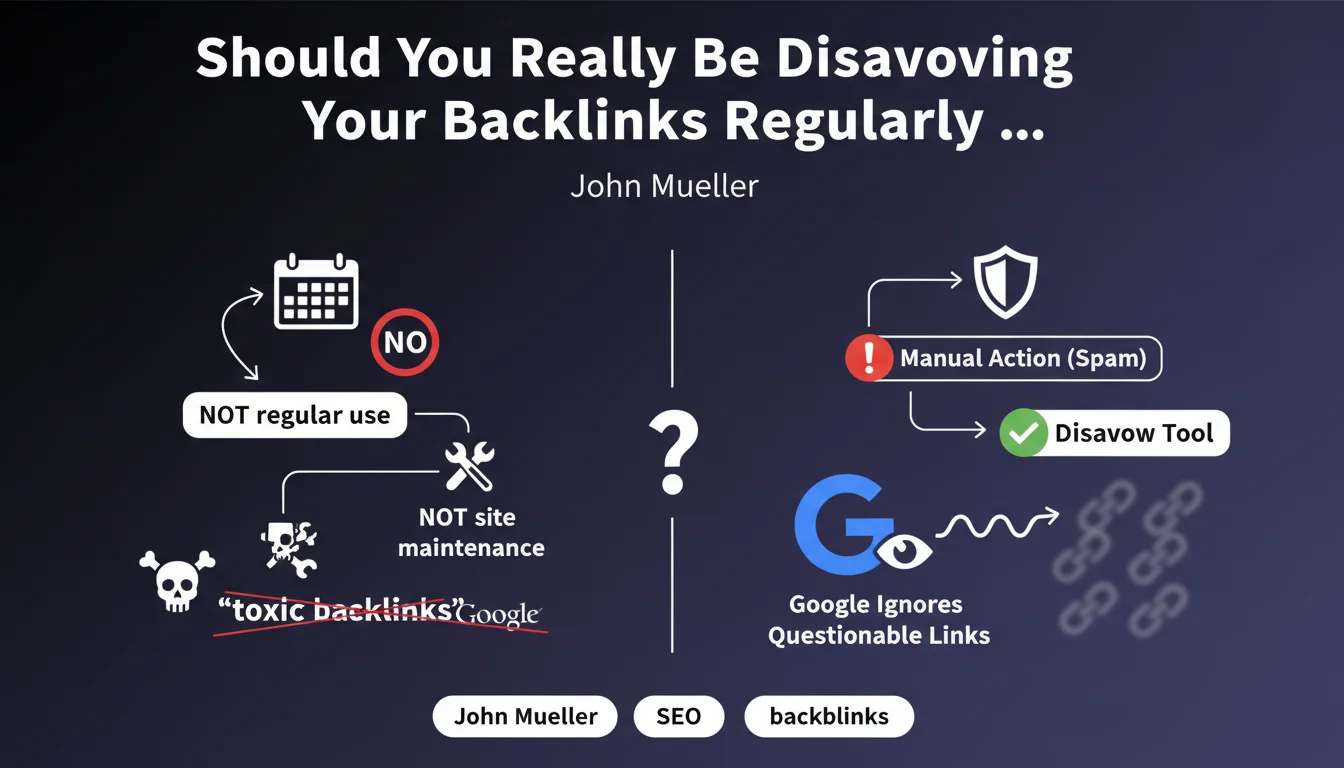
John Mueller clarified Google's official position at an event in New York: disavowing is not a common practice and should only occur in exceptional situations. Google has automatic mechanisms sophisticated enough to ignore poor-quality links without manual intervention.
The concept of "toxic backlinks" so heavily promoted by certain SEO tools does not exist in Google's vocabulary. This marketing term creates unnecessary anxiety among SEOs and site owners.
- The disavow tool is not a regular SEO maintenance tool
- Google automatically ignores questionable links in the majority of cases
- "Toxic backlinks" are a concept invented by third-party tools, not by Google
- Disavowing is only justified in case of manual action for link spam
- The main use case concerns sites that have massively purchased links in the past
SEO Expert opinion
This statement perfectly aligns with what I've been observing for several years on the sites I audit. Google's algorithms have become extremely proficient at detecting and neutralizing artificial links without penalizing the target site.
I've supported numerous clients panicked by SEO tool reports indicating hundreds of "toxic links." In 99% of cases, no disavow action was necessary, and the sites were performing very well. The SEO tools industry has partly created an artificial problem to sell solutions.
However, there are two legitimate use cases for disavowing: first, when you have received a manual action from Google explicitly related to artificial links; second, if you have taken over a site with a documented history of massive link purchasing and you want to proactively clean it up. In all other cases, disavowing is not only unnecessary, but potentially counterproductive.
Practical impact and recommendations
This clarification from Google should change your approach to link building and managing your link profile. Here are the concrete actions to implement.
- Immediately stop any regular disavowing routine if you had one
- Don't rely on third-party tools' "toxicity" scores to make disavow decisions
- Focus your efforts on acquiring natural, quality links rather than on cleaning
- Check your Search Console: only use disavow if you have received a manual action concerning links
- Delete or reduce your existing disavow file if it contains links added "as a precaution"
- Reallocate the time spent on disavowing toward creating linkable content and quality outreach
- Document your site's history: disavowing remains relevant if you have a proven past of link purchasing
- Train your teams on this official position to avoid unnecessary practices
💬 Comments (0)
Be the first to comment.