
Official statement
Other statements from this video 9 ▾
- □ Does Google Really Index Modern JavaScript Properly? Here's What You Need to Know
- □ Is Shadow DOM really holding back your multi-search engine visibility?
- □ Are SEO technical fundamentals really as critical as everyone claims they are?
- □ Is your technical SEO slowly degrading without ongoing maintenance?
- □ Does Google really penalize you for breaking heading hierarchy, and why does it matter?
- □ Does Google really believe SEO and accessibility are one and the same thing?
- □ Does Google really always reward superior content in rankings eventually?
- □ Are Core Updates secretly ruining your SEO test results?
- □ Should you really prioritize user experience over technical SEO optimization?
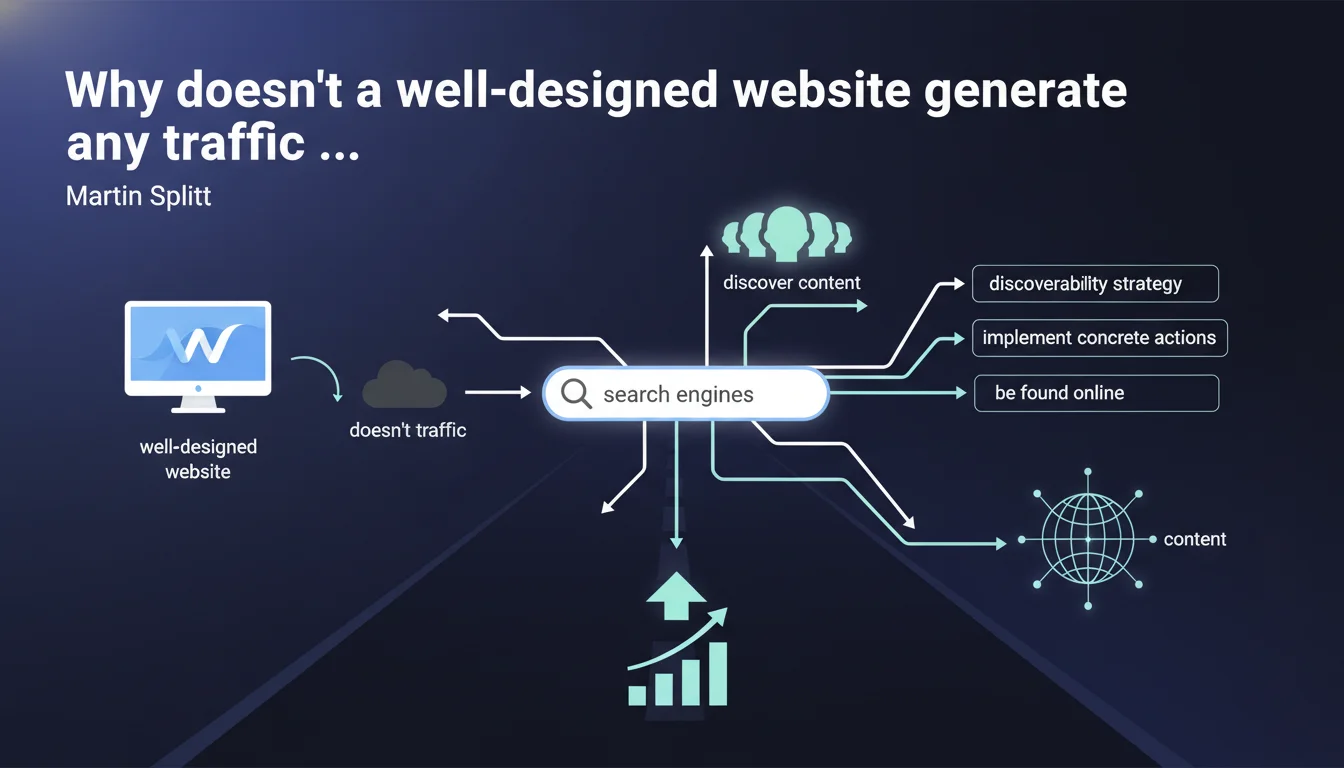
Putting a website online is not enough to generate traffic. Google reminds us of an obvious truth that many forget: without an active discoverability strategy (search engines, links, signals), users won't find your content. It's a statement that opens many doors, but it raises the question of what Google really considers an « effective » strategy.
What you need to understand
What exactly does Google say in this statement?
Martin Splitt makes a simple observation: a website does not generate traffic automatically. No magical crawling, no spontaneous visitors who guess your URL. You need to implement concrete actions to be found.
Search engines are presented as « the primary intuitive means of discovering content online ». Translation: if you don't work on your visibility in Google, you don't exist for the vast majority of users.
Why does Google remind us of this obvious principle?
Because many website owners still think that publishing content is enough to be found. They neglect the critical phase: making that content discoverable.
This statement is probably intended to reset expectations. Google won't promote your site by default. You have to give it reasons to crawl, index, and rank your pages — and that comes down to a structured SEO strategy.
What are the discoverability levers mentioned implicitly?
Splitt doesn't go into detail, but we understand he's talking about the fundamentals: search engines, external links, quality signals. Without these elements, your site remains invisible.
The term « discoverability strategy » is vague. It encompasses SEO, but also potentially social networks, backlinks, paid campaigns. Except Google never specifies what really weighs in its algorithm.
- A website online without backlinks or quality signals will attract no organic traffic
- Search engines remain the primary discovery channel for the vast majority of users
- Google won't actively promote a site that sends it no signal of relevance or authority
- Crawling and indexation don't guarantee traffic — you need to work on ranking
SEO Expert opinion
Does this statement really bring anything new?
No. It's obvious for any SEO practitioner. Putting a website online without a strategy is like opening a shop in an alley with no sign or billboard — nobody will come.
What's interesting is that Google deems it necessary to remind us. It reflects a persistent gap between public expectations and the reality of how search engines work. Many still believe in the « build it and they will come » myth.
What doesn't Google say in this statement?
Splitt remains vague on what constitutes an « effective discoverability strategy ». He mentions search engines, but doesn't detail the concrete levers: backlinks, technical structure, optimized content, domain authority. [To verify]: does Google expect only on-page SEO, or do you also need external signals to trigger regular crawling?
In the field, we observe that some well-structured sites but without quality backlinks struggle to rank, even if their content is relevant. Google will never say it outright, but external authority remains a determining factor for initial discoverability.
In what cases does this rule not fully apply?
If you already have an established domain with strong authority, publishing a new page can generate traffic quickly — Google will crawl and index faster. But for a new or weak site, without external signals, the wait can be long.
Practical impact and recommendations
What do you need to do concretely to ensure your site's discoverability?
First, work on technical fundamentals: XML sitemap submitted in Search Console, robots.txt correctly configured, coherent internal link structure. Without this, even Google can miss pages.
Then, get quality backlinks. This is the strongest signal to tell Google that your content deserves to be crawled and indexed. Without external links, your site remains in the void.
What mistakes should you avoid after this statement?
Don't think that publishing content is enough. Many sites stagnate because they passively wait for Google to discover them. Discoverability is active work, not an automatic process.
Another trap: neglecting quality signals. Google won't promote a site it deems unreliable or irrelevant. Work on E-E-A-T, thematic consistency, content depth.
How can you verify that your site is well positioned to be discovered?
- Check that your priority pages are indexed in Search Console
- Analyze your backlinks: do you have quality external links pointing to your key content?
- Control Googlebot's crawl frequency — regular crawling indicates that Google deems your site relevant
- Test your internal link structure: are all your strategic pages accessible in 3 clicks from the homepage?
- Assess your E-E-A-T signals: do you have identified authors, cited sources, demonstrated expertise?
- Track your rankings for your target queries — if you're not ranking, it means your discoverability is insufficient
In summary: a site without a discoverability strategy remains invisible. Work on your technical fundamentals, get backlinks, optimize your content for target queries, and send quality signals to Google.
These optimizations require specialized expertise and constant monitoring. If you lack time or internal resources, calling on a specialized SEO agency can help you structure an effective discoverability strategy and allow your teams to focus on your core business.
❓ Frequently Asked Questions
Un site peut-il générer du trafic sans backlinks ?
Combien de temps faut-il pour qu'un nouveau site génère du trafic ?
Google crawle-t-il automatiquement tous les nouveaux sites ?
La Search Console suffit-elle à assurer la découvrabilité d'un site ?
Les réseaux sociaux aident-ils à la découvrabilité d'un site ?
🎥 From the same video 9
Other SEO insights extracted from this same Google Search Central video · published on 09/02/2022
🎥 Watch the full video on YouTube →
💬 Comments (0)
Be the first to comment.