
Official statement
Other statements from this video 8 ▾
- □ What Really Happens to Your Site When Google Hits You with a Manual Action?
- □ Can a website outage really destroy your traffic from every single source—not just Google?
- □ Does an unintentional noindex tag really cause gradual traffic loss instead of an immediate crash?
- □ Why should you analyze 16 months of Search Console data when your traffic drops?
- □ How can you accurately analyze an SEO traffic drop without misdiagnosing the real cause?
- □ Should you really analyze every Search Console tab to diagnose a traffic drop?
- □ Are you losing thousands of organic visitors without even realizing it? Here's why your SEO analysis might be dangerously incomplete.
- □ Why does Google add annotations to Search Console and how should you interpret them?
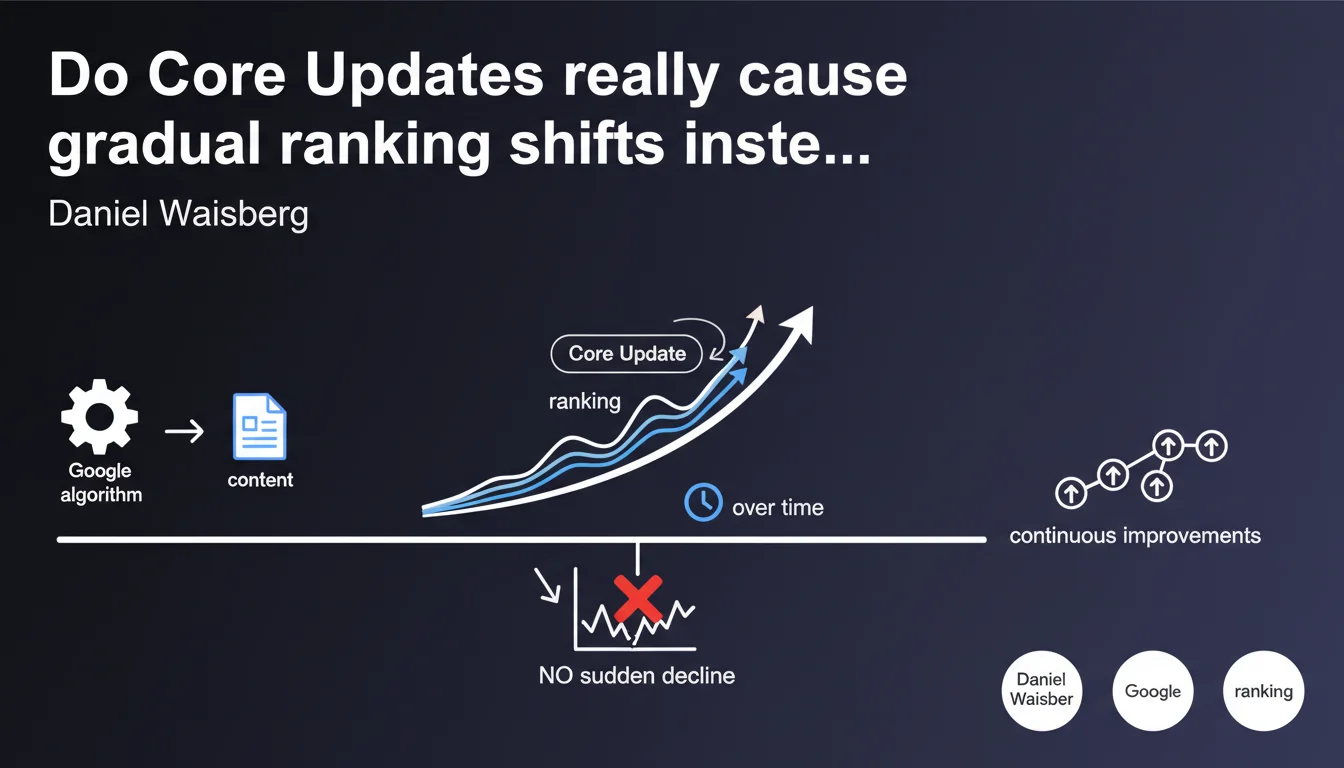
Google claims that Core Updates modify performance gradually, without sudden decline. This view contrasts with real-world experience where some sites suffer massive traffic losses overnight. The statement raises more questions than it answers about what constitutes a 'gradual change' according to Google.
What you need to understand
Daniel Waisberg makes a statement here that seems reassuring: Core Updates would not cause sudden ranking drops, but rather gradual adjustments. The underlying message? If your site loses traffic after an update, it's not a sudden penalty, but the outcome of a continuous reassessment of your content.
This statement comes at a time when Core Updates regularly generate panic among site publishers. Each deployment is accompanied by testimonies of sudden losses. Google is clearly trying to reframe the debate by emphasizing the notion of algorithmic continuity.
What does "gradual change" concretely mean?
Google doesn't clearly define what it means by "gradual." Is it a variation spread over several days, weeks, or months? The wording remains vague. For a site that loses 40% of its traffic in 72 hours, talking about "gradual change" seems disconnected from observed reality.
The idea defended here is that algorithms continuously refine their evaluation. A page that performs well today may be ranked lower tomorrow if competing content improves or if relevance criteria evolve. The problem is that this smooth vision doesn't always match what Analytics data shows.
Why does Google emphasize the absence of "sudden decline"?
This wording probably aims to prevent webmasters from viewing Core Updates as manual actions or penalties. Google wants to establish the idea that these updates don't punish, they rebalance. If your site loses traffic, it's not because you did something wrong, but because others did better.
Except that in practice, distinguishing a penalty from a sudden reassessment becomes a semantic exercise. For the publisher suffering the loss, the result is the same.
- Core Updates are presented as continuous adjustments, not one-time sanctions
- Google doesn't specify the duration or scope of these "gradual changes"
- The wording aims to reassure, but doesn't address field observations of sudden drops
- Continuous improvement of content evaluation means your position can fluctuate even without modifying your site
How does Google justify these permanent fluctuations?
The statement implies that the algorithm is in continuous improvement. Every day, Google refines its understanding of content, relevance, and authority. Core Updates are merely moments when these adjustments become more visible and impactful.
This vision implies that SEO is never static. A strategy that works today may become less effective tomorrow, not because it's bad, but because the quality bar rises permanently. It's a race with no finish line.
SEO Expert opinion
Is this statement consistent with field observations?
Not really. Analytics data from many sites show sharp drops during Core Updates, sometimes in the range of 30 to 60% in a few days. Calling this a "gradual change" is quite optimistic—or a very personal definition of the word "gradual."
Google may be right in some cases: some sites indeed see their positions slip slowly over several weeks. But for many others, the impact is massive and immediate. [To verify]: it would be useful if Google published aggregated data showing the actual distribution of traffic variations post-Core Update.
What nuances should be added to this smooth vision?
First point: saying that Core Updates don't cause "sudden decline" doesn't mean they don't cause significant decline. A 50% loss in one week may not be "sudden" by Google's standards, but it certainly is for a business model dependent on organic traffic.
Second nuance: progressivity may also be an effect of rollout. Core Updates don't apply instantly to the entire web. Some sites are reassessed before others, which can create the impression of a change spread over time. But at the individual level, the impact remains concentrated over a few days.
What to do with sites experiencing sudden drops despite this statement?
If your site suffers a massive loss after a Core Update, Google will probably tell you it's a relevance adjustment, not a penalty. The distinction matters on a technical level, but it doesn't change the immediate situation: you must identify what no longer works.
The causes can be multiple: content that's become outdated, insufficient E-E-A-T signals, increased competition, degraded technical structure. The difficulty is that Google never provides precise feedback. You must diagnose blindly by crossing available metrics.
Let's be honest: the wording of this statement won't help you recover your traffic. It mainly serves to frame Google's communication in response to recurring criticism about Core Update unpredictability.
Practical impact and recommendations
What specifically should you monitor after a Core Update?
Even if Google talks about gradual changes, you must monitor your KPIs from the beginning of a Core Update rollout. The first 48 to 72 hours often give a clear indication of the impact on your domain.
Focus on strategic pages: those that generate the most organic traffic and conversions. If these pages lose positions, immediately analyze the SERPs to identify who's ranking ahead of you. This often reveals the criteria on which Google adjusted its evaluation.
- Compare positions before/after on your priority queries within 7 days of rollout
- Identify pages losing the most traffic and analyze their common characteristics (length, structure, authority)
- Study competitors gaining visibility: what signals strengthen their relevance?
- Check if impacted pages show obvious E-E-A-T weaknesses
- Monitor the technical health of affected pages (Core Web Vitals, indexation, internal linking)
How to adapt your content strategy to this "continuous improvement"?
If the algorithm improves permanently, your content must evolve the same way. Publishing a page and leaving it stagnant for years becomes increasingly risky. Regular updates are no longer optional—they're an integral part of a sustainable SEO strategy.
This doesn't mean modifying all your content every month on principle. But you must monitor pages losing ground and identify whether they need factual updates, deeper treatment, or complete restructuring against better-ranked competition.
- Establish a revision schedule for priority content (quarterly or semi-annual depending on the topic)
- Strengthen authority signals on strategic pages (citations, internal links, expertise proof)
- Improve depth and comprehensiveness against better-ranked competitors
- Monitor search intent evolution and adapt editorial angles
Should you react immediately or wait for the rollout to complete?
Some advocate waiting for the Core Update to fully deploy before acting, to avoid overreacting to temporary fluctuations. The argument is defensible: modifying your pages during rollout can complicate result interpretation.
But waiting several weeks can also cost you significantly in traffic and revenue. The right approach depends on your risk tolerance and the scale of the observed loss. If the impact is massive from day one, immediate analysis is necessary.
❓ Frequently Asked Questions
Les Core Updates sont-elles vraiment progressives ou peuvent-elles provoquer des chutes brutales ?
Combien de temps faut-il pour mesurer l'impact réel d'une Core Update sur mon site ?
Si mon site perd du trafic après une Core Update, est-ce une pénalité ?
Dois-je modifier mon contenu immédiatement après une perte de trafic liée à une Core Update ?
Comment savoir si mes pages ont perdu en pertinence aux yeux de Google ?
🎥 From the same video 8
Other SEO insights extracted from this same Google Search Central video · published on 29/03/2023
🎥 Watch the full video on YouTube →
💬 Comments (0)
Be the first to comment.