
Official statement
Other statements from this video 8 ▾
- □ Can a website outage really destroy your traffic from every single source—not just Google?
- □ Does an unintentional noindex tag really cause gradual traffic loss instead of an immediate crash?
- □ Do Core Updates really cause gradual ranking shifts instead of sudden traffic crashes?
- □ Why should you analyze 16 months of Search Console data when your traffic drops?
- □ How can you accurately analyze an SEO traffic drop without misdiagnosing the real cause?
- □ Should you really analyze every Search Console tab to diagnose a traffic drop?
- □ Are you losing thousands of organic visitors without even realizing it? Here's why your SEO analysis might be dangerously incomplete.
- □ Why does Google add annotations to Search Console and how should you interpret them?
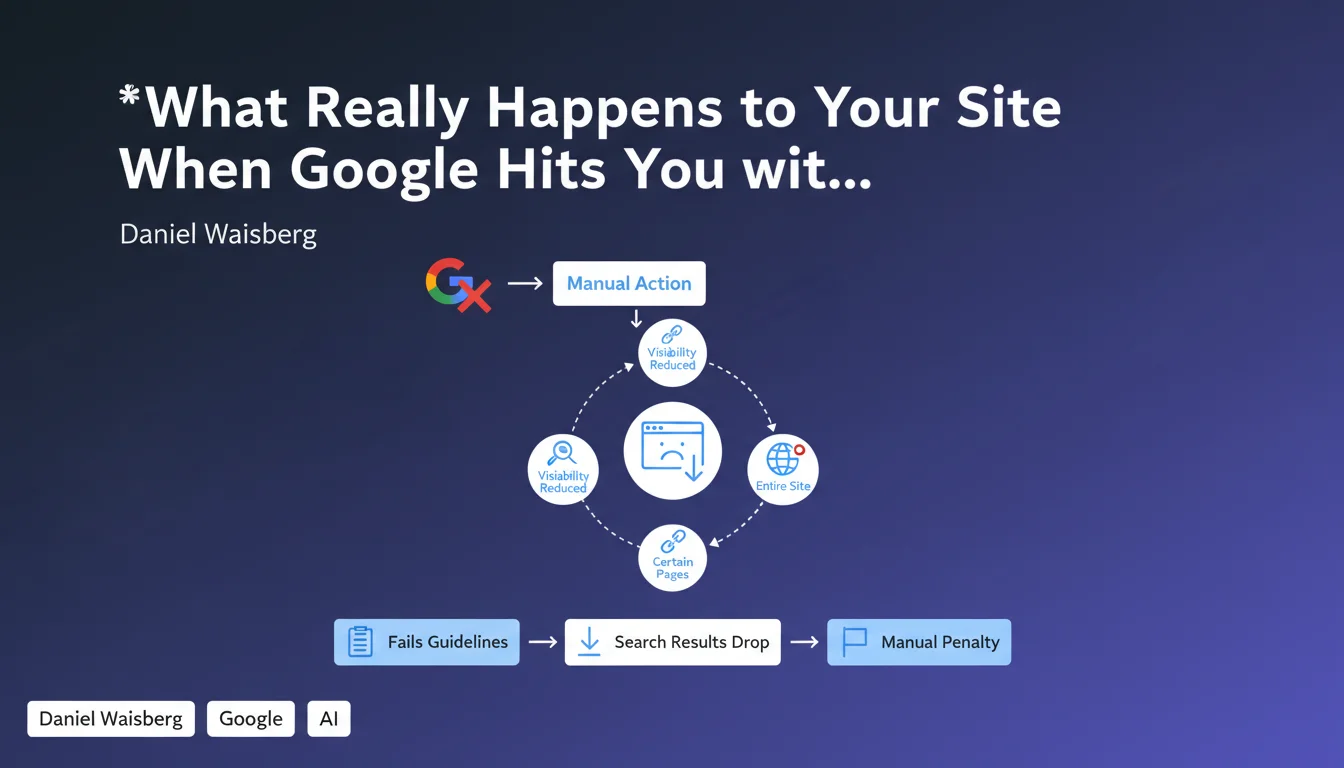
Google applies manual actions when a site violates its guidelines. Direct consequence: reduced visibility in search results, whether targeting specific pages or the entire domain. Daniel Waisberg reminds us that these penalties don't come out of nowhere — they result from human review that detects practices contrary to the rules.
What you need to understand
Manual actions represent one of the most feared penalties in SEO. Unlike algorithmic filters that operate automatically, they mean that a member of Google's quality team has reviewed your site and found violations.
Waisberg's statement remains deliberately restrained, but it confirms two levels of sanction: targeted (specific pages) or global (entire site).
What's the Difference Between a Manual Action and an Algorithmic Penalty?
A manual action requires human intervention. A Google evaluator spots an infraction — spam, artificial links, stolen content — and applies a sanction notified in Search Console.
Conversely, an algorithmic penalty triggers automatically through systems like Penguin or core updates. No notification appears in Search Console, and consequences manifest as often-sudden ranking drops.
Which Types of Sites Get Hit with Manual Actions?
Technically, any site can be subject to manual review. The most frequent triggers: manipulated backlinks, thin content at scale, automatically generated spam, cloaking, or deceptive redirects.
Sites experiencing unusual, rapid traffic growth also attract attention. A suspicious spike on certain commercial queries can trigger human review, even if practices initially appear legitimate.
- Manual actions require human review, unlike algorithmic filters
- Two levels of sanction: partial (specific pages) or global (entire domain)
- Systematic notification via Google Search Console with details on the nature of the violation
- Ability to submit a reconsideration request after fixing identified issues
- Most common reasons: artificial links, duplicate content, spam, cloaking
SEO Expert opinion
Does This Statement Reflect What Actually Happens?
Yes, broadly speaking. Manual actions do fall when Google detects flagrant violations. Except Waisberg omits one crucial point: consistency of enforcement.
In the field, we observe situations where two sites with similar practices receive different treatment. One gets hit with a manual action, the other stays untouched for months. [To verify]: Google claims to apply its rules uniformly, but experience shows detection remains uneven across sectors and languages.
What Does "Reduced Visibility" Actually Mean?
Google's phrasing stays deliberately vague. "Reduced visibility" can range from complete deindexing to a simple ranking drop on certain queries.
For a global manual action on spam, expect near-total SERP disappearance. For a targeted action on artificial links, impact varies: affected pages may drop 20-30 positions, while the rest of the site maintains rankings. Severity depends on infraction type and scale.
Does the Reconsideration Process Actually Work?
Yes, but with important caveats. If you genuinely fix the identified issues and document your actions in the reconsideration request, Google typically lifts the penalty.
The catch? Google teams often respond with standardized messages that don't explain precisely what's still wrong. It sometimes takes three or four requests before obtaining full lifting, even when corrections seem comprehensive. [To verify]: Google claims each request receives individual review, but some rejections appear automated.
Practical impact and recommendations
What Should You Do Upon Receiving a Manual Action Notice?
First step: precisely identify the nature of the violation. Google Search Console indicates the action type and often provides examples of problematic URLs or links. Don't overlook these clues — they directly guide your corrections.
Next, audit all affected pages or sections comprehensively. If the action involves artificial links, export your complete backlink profile (Search Console + third-party tools). For thin content, list all pages weak in volume and added value.
What Mistakes Should You Avoid During Correction?
Classic mistake: removing only a few visible links or pages without addressing the root cause. If you bought 500 backlinks and only disavow 50, Google will reject your reconsideration request.
Another trap: submitting a reconsideration request without genuinely fixing the problems. The manual review teams aren't fooled. A vague message like "we cleaned up the site" without precise documentation results in near-certain rejection.
Finally, don't spam multiple requests without making substantial changes between attempts. This slows processing and can irritate evaluators.
How Do You Document Your Reconsideration Request Effectively?
Be factual and transparent. List actions taken: deleted URLs, disavowed links (with .txt file attached), rewritten content. Use tables, before/after screenshots if relevant.
Explain the approach without unnecessary jargon or corporate speak. Google wants assurance you've understood the violation and taken steps to avoid recurrence. A clear commitment to future processes strengthens your credibility.
- Immediately check Google Search Console to identify the action type and provided examples
- Perform a comprehensive audit of implicated sections or links — don't limit yourself to examples
- For artificial links: export your profile, identify all suspicious links, disavow them via the Disavow file
- For thin content: delete or consolidate weak pages, enrich those worth keeping
- Document each action in a summary file to attach to your reconsideration request
- Submit the request via Search Console with clear, factual explanations and no beating around the bush
- Monitor responses and adjust if needed — multiple iterations are sometimes required
Manual actions directly impact your visibility and organic traffic. Reacting quickly and methodically increases your chances of rapid lifting. The essentials: understand the violation, correct exhaustively, document precisely.
Given the complexity of certain audits — particularly with large backlink profiles or extensive content architecture — engaging a specialized SEO agency can accelerate diagnosis and secure the reconsideration process. Expert support helps identify all problem sources and avoid pitfalls that unnecessarily prolong the penalty.
❓ Frequently Asked Questions
Combien de temps faut-il pour qu'une action manuelle soit levée après correction ?
Peut-on recevoir une action manuelle même sans avoir commis de violation intentionnelle ?
Une action manuelle levée garantit-elle un retour aux positions initiales ?
Faut-il désavouer tous les liens suspects même si l'action manuelle ne porte que sur quelques exemples ?
Peut-on continuer à faire du SEO pendant qu'une action manuelle est active ?
🎥 From the same video 8
Other SEO insights extracted from this same Google Search Central video · published on 29/03/2023
🎥 Watch the full video on YouTube →
💬 Comments (0)
Be the first to comment.