
Official statement
Other statements from this video 8 ▾
- □ Does improving user experience really impact your search engine rankings?
- □ Are accordions and collapsible content still hurting your mobile SEO rankings?
- □ Do Core Web Vitals Really Affect Your Google Rankings?
- □ Is lazy loading really an easy SEO optimization to implement without risks?
- □ Does JavaScript package size really impact your SEO rankings?
- □ Should you really be using Lighthouse with feature flags to measure SEO impact before rolling out changes?
- □ Is semantic HTML really a game-changing ranking factor for SEO?
- □ Should SEO experts really be involved from the technical design phase?
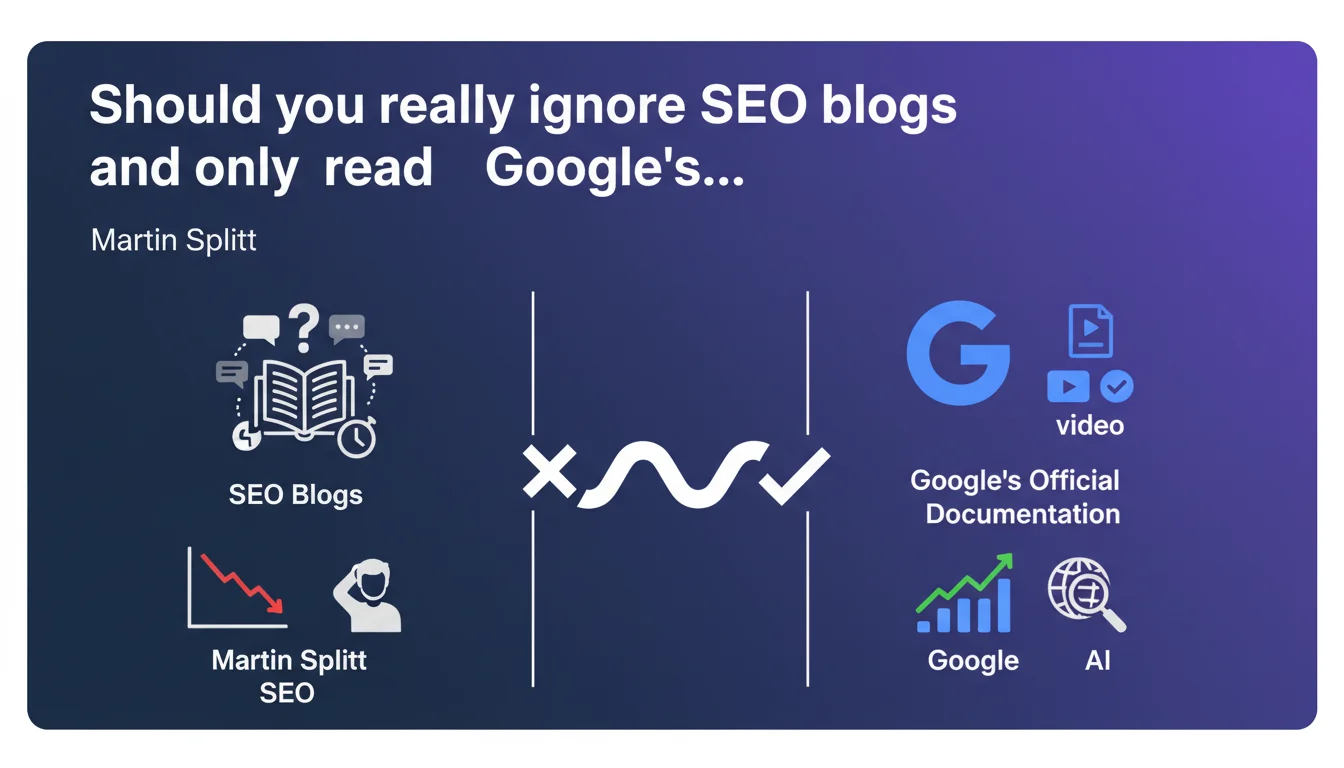
Martin Splitt recommends consulting Google's official resources directly rather than third-party sources. The argument? These sources can spread outdated or incorrect information. A position that raises questions: does Google want to completely control the narrative about its own algorithm?
What you need to understand
Why does Google insist so much on its official resources?
Google produces comprehensive technical documentation: Search Central, YouTube videos, webmaster guidelines. The stated objective is to provide first-hand information, directly validated by internal teams.
The problem raised by Splitt concerns signal degradation: once official information is picked up by third parties, it can be truncated, misinterpreted, or simply become outdated without updates. Advice that was valid in 2018 can be counterproductive today.
Which third-party sources are in the crosshairs?
The statement names no one — but clearly targets SEO blogs, forums, advice aggregators. Some sites relay outdated tactics (keyword stuffing, gray-hat linking techniques) without specifying their expiration date.
Others misinterpret Google statements, turning a nuance into an absolute rule. The SEO telephone game, in short.
Is this recommendation really new?
Not at all. Google has been repeating this message for years — but with increasing insistence. Why? Because the SEO ecosystem has become professionalized, and with it, the volume of contradictory information.
The underlying real question: does Google want to limit alternative interpretations of its algorithm? Official documentation rarely says everything — and sometimes, practitioners in the field observe behaviors that Google has never documented.
- Official resources: Search Central, Search Off the Record videos, Google Search Status Dashboard
- Problem: third-party sources can spread outdated or distorted information
- Risk: applying SEO tactics that backfire based on outdated advice
- Nuance: official documentation is not always complete or up-to-date
SEO Expert opinion
Is Google's documentation really exhaustive?
Let's be honest: no. Google documents the big picture, but remains deliberately vague on many mechanisms. No official documentation explains precisely how internal PageRank calculation works, the exact weight of E-E-A-T signals, or Panda penalty thresholds.
SEO practitioners fill these gaps through field experimentation — and that's where third-party sources find their value. A well-run A/B test across 500 sites often provides more insights than an evasive statement from Google. [Needs verification]: Google claims that everything essential is documented, but many ranking factors remain undocumented.
Is this statement consistent with observed practices?
Partially. Yes, some SEO blogs relay persistent myths: ideal keyword density, the magic number of backlinks, the importance of meta keywords. These sites certainly pollute the discourse.
But other sources — case studies, algorithm reverse engineering, Google patent analysis — reveal mechanisms that Google never confirms officially. Ignoring these sources would mean depriving yourself of an entire dimension of engine understanding.
In which cases does this rule not apply?
When official documentation is silent, contradictory, or deliberately vague. Example: Google long denied the existence of manual penalties before documenting them. SEO professionals who swore by official docs missed out for years.
Similarly, some algorithm updates are never officially confirmed — but their effects are measurable. In that case, third-party analysis becomes the only usable source of information.
Practical impact and recommendations
What should you do concretely?
Always start by verifying the primary source: if a blog cites a Google statement, trace it back to the original video or tweet. Too often, the initial advice is nuanced, and the repost is categorical.
Set up structured SEO monitoring: follow official Google channels (Search Central Blog, @googlesearchc on X, Office Hours), but cross-reference with reliable third-party sources — those that cite their data, tests, and samples.
What mistakes should you avoid?
Don't fall into the trap of "Google said it so it must be true". Google also communicates through omission: what isn't documented can be as important as what is. An example? Link patterns considered manipulative are never listed exhaustively.
Also avoid blindly following outdated SEO advice. If an article doesn't specify its publication or update date, be suspicious. Advice valid in 2015 can be counterproductive today.
How do you verify that your sources are reliable?
Ask yourself three questions: does the source cite its data? Does it clearly distinguish facts from interpretations? Is it regularly updated? If the answer is yes three times, you're probably holding a usable source.
For critical information, test it yourself. An SEO recommendation is only worth applying if it produces measurable results in your context. No dogma — only data.
- Prioritize Search Central, official Google videos, Office Hours
- Systematically trace back to primary sources before applying advice
- Cross-reference official documentation with documented third-party case studies
- Check the publication date of SEO articles — ignore those over 18 months old without updates
- Test on a sample before rolling out changes at scale
- Follow Google patents and information retrieval researcher analyses
- Never treat a Google statement as absolute — look for nuances
❓ Frequently Asked Questions
Peut-on se fier uniquement à la documentation officielle Google pour optimiser son SEO ?
Quelles sont les ressources officielles Google à consulter en priorité ?
Pourquoi Google insiste-t-il autant sur ses propres ressources ?
Les blogs SEO tiers sont-ils tous à éviter ?
Comment savoir si une information SEO est encore d'actualité ?
🎥 From the same video 8
Other SEO insights extracted from this same Google Search Central video · published on 09/03/2022
🎥 Watch the full video on YouTube →
💬 Comments (0)
Be the first to comment.