
Official statement
Other statements from this video 8 ▾
- □ Does improving user experience really impact your search engine rankings?
- □ Are accordions and collapsible content still hurting your mobile SEO rankings?
- □ Should you really ignore SEO blogs and only read Google's official documentation?
- □ Do Core Web Vitals Really Affect Your Google Rankings?
- □ Is lazy loading really an easy SEO optimization to implement without risks?
- □ Does JavaScript package size really impact your SEO rankings?
- □ Should you really be using Lighthouse with feature flags to measure SEO impact before rolling out changes?
- □ Should SEO experts really be involved from the technical design phase?
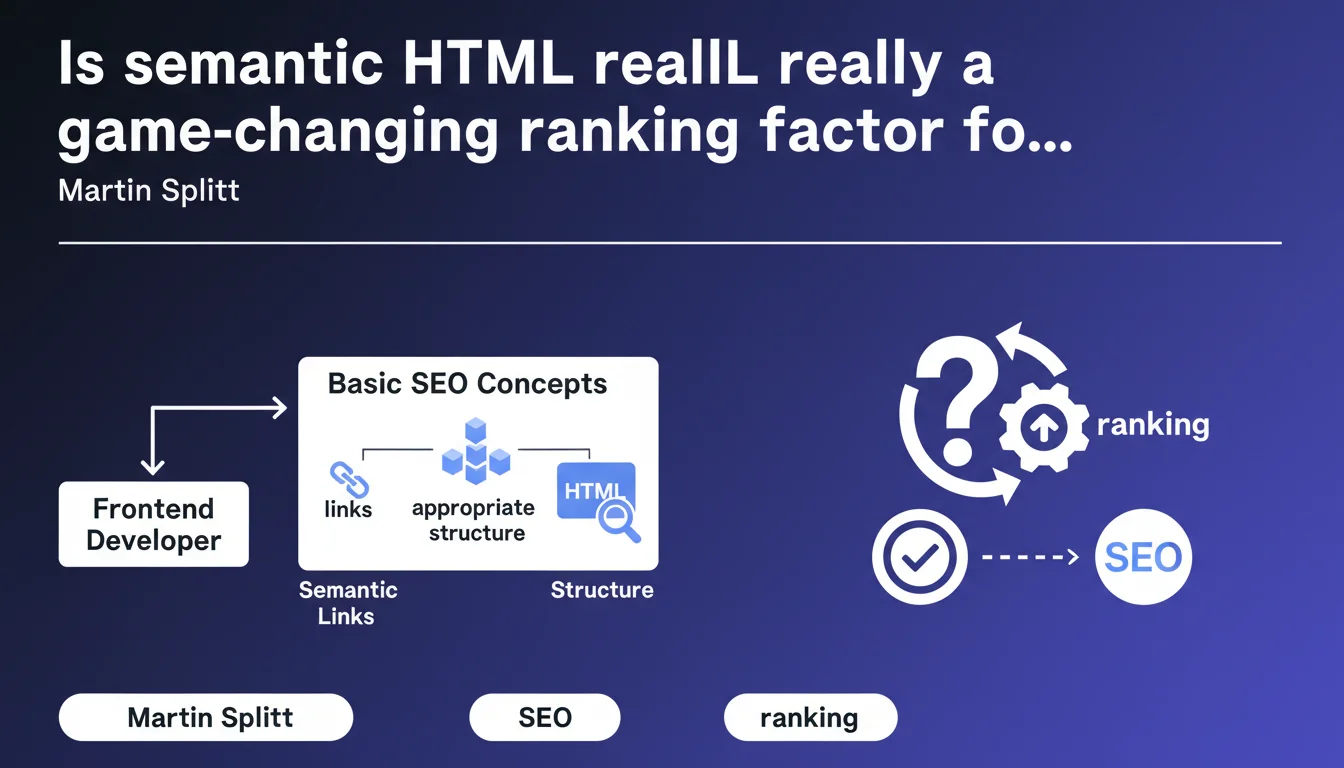
Google confirms that mastering semantic HTML (appropriate tags, logical structure, well-formed links) is part of the fundamental technical skills every frontend developer should have for SEO. It's not a revolutionary ranking factor, but a non-negotiable technical foundation that allows the search engine to properly understand and index your pages.
What you need to understand
What exactly does "semantic HTML" mean in an SEO context?
Semantic HTML means using the appropriate tags to describe the actual nature of your content. Navigation should be in a <nav>, an article in an <article>, a main heading in an <h1>.
This goes beyond simple visual display — it's about providing Googlebot with a logical structure that reflects the hierarchy and meaning of your content. A <div class="title"> styled in bold doesn't carry the same weight as a true <h2>.
Why does Google emphasize this "fundamental" technical aspect?
Because without clear structure, the search engine wastes resources interpreting the intent of each content block. Modern crawlers are certainly powerful, but malformed or non-semantic HTML complicates analysis and can lead to indexing errors.
Martin Splitt is speaking here to frontend developers, not directly to SEO professionals. The underlying message? Too many sites still rely on outdated or poorly designed structures, often inherited from misconfigured frameworks or jury-rigged CMS setups.
What are the priority semantic elements for SEO?
- Heading hierarchy (
<h1>to<h6>): structures content logically and facilitates thematic understanding - Structural tags (
<header>,<main>,<footer>,<aside>): clearly delimit the functional zones of the page - Semantic links:
<a>tags with validhrefattributes, descriptive anchor text, avoidonclickJavaScript replacements - Structured lists (
<ul>,<ol>): for enumerations, menus, breadcrumbs - Semantic tables (
<table>with<thead>,<tbody>): for tabular data, never for page layout
SEO Expert opinion
Does this statement reveal anything genuinely new?
No. Semantic HTML is a principle documented for years in Google's guidelines. What's interesting is that Splitt discusses it as a "fundamental concept" that frontend developers "should master" — wording that suggests a significant portion of the web still doesn't follow these standards.
In practice, we observe that many SaaS, e-commerce, and media sites rely on React/Vue/Angular frameworks with JavaScript-first rendering and completely neglect semantic HTML. Result: flat structure, absence of logical headings, navigation built with clickable <div> elements.
Is semantic HTML a direct ranking factor?
Google has never explicitly confirmed it as a ranking signal in the same way as backlinks or content relevance. But that's never been the right question to ask.
Semantic HTML impacts ranking indirectly by improving content understanding by the search engine, by facilitating entity extraction, by strengthening the thematic coherence perceived by the algorithm. A poorly structured page can be indexed, but it starts with a handicap in the race for positioning.
What are the practical limitations of this recommendation?
Telling frontend developers "master semantic HTML" is easy. The problem is that most work under imposed constraints: misconfigured front-end frameworks, rigid proprietary CMS systems, design directives that override semantic logic.
On certain projects, refactoring HTML structure represents weeks of development for an SEO impact that remains difficult to quantify in isolation. [Needs verification]: Google has never published a quantified correlation between semantic quality and ranking improvement. We're navigating here in the domain of best practices, not levers with immediate ROI.
Practical impact and recommendations
What should you audit as a priority on your pages?
Start by checking the consistency of your heading hierarchy. Each page should have a unique <h1>, followed by <h2> for main sections, <h3> for subsections. No jumps (no <h4> appearing directly after an <h2>).
Next, examine your internal links. Are they genuine <a href="..."> tags or <div onclick="...">
❓ Frequently Asked Questions
Un site sans HTML sémantique peut-il quand même être bien indexé par Google ?
Le HTML sémantique est-il plus important que le balisage schema.org ?
Faut-il refondre entièrement un site pour corriger la sémantique HTML ?
Les frameworks JavaScript modernes respectent-ils automatiquement la sémantique HTML ?
Google pénalise-t-il activement les sites avec un HTML mal structuré ?
🎥 From the same video 8
Other SEO insights extracted from this same Google Search Central video · published on 09/03/2022
🎥 Watch the full video on YouTube →
💬 Comments (0)
Be the first to comment.