
Official statement
Other statements from this video 8 ▾
- □ Does improving user experience really impact your search engine rankings?
- □ Are accordions and collapsible content still hurting your mobile SEO rankings?
- □ Should you really ignore SEO blogs and only read Google's official documentation?
- □ Is lazy loading really an easy SEO optimization to implement without risks?
- □ Does JavaScript package size really impact your SEO rankings?
- □ Should you really be using Lighthouse with feature flags to measure SEO impact before rolling out changes?
- □ Is semantic HTML really a game-changing ranking factor for SEO?
- □ Should SEO experts really be involved from the technical design phase?
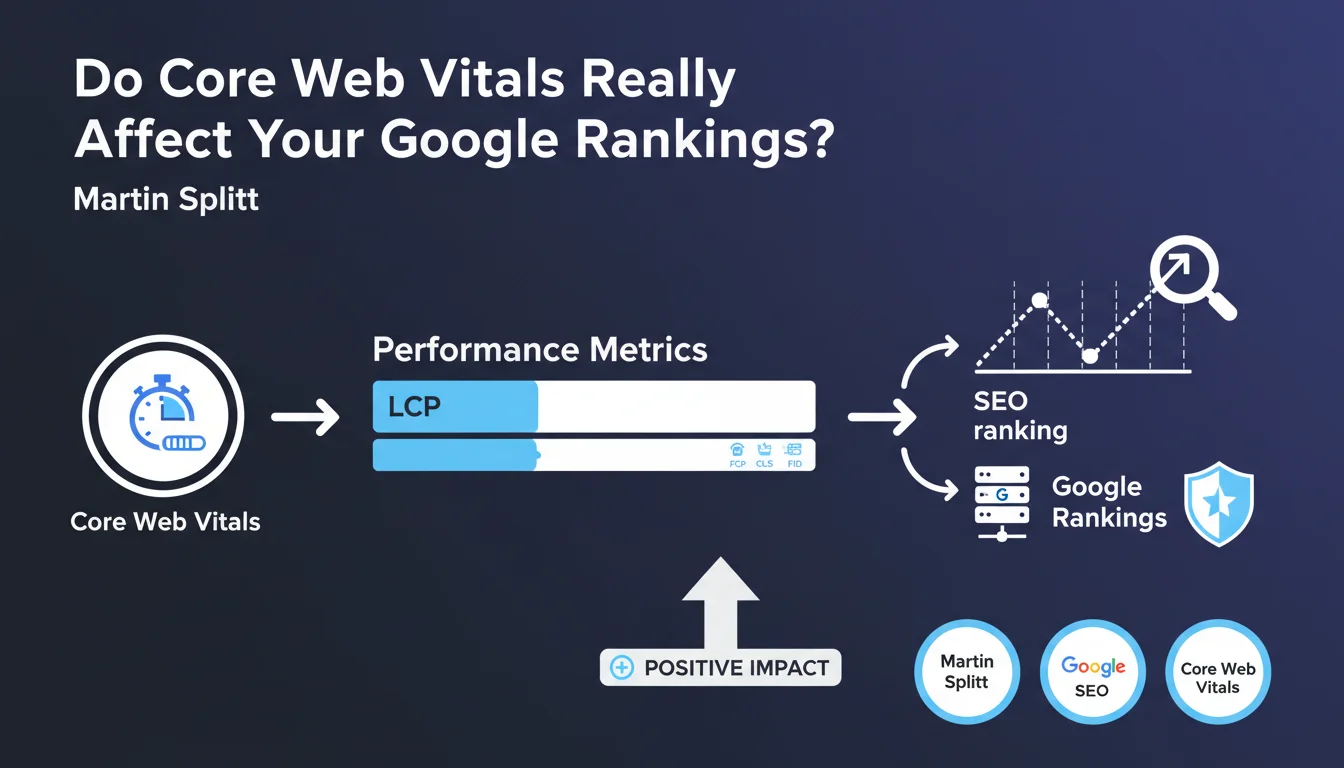
Google officially confirms that Core Web Vitals, particularly LCP, have a positive impact on rankings. Martin Splitt explicitly links improvements in these performance metrics to better 'index rating' and SEO visibility. This is one of the few ranking signals Google openly acknowledges.
What you need to understand
What does this 'index rating' that Splitt mentions actually mean in practice?
The term 'index rating' is interesting because it suggests Google assigns some form of qualitative score to indexed pages. Splitt directly ties this score to technical performance, particularly via LCP.
In practice, this means two pages with equivalent content can rank differently if one delivers a noticeably superior user experience. LCP measures the load time of the largest visible element — a metric that reflects how fast users actually perceive the page to be.
Why does Google emphasize LCP so much more than the other Core Web Vitals?
LCP is the most directly correlated with user frustration. Poor FID (First Input Delay) or high CLS (Cumulative Layout Shift) hurt experience, sure, but slow LCP immediately gives the impression that the site is laggy.
Google prioritizes signals that predict bounce rate and engagement. An LCP beyond 2.5 seconds statistically multiplies abandons. Improving this single metric alone can transform engagement metrics — and by extension, rankings.
Does this statement change anything for sites already ranking well?
Not necessarily. If your site dominates positions 1-3 despite mediocre LCP, it's because other factors (authority, relevance, intent match) more than compensate. Core Web Vitals mainly play a role in tiebreaking between similarly-quality pages.
Where it really matters: positions 8-15, ultra-competitive markets, queries where intent is unclear. In those cases, optimizing performance can shift a few positions — and a few positions sometimes means 30% more traffic.
- LCP directly impacts ranking according to Google, not just user experience
- The 'index rating' suggests an internal qualitative score tied to performance
- Core Web Vitals function as a tiebreaker factor between similarly-quality content
- Impact is more pronounced in competitive SERPs where relevance gaps are small
SEO Expert opinion
Is this statement consistent with real-world observations?
Yes and no. In sectors like e-commerce or media, we do observe correlations between LCP improvements and ranking gains. But caution: correlation isn't causation.
Often, a site improving LCP also optimizes its code, hosting, images — all factors that improve crawlability, indexation, engagement. Hard to isolate the pure LCP effect. [To verify]: Google has never published figures on the relative weight of Core Web Vitals in the algorithm.
What's the real weight of Core Web Vitals compared to other signals?
Let's be honest: they weigh far less than content relevance or domain authority. Google said so itself during the Page Experience Update rollout — 'better content wins, even if it's slow'.
In practice, Core Web Vitals act as a marginal boost. On non-competitive queries with mediocre content, improving them won't save anything. But on queries where 5 results are within 2 quality points, yes, it can tip the balance.
And here's the rub: Martin Splitt talks about 'positive impact' but gives no magnitude. Is it +2% of overall score? +10%? Nobody knows. [To verify]
In which cases is optimizing Core Web Vitals pointless?
If your content doesn't match search intent, you can have 0.8-second LCP and still remain invisible. Similarly, a site without backlinks or authority in an ultra-competitive niche won't climb just because it loads fast.
Another edge case: sites with mostly branded or direct traffic. If people type your URL directly, Google has no reason to penalize you on performance — you're not competing in SERPs.
Practical impact and recommendations
What concretely should you do to improve LCP?
LCP typically depends on three critical elements: server time, weight of the main element (often an image), and client-side rendering (JavaScript).
Start by identifying which element makes up your LCP using PageSpeed Insights or Lighthouse. Often it's a hero image, banner, or text block. Then optimize that element as a priority: WebP or AVIF compression, smart lazy loading, critical resource preload.
On the server side, a well-configured CDN and robust caching can cut your LCP in half. And if your site is stuffed with third-party scripts (tracking, ads, widgets), now's the time to clean house — every deferred or removed script is rendering time gained.
What mistakes should you avoid when optimizing Core Web Vitals?
Classic mistake: optimizing only the homepage. Google evaluates Core Web Vitals across your entire site, not just one URL. If your product pages or articles are slow, it tanks your overall score.
Another trap: focusing solely on lab tests (Lighthouse) and ignoring real-world data (CrUX). Google uses actual user data, not simulations. A perfect Lighthouse score guarantees nothing if 70% of your traffic comes from 3G mobile with catastrophic LCP.
Finally, don't break your site to shave 0.1 seconds. If you remove critical features (carousels, videos, interactions) for performance, you risk destroying engagement — and engagement is a far more powerful ranking signal.
How do you verify your site meets the recommended thresholds?
Use Google Search Console, 'Core Web Vitals' section. That's the source of truth — the actual data Google uses for ranking. If over 75% of your URLs pass the thresholds, you're 'good'.
Complement with PageSpeed Insights for detailed diagnosis, and Chrome UX Report (CrUX) to benchmark against competitors. If your LCP is 2.8 seconds and your top 3 competitors are under 2 seconds, that's a visible handicap.
- Identify the LCP element for each page type (homepage, category, product, article)
- Optimize images: WebP/AVIF, compression, dimensions, preload if critical
- Reduce server time: CDN, caching, performant hosting
- Remove or defer non-essential scripts, especially third-party ones
- Monitor CrUX data in Search Console, not just lab tests
- Test on real mobile 3G/4G, not just desktop Wi-Fi
❓ Frequently Asked Questions
Le LCP est-il plus important que le CLS et le FID pour le classement ?
Un bon score Core Web Vitals peut-il compenser un contenu moyen ?
Faut-il optimiser toutes les pages du site ou seulement celles qui génèrent du trafic ?
Les Core Web Vitals impactent-ils uniquement le mobile ou aussi le desktop ?
Combien de temps après une optimisation voit-on un effet sur le classement ?
🎥 From the same video 8
Other SEO insights extracted from this same Google Search Central video · published on 09/03/2022
🎥 Watch the full video on YouTube →
💬 Comments (0)
Be the first to comment.