
Official statement
Other statements from this video 8 ▾
- □ L'expérience utilisateur améliore-t-elle vraiment le référencement naturel ?
- □ Faut-il vraiment ignorer les blogs SEO et ne lire que la documentation Google ?
- □ Les Core Web Vitals influencent-ils réellement le classement dans Google ?
- □ Le lazy loading est-il vraiment une optimisation SEO facile à implémenter ?
- □ La taille des packages JavaScript impacte-t-elle réellement votre SEO ?
- □ Faut-il vraiment utiliser Lighthouse avec des feature flags pour mesurer l'impact SEO de vos modifications ?
- □ Le HTML sémantique est-il vraiment un critère de référencement déterminant ?
- □ Faut-il vraiment impliquer le SEO dès la phase de conception technique ?
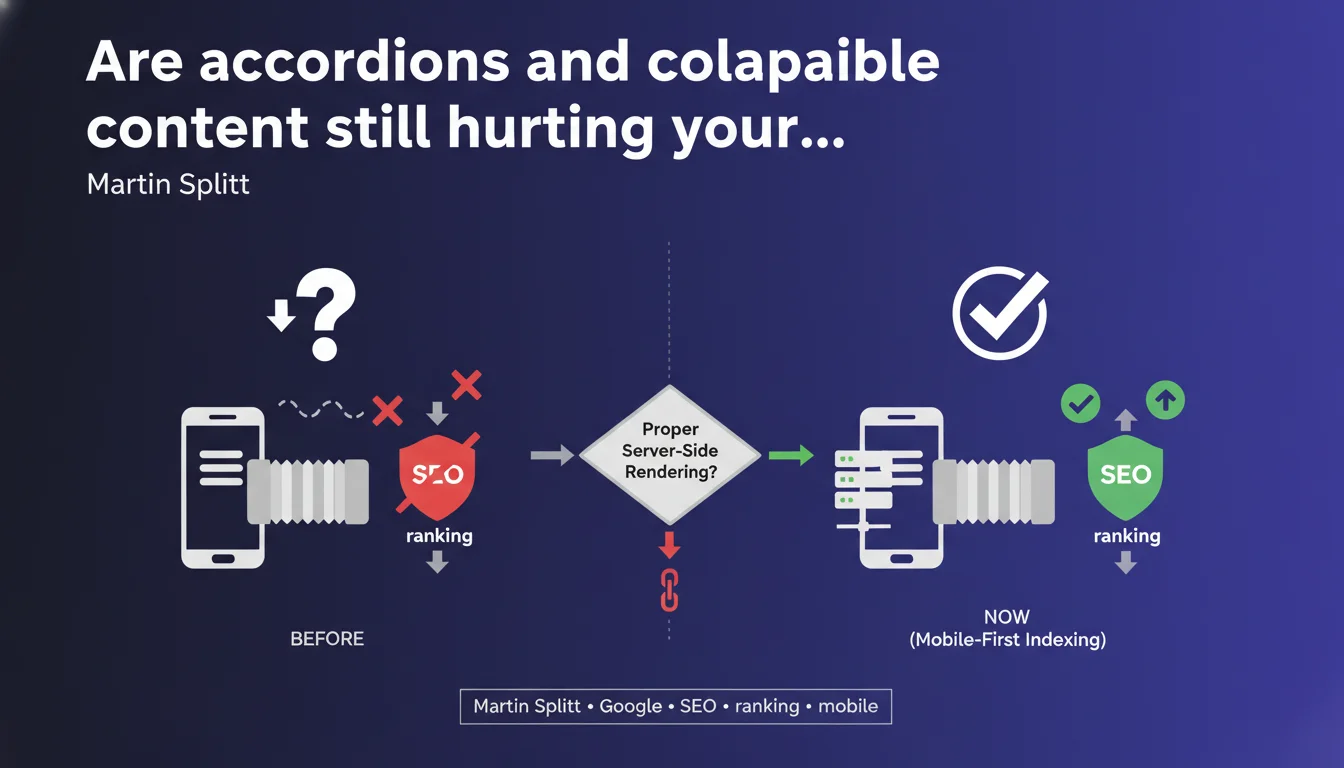
Google now tolerates accordions and collapsible content on mobile without SEO penalty, provided they are implemented with server-side rendering. This flexibility reflects the space constraints on compact screens, but remains conditional on flawless technical implementation.
What you need to understand
Why did Google change its stance on hidden content?
Historically, Google has always been suspicious of hidden or collapsible content. The logic was straightforward: if content isn't directly visible, it could be used to manipulate indexation without providing real value to users.
With the shift to mobile-first indexing, this position became untenable. Mobile screens impose space constraints incomparable to desktop — displaying all long-form content without accordions or tabs would be counterproductive for user experience.
What does Google mean by "properly implemented"?
The nuance is critical. Google doesn't give a blank check to all collapsible content, but specifies that implementation must rely on server-side rendering.
Concretely, this means the complete HTML of the accordion or collapsible content must be present in the initial source code, not loaded dynamically by JavaScript afterward. Googlebot must be able to access the content without executing complex scripts or waiting for AJAX requests.
What are the limits of this tolerance?
This permissiveness doesn't apply to all contexts. Google remains vigilant about potential abuse — stuffing accordions with keywords without editorial coherence remains a risky practice.
Furthermore, mobile-first indexing means the mobile version serves as the reference for indexation. If your desktop displays content absent from mobile, that content risks not being considered by Google.
- Server-side rendering mandatory : hidden content must be present in the HTML source
- Editorial coherence : accordions must serve user experience, not SEO manipulation
- Mobile/desktop parity : essential content must be present on both versions
- Accessibility : collapsible content must remain accessible to screen readers and assistive technologies
SEO Expert opinion
Is this statement consistent with real-world observations?
Yes and no. In practice, we do see that Google indexes properly implemented accordion content correctly for years now. Tests show that FAQ accordions, for example, can generate featured snippets without issues.
But — and this is where it gets tricky — the definition of "properly implemented" remains vague. Google talks about server-side rendering, but to what extent does it tolerate hybrid implementations with lightweight JavaScript? [Needs verification] on edge cases.
What nuances should we add to this tolerance?
Let's be honest: this permissiveness doesn't mean all collapsible content is equal in Google's eyes. An accordion structuring a legitimate FAQ doesn't carry the same weight as a hidden tab at the bottom of a product page.
Experience shows that Google still prioritizes immediately visible content in its relevance evaluation. Hidden content will be indexed, yes, but could weigh less in overall scoring — even if Google never explicitly admits it.
In which cases does this rule not apply?
If your implementation relies on client-side JavaScript without HTML fallback, you're still in hostile territory. Google may be progressing in JavaScript rendering, but betting solely on that weakens your indexation.
Likewise, content hidden by CSS with display:none without clear UX justification can still be considered manipulative. Context matters — a mobile accordion makes sense, a hidden block on desktop for no valid reason far less so.
Practical impact and recommendations
What should you concretely do to secure your collapsible content?
First step: audit the technical implementation of your accordions and tabs. The content must be present in the initial HTML source, visible in the "Elements" tab of Chrome DevTools before any user interaction.
Next, verify that Googlebot can access this content. The URL inspection tool in Search Console lets you simulate Google's rendering — the rendered HTML must contain all content, not just a placeholder.
What mistakes should you avoid at all costs?
Don't load your collapsible content via deferred AJAX after initial display. Even if Google can technically execute JavaScript, you're introducing unnecessary non-indexation risk.
Also avoid the temptation to create "ghost" accordions — hidden content with no visible trigger for users. Google detects these patterns and may consider them disguised cloaking.
Finally, don't massively duplicate content between desktop and mobile via accordions. If your desktop displays everything clearly and your mobile shows the same content in an accordion, that's coherent. But creating extra hidden content only on mobile falls into a gray area.
How do you verify your implementation is compliant?
- Inspect source code (Ctrl+U) : accordion content must be present in raw HTML
- Test with Google Search Console's URL inspection tool
- Disable JavaScript in browser: content must remain accessible (even if visually hidden)
- Check ARIA attributes for accessibility (aria-expanded, aria-hidden)
- Compare indexation rate before/after accordion implementation on test pages
- Monitor rankings for keywords present in collapsible content
Google's tolerance for mobile collapsible content is real, but conditional on technical rigor that few sites master perfectly. Between server-side rendering, accessibility, cross-device consistency, and avoiding manipulative patterns, the margin for error remains slim.
For complex sites or high-stakes projects, these optimizations can quickly exceed the scope of one-off interventions. A thorough technical audit and specialized guidance help avoid pitfalls — some SEO agencies have actually specialized in these mobile indexation issues and can provide expert perspective on your architecture.
❓ Frequently Asked Questions
Les accordéons implémentés en React ou Vue.js sont-ils compatibles avec cette déclaration ?
Le contenu dans un accordéon a-t-il le même poids SEO que du contenu visible ?
Dois-je dupliquer mes accordéons desktop sur mobile pour éviter les incohérences ?
Les tabs horizontaux sont-ils traités différemment des accordéons verticaux ?
Peut-on cacher du contenu moins important en accordéon pour améliorer les Core Web Vitals ?
🎥 From the same video 8
Other SEO insights extracted from this same Google Search Central video · published on 09/03/2022
🎥 Watch the full video on YouTube →
💬 Comments (0)
Be the first to comment.