
Official statement
Other statements from this video 11 ▾
- □ Is old content really killing your search rankings?
- □ Can old content still rank well despite its age?
- □ Should you really fix broken links in your older content?
- □ Should you really update all your old content for SEO?
- □ Should you really let your old articles stay with their original mistakes?
- □ Should you really delete outdated content instead of simply marking it as deprecated?
- □ Is using the canonical tag as a hidden redirect costing you your SEO rankings?
- □ Why does Google discourage crypto-redirects for your site migrations?
- □ Should you really stop adding dates to your titles just to make them look fresh?
- □ Should you redirect or create an explanatory page when discontinuing a tool?
- □ Is auditing your documentation regularly really essential to maintain strong SEO performance?
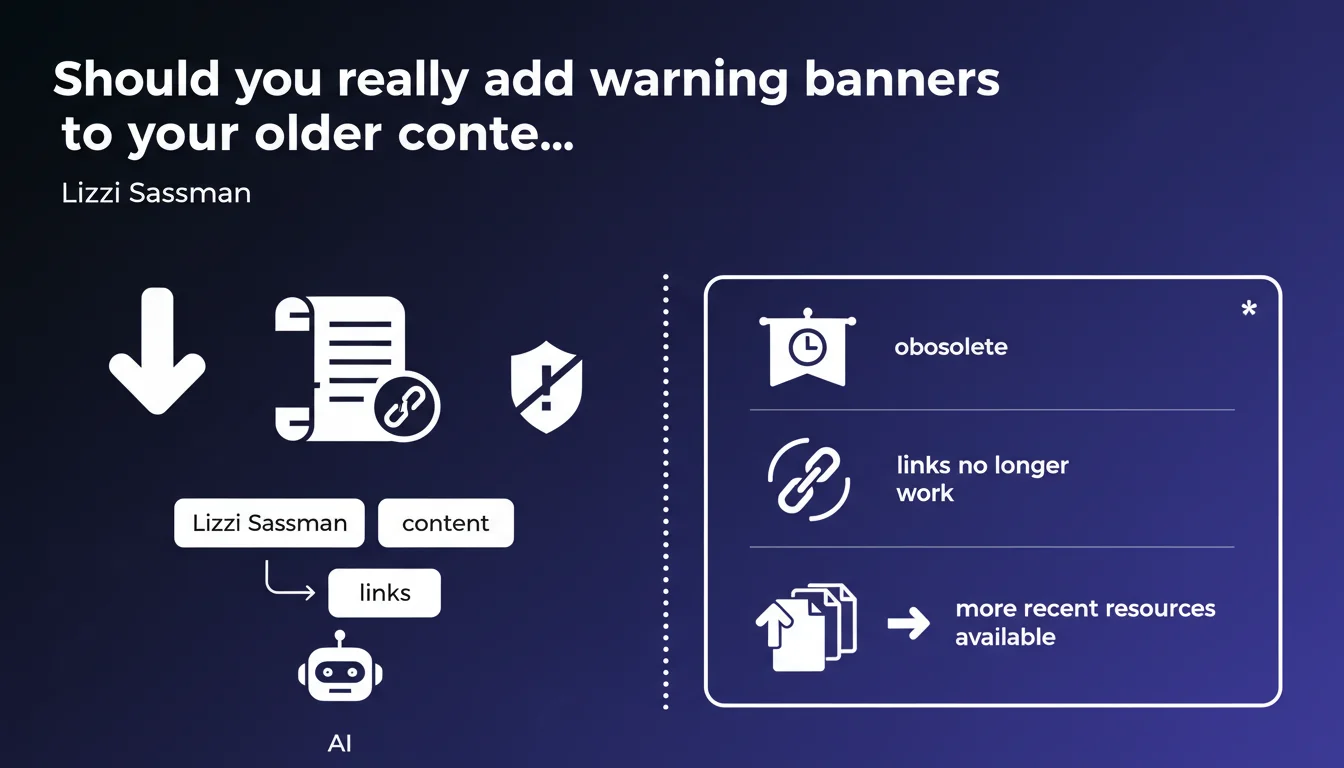
Google recommends using banners to signal to users that content is outdated, that certain links may be broken, or that more recent resources exist. This practice improves user experience by contextualizing information, but remains a weak signal compared to a complete content update.
What you need to understand
Why is Google highlighting this practice now?
The statement from Lizzi Sassman comes at a time when Google increasingly values the perceived freshness of content. The algorithm seeks to avoid serving obsolete information without systematically penalizing older articles that retain historical or referential value.
This approach makes it possible to keep outdated content online without misleading the user about its timeliness. It's a compromise between preserving editorial heritage and meeting temporal relevance requirements.
How do these banners influence your SEO?
Technically, these banners have no direct impact on crawling or indexation. Google doesn't read these mentions as SEO directives. Their effect is measured through behavioral signals: time spent, bounce rate, clicks to more recent resources.
If a user immediately sees that an article is dated and finds a link to the updated version, they stay on your site rather than returning to the SERPs. This behavior sends Google a positive satisfaction signal.
What elements should be included in these banners?
- Original publication date clearly visible
- Explicit mention that some information may be outdated
- Link to an updated resource if one exists
- Warning about potentially broken links if the content is very old
- Indication of the last time the content was reviewed, if applicable
SEO Expert opinion
Is this recommendation consistent with practices observed in the field?
Yes, but with a major caveat: sites that have massively adopted these banners have not seen visible boosts in their analytics. The impact remains marginal compared to a true editorial overhaul.
A/B tests show that these banners slightly reduce bounce rates on content older than 3 years, but the effect is statistically weak — we're talking about 2 to 5% improvement in the best cases. [To be verified]: Google has never published data proving a measurable impact on rankings.
In what cases is this practice counterproductive?
On a technical or scientific blog, systematically adding "this content may be outdated" can harm credibility — especially if the information remains valid. The risk: creating artificial distrust when the content is still relevant.
Another pitfall: placing these banners on evergreen content that isn't meant to be updated. A timeless guide loses authority if you present it as potentially outdated.
What's the alternative if you lack resources for these banners?
Frankly? Archive or consolidate. If you don't have time to maintain a coherent banner, it's better to merge several old articles into a single updated piece of content with a 301 redirect.
Banners are a band-aid, not a strategy. They buy you time, but never replace a rigorous editorial governance.
Practical impact and recommendations
What do you need to set up concretely on your site?
Start by identifying content older than 18 months that still generates organic traffic. Use a filter in Google Analytics or Search Console to spot old pages with stable impressions.
Then, create a modular banner system — ideally through a reusable snippet in your CMS. The message should be customizable based on content type: technical article, product comparison, news, how-to guide.
What mistakes should you avoid when implementing?
- Don't place the banner too high in the content — it shouldn't push the title or intro down (bad for CLS)
- Avoid vague wording like "this article is old" without context or alternatives
- Never link to a competitor or external page as a "more recent resource" — keep the traffic
- Don't add these banners via late-loading JavaScript that wouldn't be crawled effectively
- Avoid intrusive pop-ups or overlays that degrade mobile UX
How do you measure the effectiveness of this optimization?
Set up event tracking on clicks to updated resources mentioned in the banner. Compare bounce rate and session duration before/after implementation on a sample of pages.
Also monitor Core Web Vitals: a poorly integrated banner can degrade CLS if it pushes content down after initial load.
❓ Frequently Asked Questions
Les bannières d'avertissement influencent-elles directement le classement dans Google ?
Doit-on ajouter ces bannières sur tous les contenus de plus d'un an ?
Faut-il utiliser un balisage structuré spécifique pour ces bannières ?
Peut-on remplacer une bannière par une simple mention en fin d'article ?
Ces bannières peuvent-elles nuire à la crédibilité du site ?
🎥 From the same video 11
Other SEO insights extracted from this same Google Search Central video · published on 09/05/2024
🎥 Watch the full video on YouTube →
💬 Comments (0)
Be the first to comment.