
Official statement
Other statements from this video 11 ▾
- □ Can structured data really boost your qualified SEO traffic?
- □ What's the point of perfect structured data if Google can't actually crawl your pages?
- □ Why does Google rely on Schema.org as its primary language for understanding your content?
- □ Should you really multiply structured data on your pages to please Google?
- □ Why does Google recommend JSON-LD over Microdata or RDFa for structured data implementation?
- □ Should you really rely on CMS plugins to handle your structured data automatically?
- □ Is the Rich Results Test really enough to validate your structured data?
- □ Does Google Search Console really alert you to every structured data problem?
- □ Can structured data errors actually hurt your search rankings?
- □ Can off-topic structured data really penalize your website?
- □ Can conflicting structured data really kill your rich snippets?
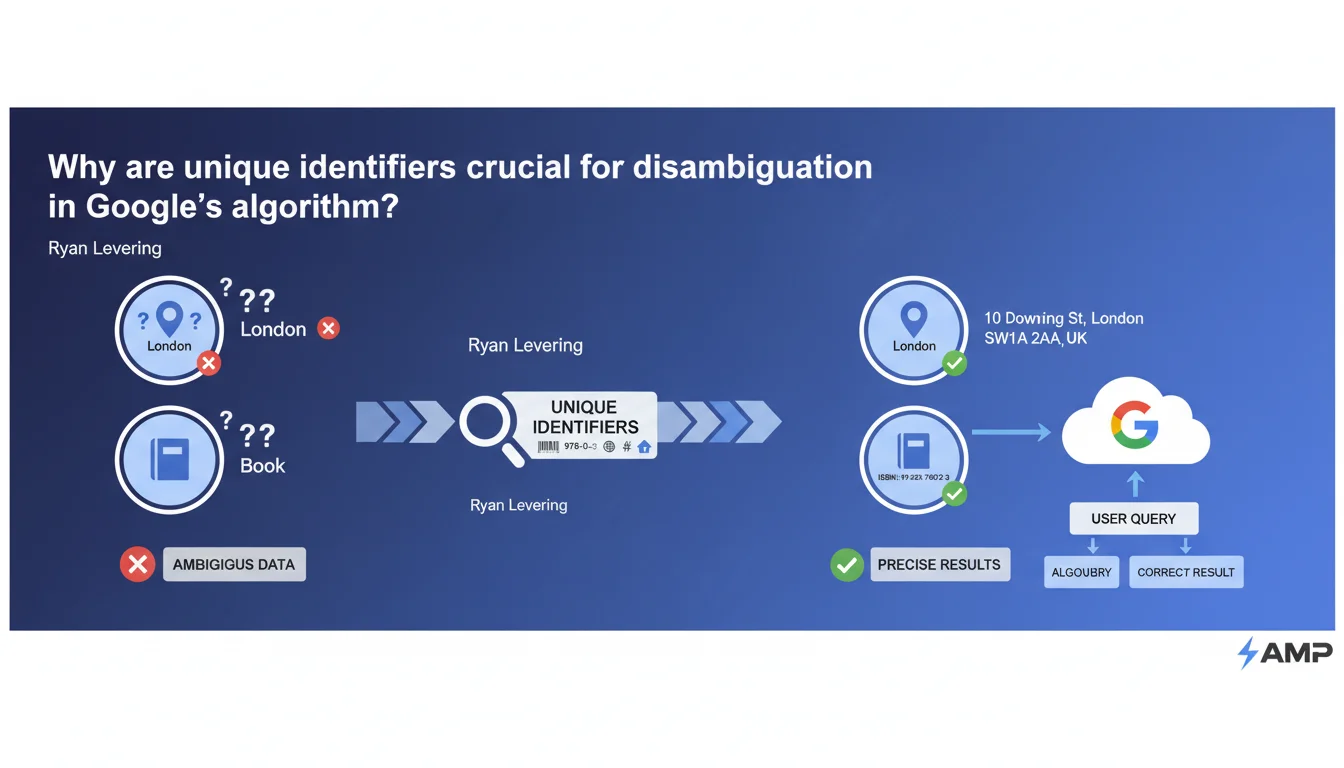
Google recommends using unique identifiers and precise structured data to help its algorithm clearly distinguish entities from one another. In practice: a complete address rather than just a city name, an ISBN rather than a generic book title. The goal? To improve the match between your content and the user queries that are actually relevant to you.
What you need to understand
What does "disambiguate" mean in the context of Google?
Disambiguation is the process by which Google attempts to differentiate between two entities that share the same name or similar characteristics. Without unique identifiers, the algorithm struggles to know whether you're talking about the concert in Paris 15th district or the one in Paris, Texas.
Ryan Levering uses the example of an event: providing just "Paris" as the location creates ambiguity. However, furnishing the complete address — street, postal code, city — allows Google to attach the event to a precise geographic entity in its Knowledge Graph.
Why do ISBNs and other standard identifiers make such a difference?
An ISBN (International Standard Book Number) is a universal identifier that designates a specific book, a given edition. Using this ISBN in your structured data (Schema.org type Book) eliminates any confusion with other books having a similar or identical title.
Google can then cross-reference this information with its external databases (Google Books, Wikidata, publishers) to enrich its entity and display relevant results — reviews, availability, excerpts — without risk of mixing it up with a homonym.
What are the implications for natural search visibility?
The precision of identifiers directly impacts your visibility for long-tail queries and localized searches. If Google cannot disambiguate your content, it risks not showing you at all — or worse, showing you for irrelevant queries, degrading your click-through rate.
- Unique identifiers strengthen the consistency of your entity in the Knowledge Graph
- They facilitate alignment with reliable third-party sources (Wikidata, professional databases)
- They reduce the risk of cannibalization between similar pages
- They improve eligibility for rich snippets and enriched results (events, products, books)
SEO Expert opinion
Is this statement consistent with practices observed in the field?
Yes, and testing has confirmed this for years. E-commerce sites that populate GTIN, MPN, or ISBN in their Schema.org Product tags achieve significantly higher rich snippet display rates than those that don't.
For events, a complete address improves ranking in local searches and Google Maps. But — and this is where it gets tricky — Google says nothing about the relative weight of these identifiers compared to other signals. The ISBN alone doesn't guarantee ranking; it just helps you avoid being confused with another book.
What nuances should be applied to this recommendation?
Levering's statement remains deliberately generic. It doesn't specify which identifiers are mandatory versus recommended, nor how Google handles cases where multiple sources provide contradictory identifiers for the same entity. [To verify]: Google's exact behavior when faced with an incorrect or obsolete ISBN is not documented.
Another point: not all sectors have standard identifiers. If you sell unique handmade creations, there's no GTIN. In that case, Google relies on other signals — brand name, detailed descriptions, images — but disambiguation remains weaker.
In which cases doesn't this rule apply fully?
For editorial content — blog posts, guides — there is no universal identifier comparable to an ISBN. You must instead rely on clear named entities (people, places, organizations) and rigorous Schema.org Article markup, but disambiguation relies mainly on semantic context.
Single-location pages benefit less from this multi-identifier logic. The essentials lie in NAP (Name, Address, Phone) consistency and your Google Business profile, not in an imaginary ISBN.
Practical impact and recommendations
What should you do concretely to improve disambiguation?
Start by auditing your existing structured data. If you manage products, verify that each listing contains at minimum the GTIN (or MPN if no GTIN is available). For books, the ISBN is essential. For events, the address must be complete down to the street number.
Next, cross-reference your identifiers with official databases. A GTIN must be valid in the GS1 database, an ISBN in the international registry. Google surfaces errors in Search Console if your identifiers are rejected — regularly check the "Enhancements" tab > "Products" or "Events".
What errors should you avoid when implementing?
Never duplicate the same identifier across multiple distinct products. Each variant (size, color) of a product has its own GTIN — otherwise Google considers you're describing the same thing and doesn't differentiate between variants.
Avoid generic or made-up identifiers. If you don't have a GTIN, leave the field empty rather than entering "000000" or "N/A". Google prefers the absence of information to false information, which degrades the overall trustworthiness of your markup.
- Populate GTIN / MPN / ISBN in Schema.org Product, Book, or merchant feeds
- Provide complete addresses (street, postal code, city, country) for events and establishments
- Validate identifiers via official databases (GS1, ISBN.org)
- Check consistency between markup, Google Merchant Center feeds, and third-party data (Wikidata, DBpedia)
- Monitor Search Console alerts for rejected structured data
- Avoid reusing the same identifier for multiple distinct entities
The use of unique identifiers is not a "nice to have" — it's a technical prerequisite for Google to understand precisely what you're describing and show you for the right queries. The clearer your entities are identified, the more your content is eligible for enriched results and position zero.
Bringing these identifiers into compliance across a large catalog, with verification against external databases and ongoing maintenance, can quickly become time-consuming. If your team lacks resources or expertise in structured data, working with a specialized SEO agency will allow you to automate checks, optimize feeds, and ensure lasting consistency across your data sources.
❓ Frequently Asked Questions
Que faire si mon produit artisanal n'a pas de GTIN ?
Un ISBN suffit-il pour bien ranker un livre sur Google ?
Google rejette mes données structurées produit : est-ce forcément à cause du GTIN ?
Dois-je ajouter un identifiant unique pour chaque page de mon blog ?
Les identifiants uniques influencent-ils le crawl budget ?
🎥 From the same video 11
Other SEO insights extracted from this same Google Search Central video · published on 23/08/2022
🎥 Watch the full video on YouTube →
💬 Comments (0)
Be the first to comment.