
Official statement
Other statements from this video 11 ▾
- □ Can structured data really boost your qualified SEO traffic?
- □ What's the point of perfect structured data if Google can't actually crawl your pages?
- □ Why does Google rely on Schema.org as its primary language for understanding your content?
- □ Should you really multiply structured data on your pages to please Google?
- □ Should you really rely on CMS plugins to handle your structured data automatically?
- □ Is the Rich Results Test really enough to validate your structured data?
- □ Does Google Search Console really alert you to every structured data problem?
- □ Can structured data errors actually hurt your search rankings?
- □ Can off-topic structured data really penalize your website?
- □ Why are unique identifiers crucial for disambiguation in Google's algorithm?
- □ Can conflicting structured data really kill your rich snippets?
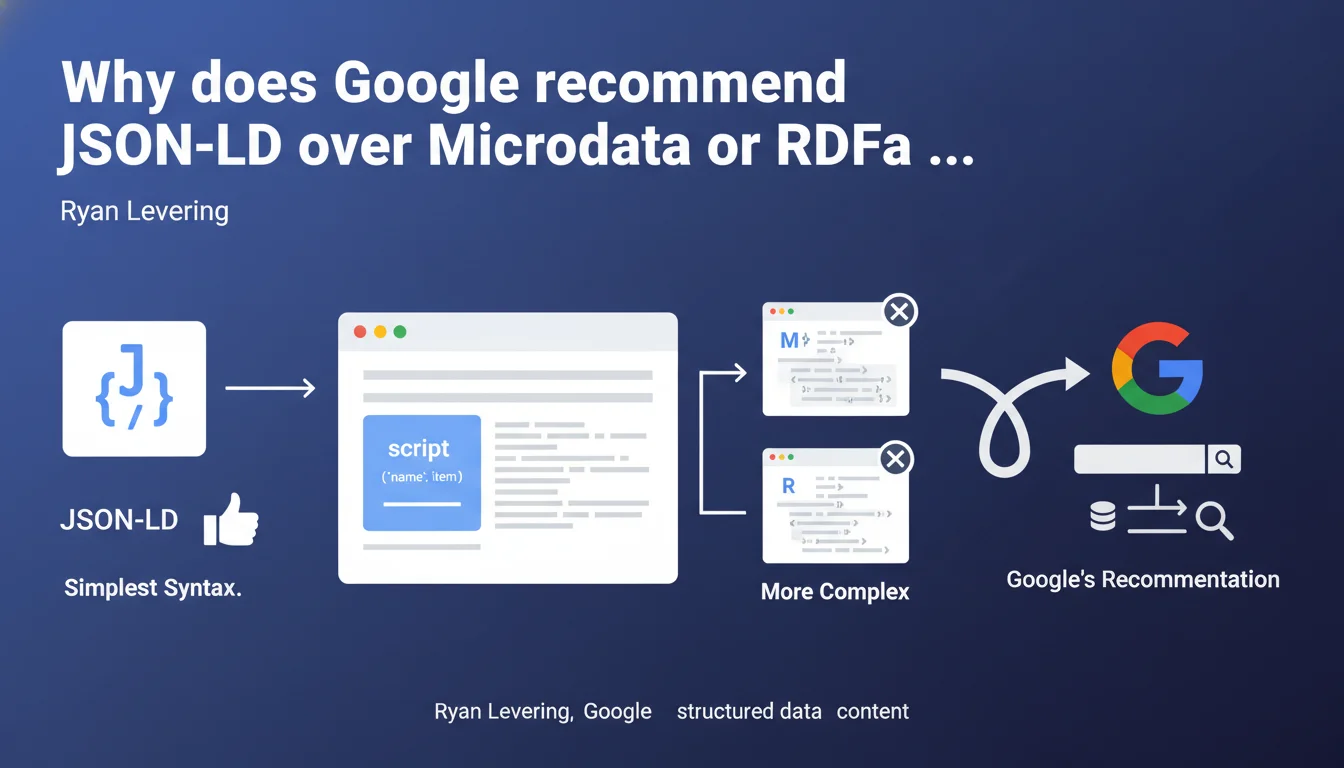
Google favors JSON-LD as the structured data format because it's the simplest syntax to implement. Unlike Microdata or RDFa which are embedded within visible HTML, JSON-LD sits in a separate script block, making deployment and maintenance easier for technical teams.
What you need to understand
What is JSON-LD and how does it differ from other formats?
JSON-LD (JavaScript Object Notation for Linked Data) is a structured data format inserted within a <script type="application/ld+json"> tag. Its main advantage: it remains completely independent from the HTML displayed to users.
Microdata and RDFa, on the other hand, require adding attributes directly to the tags in visible content. A maintenance nightmare — especially if your CMS changes or multiple teams work on the code.
Why does Google emphasize the "simplicity" of JSON-LD?
The separation between visible content and structured metadata accelerates implementation. No need to modify every HTML element: just paste a JSON block at the beginning or end of the page, and you're done.
For developers, it's less risky. Adding an itemscope attribute in the wrong place could break the layout or business logic. An isolated JSON script? Zero impact on rendering or frontend interactions.
Does this statement change current practices?
No, it's a confirmation of an already documented position. For several years now, Google Search Console and guidelines have pointed to JSON-LD as the priority format.
What's interesting is the word "recommended." Google doesn't say "mandatory." Microdata and RDFa remain supported — but clearly, JSON-LD is the gold standard if you're launching a new project or redesigning a site.
- JSON-LD is placed in a separate script tag from visible HTML
- Microdata and RDFa are embedded within HTML tags, complicating maintenance
- Google supports all three formats but clearly favors JSON-LD
- Content/metadata separation reduces the risk of bugs during updates
SEO Expert opinion
Is this recommendation consistent with what we observe in practice?
Absolutely. Sites migrating to JSON-LD typically see fewer errors reported in Google Search Console. Why? Google's parsers handle a clean JSON block better than scattered Microdata spread across 15 different templates.
However — and this is where it gets tricky — JSON-LD also makes it easier to stuff structured data that has no relation to visible content. Google knows this. Hence the recurring penalties on sites that abuse it: fake reviews, non-existent offers, breadcrumbs that don't match anything.
In what cases are Microdata or RDFa still relevant?
If your site is already running on Microdata and everything works — no reason to break everything to migrate. Google reads all three formats.
RDFa has value for platforms exposing linked data (Linked Data) beyond Google, particularly in academic or government contexts. But for pure SEO? JSON-LD dominates the competition.
Does this statement sidestep important questions?
Yes. Ryan Levering says nothing about validation by Google versus by Schema.org. Google's validator sometimes accepts structures that fail the official Schema.org validator — and vice versa. [To be verified]
Another gray area: no mention of crawl time and processing time. Is JSON-LD really faster for Googlebot to parse? No public data on this. We assume it is, but Google never quantifies it.
Practical impact and recommendations
What should you do concretely if your site still uses Microdata or RDFa?
Don't panic. Google will continue reading these formats for years to come. But if you're redesigning a site or deploying new structured features, go straight to JSON-LD.
For a gradual migration: first identify priority templates — products, articles, events. Replace Microdata with JSON-LD page by page, then verify in Search Console that rich snippets still display correctly.
What errors should you avoid when implementing JSON-LD?
First common mistake: duplicating information across multiple JSON-LD blocks. If you declare a product and a breadcrumb, make sure the URLs and names match exactly.
Second trap: generating JSON-LD dynamically without escaping special characters. A single unescaped quotation mark in a product title, and the entire block becomes invalid. Google silently ignores it — and you lose rich snippets without even knowing.
Third error: relying solely on Google's validator. Also test with the official Schema.org validator. The two don't always flag the same warnings.
How do you verify that your JSON-LD is working correctly?
Use Google's Rich Results Test for each content type. Also verify that data is properly showing up in the "Enhancements" reports in Search Console.
Install a Chrome extension like "Structured Data Testing Tool" to audit live. And most importantly, compare the declared JSON-LD with what users actually see. If your JSON-LD price doesn't match the displayed price, Google can ignore you — or worse, penalize you.
- Prioritize JSON-LD for any new structured data implementation
- Don't mix JSON-LD, Microdata, and RDFa on the same page
- Validate each block with Google's Rich Results Test AND the official Schema.org validator
- Verify that structured data matches exactly what users see
- Monitor "Enhancements" reports in Search Console after each production deployment
- Properly escape all special characters in dynamically generated JSON strings
❓ Frequently Asked Questions
Dois-je migrer mon site de Microdata vers JSON-LD immédiatement ?
Puis-je mélanger JSON-LD et Microdata sur une même page ?
Le JSON-LD améliore-t-il directement le classement dans les résultats de recherche ?
Où placer le bloc JSON-LD dans le code HTML ?
Comment savoir si Google lit correctement mon JSON-LD ?
🎥 From the same video 11
Other SEO insights extracted from this same Google Search Central video · published on 23/08/2022
🎥 Watch the full video on YouTube →
💬 Comments (0)
Be the first to comment.