
Official statement
Other statements from this video 10 ▾
- □ Why is Google's SEO Starter Guide absolutely crushing it with users?
- □ Do you still need to worry about HTTPS for SEO in 2025?
- □ Has mobile compatibility really become a non-issue for SEO?
- □ Is word count really a Google ranking factor?
- □ Does HTML structure really have minimal impact on Google rankings?
- □ Can you really trust modern CMSs to handle title tags automatically without any manual oversight?
- □ Do keywords in your domain name still matter for SEO in 2024?
- □ Should you remove the meta keywords tag from your website?
- □ Do you really need Google Analytics or Google Ads to rank better in search?
- □ Should you really change your domain name to boost your SEO rankings?
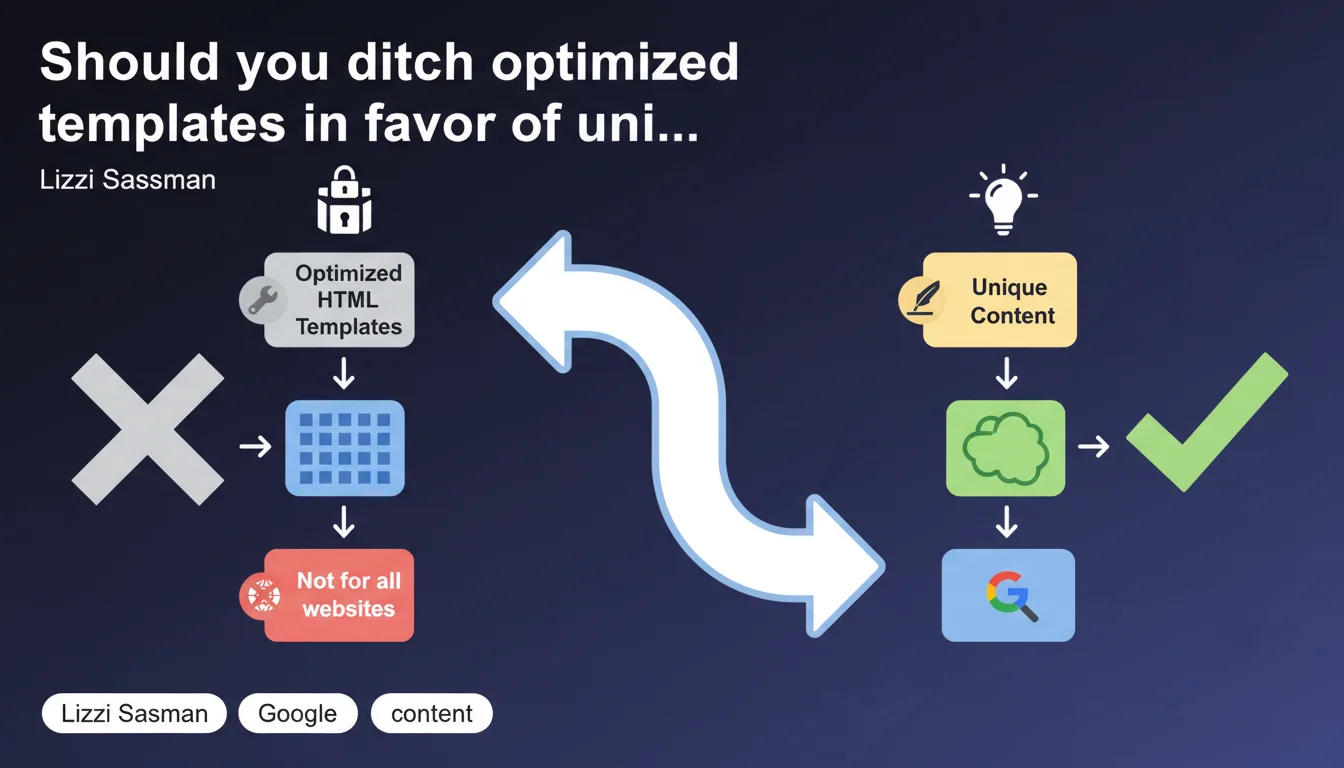
Google states that no universal perfect HTML structure exists. Priority should go to creating unique content rather than searching for an ideal standardized template. This position refocuses attention on editorial value at the expense of structural technical optimization.
What you need to understand
Why does Google insist on unique content rather than structure?
This statement comes at a time when many SEO professionals are searching for the perfect HTML template — one that would guarantee better rankings thanks to optimal structure. Google puts an end to this quest by asserting that no universal model can work for all websites.
The algorithm prioritizes content relevance and originality over structural uniformity. The same page schema can work for an e-commerce site and be unsuitable for a media outlet or corporate site. What matters is the content's ability to answer search intentions, not technical standardization.
What really differentiates unique content from a standardized structure?
Unique content refers to original, non-duplicated information that provides a specific answer to a query. Standardized structure, on the other hand, refers to a repetitive HTML framework — same tags, same hierarchy, same content areas.
Concretely, two pages with the same architecture can have radically different performance if one offers rich, documented content while the other recycles generic text. Google doesn't penalize the use of templates, but refuses to consider them a decisive ranking factor.
Does this approach question technical optimization?
No. Technical optimization remains essential for crawlability, indexing, and user experience. But it's not enough to compensate for weak content. A technically flawless page without editorial value won't rank better than a less optimized page rich in information.
This statement reminds us that technical optimization must serve content, not be an end in itself. Let's be honest: too many sites invest in complex structural audits without ever questioning the actual quality of their content.
- There is no universal HTML template guaranteeing better rankings
- Unique content takes precedence over structural standardization
- Technical optimization remains essential but doesn't compensate for weak content
- Google evaluates editorial relevance before page model compliance
SEO Expert opinion
Is this statement consistent with real-world observations?
Yes and no. In principle, it's perfectly aligned with what we observe: sites with heterogeneous structures can dominate SERPs if their content is solid. But — and this is where it gets tricky — this position underestimates the real weight of certain recurring structural patterns among well-ranking sites.
Featured snippets, for example, clearly favor certain content structures: lists, tables, definitions at the beginning of paragraphs. Pages that respect these schemas have a measurable advantage. So saying there's no perfect template is true at the macro scale but false at the micro scale for certain result types. [To verify]: Google could clarify whether this rule applies uniformly to all SERP formats or if certain types of rich results escape this logic.
What nuances should be added to this statement?
Google talks about page structure, not semantic markup. Structured data (Schema.org), hierarchical Hn tags, alt attributes on images — all of that remains critical. What Google is saying is that you shouldn't look for THE magical HTML structure that would automatically rank, not that you should neglect markup.
Another nuance: unique content doesn't mean long or complex content. A product page with 150 words can be unique and performant if it precisely answers purchase intent. Conversely, a 3000-word article recycling ideas already present elsewhere adds nothing.
In what cases doesn't this rule fully apply?
For certain types of sites — aggregators, comparators, marketplaces — structure becomes a differentiating factor. A price comparison site with a page structure optimized to clearly display prices, reviews, and merchants will have an advantage over a competitor with confusing layout, even if raw content is similar.
Likewise, for media sites or blogs with high volume, a coherent editorial structure improves internal navigation, linking, and user experience — which indirectly impacts SEO. So yes, unique content is priority, but thoughtful structure amplifies its impact.
Practical impact and recommendations
What should you do concretely after this statement?
Stop looking for the perfect HTML template. Focus on editorial quality: each page must provide original, documented information that answers a specific search intent. This doesn't mean abandoning technical optimization, but rebalancing priorities.
Audit your existing content: how many pages are variations of the same text? How many recycle generic information available everywhere else? If the answer is "a lot," you have a problem with editorial cannibalization, not a structure problem.
What mistakes should you avoid after this announcement?
Don't neglect technical optimization under the pretext that Google prioritizes content. Semantic markup, structured data, Hn hierarchy, performance — all of that remains fundamental. What Google is saying is that these elements aren't enough to compensate for weak content.
Another mistake: believing that "unique content" means "long content." Google doesn't count words. A short page that precisely answers a query is worth more than a generic 2000-word slab. Prioritize relevance over volume.
- Audit existing content to identify weak or redundant pages
- Prioritize creating original and documented content on each page
- Maintain technical optimization (markup, structured data, Hn hierarchy)
- Avoid searching for a magical universal HTML template
- Measure editorial performance through reading time, engagement rate, conversions
- Adapt page structure to the content type and specific search intent
❓ Frequently Asked Questions
Google pénalise-t-il l'utilisation de templates HTML standardisés ?
Le contenu unique suffit-il à bien se positionner sans optimisation technique ?
Faut-il abandonner les structures de page éprouvées qui rankent bien ?
Les featured snippets ne favorisent-ils pas certaines structures de contenu ?
Comment mesurer si mon contenu est suffisamment unique ?
🎥 From the same video 10
Other SEO insights extracted from this same Google Search Central video · published on 25/01/2024
🎥 Watch the full video on YouTube →
💬 Comments (0)
Be the first to comment.