
Official statement
Other statements from this video 10 ▾
- □ Pourquoi le SEO Starter Guide de Google cartonne-t-il à ce point ?
- □ Faut-il encore se préoccuper de HTTPS pour le référencement ?
- □ La compatibilité mobile est-elle vraiment devenue un non-sujet SEO ?
- □ Le nombre de mots est-il vraiment un facteur de classement Google ?
- □ La structure HTML a-t-elle vraiment peu d'impact sur le classement Google ?
- □ Peut-on vraiment faire confiance aux CMS modernes pour gérer les balises title automatiquement ?
- □ Les mots-clés dans le nom de domaine influencent-ils encore le référencement ?
- □ Faut-il vraiment utiliser Google Analytics ou Google Ads pour mieux ranker ?
- □ Faut-il vraiment changer de nom de domaine pour améliorer son SEO ?
- □ Faut-il abandonner les templates HTML optimisés au profit du contenu unique ?
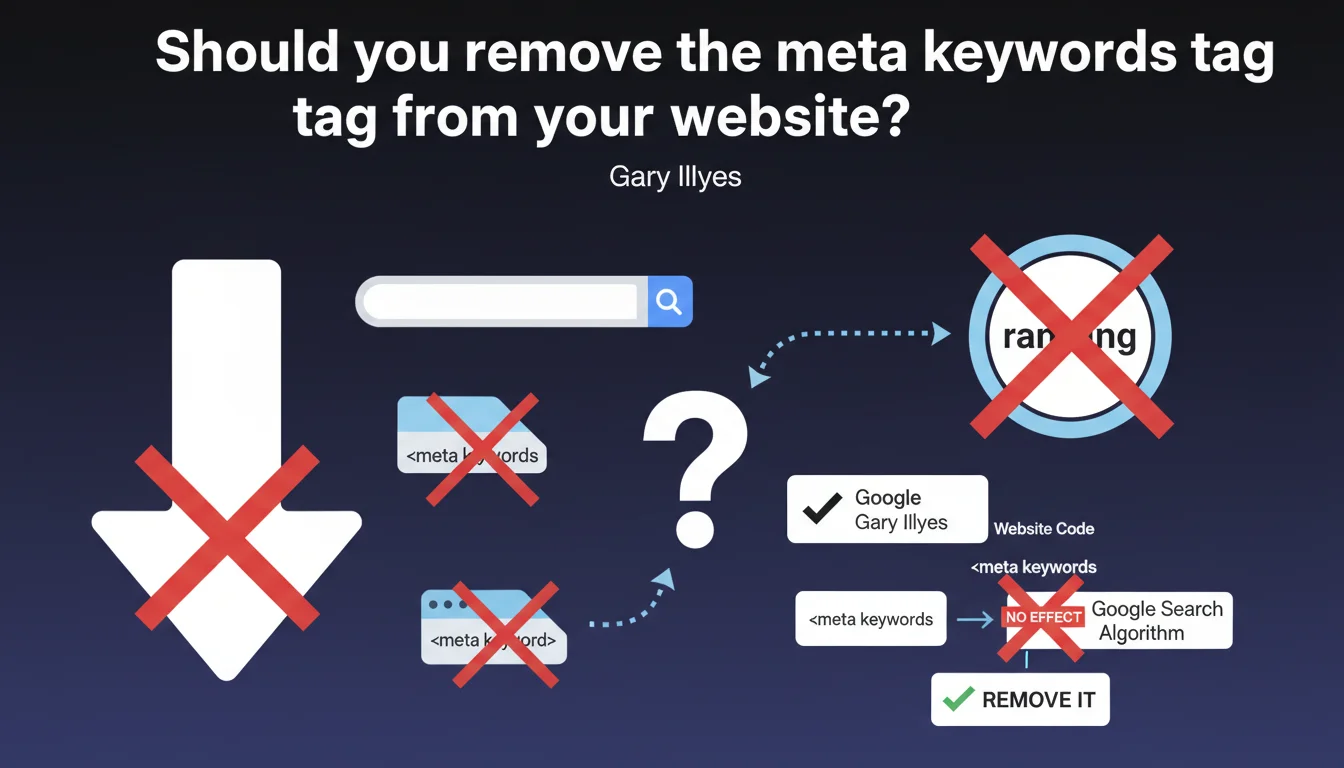
Google does not take into account the meta keywords tag for ranking and has never done so. This tag is completely ignored by the Google Search algorithm. You can remove it without any negative impact on your SEO.
What you need to understand
Why does Google ignore this legacy tag?
The meta keywords tag was introduced in the 1990s to help search engines understand the content of a page. At that time, algorithms were rudimentary and relied on these explicit signals.
The problem is that this tag was massively abused. Webmasters would stuff it with hundreds of irrelevant keywords — and it worked. Google decided very early on to never use it in its ranking algorithm. Not in 2009, not before: never.
Does this statement apply only to Google?
Yes and no. Google is the dominant search engine, but it's not the only one. Bing and Yandex have also confirmed they don't use this tag for ranking. However, some niche Chinese or Russian search engines might still use it — but their market share is marginal.
Realistically, if you're working in Western markets, this tag is strictly useless for organic SEO.
Are there cases where this tag can be harmful?
Directly? No, Google ignores it completely. But indirectly, yes: if you stuff this tag with keywords, you expose your editorial strategy to your competitors. They see exactly which terms you're targeting.
Additionally, some CMS platforms or plugins automatically generate this tag by duplicating content from other meta tags, which can bloat your HTML code without any benefit.
- Google has never used the meta keywords tag for ranking
- Other major search engines (Bing, Yandex) also ignore it
- The tag can expose your keyword strategy to competitors
- It provides no SEO value, even on secondary search engines
- Removing this tag has no negative impact on your rankings
SEO Expert opinion
Is this statement consistent with real-world observations?
Absolutely. Throughout my SEO practice, I've never observed any correlation between the presence of this tag and ranking performance. A/B tests conducted on thousands of pages confirm it: adding, modifying, or removing the meta keywords tag changes nothing in the SERPs.
What's interesting is that Gary Illyes uses categorical language: "never" and "will never use it." That's rare from Google, which usually prefers evasive phrasing. Here, the message is crystal clear.
Why does this tag persist on so many websites?
Inertia. Many CMS platforms and WordPress themes still include this tag by default, simply because nobody bothered to clean up legacy code. Some SEO plugins generate it automatically — not out of necessity, but out of historical habit.
There's also a psychological factor: clients or project managers who learned SEO in the 2000s still believe this tag matters. As a result, agencies maintain it to avoid sterile debates.
Are there situations where keeping it makes sense?
Only one: if your internal search engine leverages this tag to improve the relevance of its results. Some on-site search systems (particularly on custom e-commerce platforms) still parse these meta tags.
But let's be honest: that's an ultra-minority use case. And even in that scenario, there are more robust alternatives (structured data, clean taxonomies, dedicated filters). Keeping an obsolete tag for such a marginal use case is not a sustainable strategy.
Practical impact and recommendations
What should you do concretely with this tag?
The simplest answer: remove it. If it's generated automatically by your CMS or SEO plugin, disable this option. You'll lighten your HTML code without any risk.
If you manage a complex site with thousands of pages, automate the removal via your template. A find-replace in your theme or a Python script on your HTML exports does the job in minutes.
What mistakes should you avoid when cleaning up?
Don't touch other meta tags at the same time. I've seen overzealous technical teams delete meta keywords and meta description simultaneously, convinced that "all of this is outdated." Result: loss of control over SERP snippets.
Another pitfall: don't confuse meta keywords with the keywords targeted in your content strategy. Removing the tag doesn't mean abandoning your keyword research — just stop declaring them explicitly in an HTML tag that nobody reads.
How do you verify that your site is compliant?
Inspect the source code of a few representative pages. Look for the string "meta name=\"keywords\"". If you find it, clean it up. If it doesn't appear, you're already clean.
For a complete audit, use a crawler (Screaming Frog, Oncrawl, Botify) and extract all meta tags. Filter for "keywords" and identify the affected templates. You'll know exactly where to intervene.
- Remove the meta keywords tag from your templates
- Disable automatic generation in your SEO plugins
- Don't confuse meta keywords with meta description (the latter remains useful)
- Verify that the removal doesn't impact your internal search engine (rare case)
- Document the change to prevent a developer from accidentally reintroducing it
- Use this opportunity to audit other obsolete meta tags (revisit-after, etc.)
❓ Frequently Asked Questions
La balise meta keywords a-t-elle déjà été utilisée par Google ?
Bing ou Yandex utilisent-ils encore la meta keywords ?
Supprimer la balise meta keywords peut-il nuire à mon référencement ?
Y a-t-il un risque à conserver la balise meta keywords ?
Faut-il remplacer la meta keywords par une autre balise ?
🎥 From the same video 10
Other SEO insights extracted from this same Google Search Central video · published on 25/01/2024
🎥 Watch the full video on YouTube →
💬 Comments (0)
Be the first to comment.