
Official statement
Other statements from this video 10 ▾
- □ Pourquoi le SEO Starter Guide de Google cartonne-t-il à ce point ?
- □ Faut-il encore se préoccuper de HTTPS pour le référencement ?
- □ La compatibilité mobile est-elle vraiment devenue un non-sujet SEO ?
- □ Le nombre de mots est-il vraiment un facteur de classement Google ?
- □ Peut-on vraiment faire confiance aux CMS modernes pour gérer les balises title automatiquement ?
- □ Les mots-clés dans le nom de domaine influencent-ils encore le référencement ?
- □ Faut-il supprimer la balise meta keywords de votre site ?
- □ Faut-il vraiment utiliser Google Analytics ou Google Ads pour mieux ranker ?
- □ Faut-il vraiment changer de nom de domaine pour améliorer son SEO ?
- □ Faut-il abandonner les templates HTML optimisés au profit du contenu unique ?
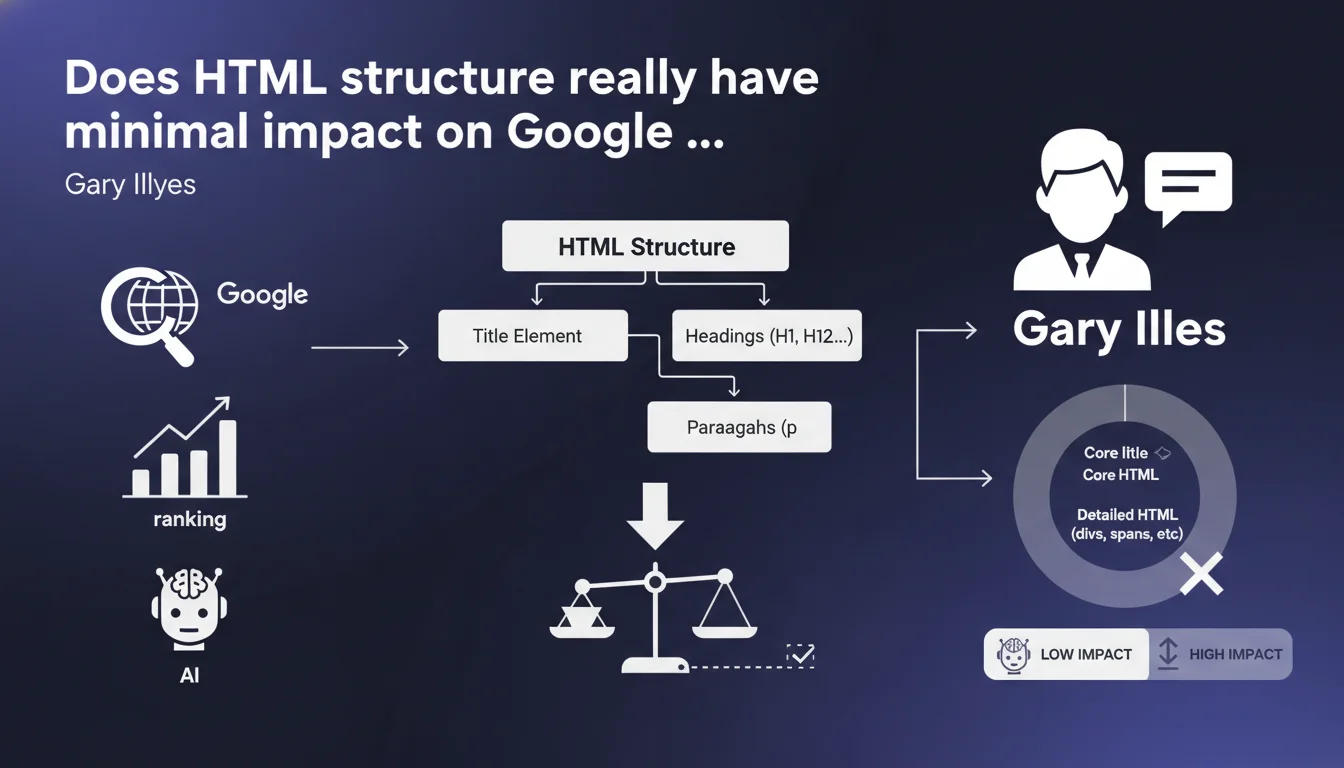
Gary Illyes asserts that a page's detailed HTML structure carries little weight in rankings. Only the fundamentals matter: headings, title tag, paragraphs. Everything else? Google largely ignores it. A position that deserves to be nuanced by real-world experience.
What you need to understand
What exactly does Gary Illyes say about HTML structure?
The statement is crystal clear: beyond basic structural tags (H1-H6 headings, title tag, paragraphs), detailed HTML structure does not significantly influence your position in the SERPs. Google does not reward the effort of pushing semantic markup to its limits.
This statement breaks a persistent belief among some junior SEO professionals: no, a perfectly semantic HTML with carefully nested article, section, and aside tags won't catapult you 10 positions higher. The search engine focuses on content and its relevance, not on code elegance.
Which tags actually matter?
Illyes mentions three elements: headings (the Hn hierarchy), the title tag, and paragraphs. These are the structural foundations that Googlebot uses to understand content organization.
The heading hierarchy helps the engine identify main sections, subsections, and the logic of your discourse. The title tag remains a major SEO signal. Paragraphs delimit exploitable text blocks. Everything else — schema, nav, header, footer — is a bonus for accessibility and user experience, not for ranking.
Why this statement now?
Google regularly combats persistent SEO myths. Many professionals waste time polishing complex HTML markup thinking they'll gain a competitive edge. This clarification aims to refocus efforts on what matters: quality content, relevance, and authority.
The implicit message? Stop over-optimizing markup. Focus on real value delivered to users.
- Detailed HTML structure is not a significant ranking factor
- Only these matter: Hn headings, title tag, paragraphs
- Advanced semantic markup serves accessibility, not ranking
- Google prioritizes content and relevance over code elegance
SEO Expert opinion
Is this statement consistent with real-world observations?
Yes and no. Across thousands of audits, I have rarely seen a site progress solely through HTML cleanup. Gains almost always come from content improvements, internal linking, and backlinks. In that sense, Illyes is right.
But — and this is a big but — chaotic HTML structure can indirectly harm your site. Incoherent markup makes crawling less efficient, complicates entity extraction, and disrupts semantic understanding. The causal link is not direct, but it exists. [To verify]: the exact impact of clean markup on crawl speed and quality remains unclear in this statement.
What nuances should we add to this position?
Illyes speaks of ranking, not indexation, understanding, or SERP display. Structured markup with schema.org data can earn rich snippets, featured snippets, and knowledge graphs. These aren't classic ranking factors, but they directly impact visibility and CTR.
Another point: HTML structure influences accessibility, which influences user experience, which potentially influences behavioral signals (time on site, bounce rate). The engine may not admire your nav tag, but an accessible site generates better user signals — and Google picks up on that.
When does this rule not apply?
Complex sites — e-commerce with thousands of products, media sites with multiple taxonomies — benefit enormously from rigorous markup. Not for direct ranking, but for crawl consistency, exploration budget management, and strategic content prioritization.
On a 50-page blog, yes, detailed HTML structure is secondary. On a 500,000-URL site, clean markup becomes a critical information architecture issue. Illyes's statement doesn't apply uniformly across all contexts.
Practical impact and recommendations
What should you do with this information?
First, never neglect the fundamentals: a unique, descriptive title tag per page, a logical Hn heading hierarchy (one H1, H2s for sections, H3s for subsections), and well-delimited paragraphs. These are non-negotiable prerequisites.
Second, stop fantasizing about perfect HTML5 semantic markup. Use section, article, aside? Yes if it improves your workflow and accessibility. No if you think it will push you ahead of competitors. Effort must be proportional to real gains.
Third, focus on structured data. That's where markup has visible impact: rich snippets, breadcrumbs in SERPs, featured snippet eligibility, knowledge panels. Schema.org markup doesn't boost ranking, but it boosts visibility — which is often more profitable.
What mistakes should you avoid after this statement?
Don't fall into the opposite extreme: sloppy HTML remains a problem. Unclosed tags, headings out of order (H3 before H2, multiple H1s), missing paragraphs — all of this complicates the bot's work and degrades experience.
Another mistake: ignoring the link between HTML and Core Web Vitals. Heavy markup, infinitely nested divs, unoptimized CSS-in-JS — all slow down rendering and tank CLS. HTML structure impacts performance, and performance impacts ranking. The link is indirect, but real.
How do you verify your site respects the fundamentals?
Audit your title tags: are they unique, descriptive, within 60 characters? Check your Hn hierarchy with a crawler or HTML validator. Ensure each page has a unique, relevant H1, and that H2s logically structure the content.
Use Google Search Console to identify crawl and indexation issues. If Googlebot encounters massive HTML errors, that's an alarm bell. Clean code doesn't guarantee success, but broken code guarantees problems.
- Verify each page has a unique, optimized title tag
- Audit the heading hierarchy (one H1, logical H2s, coherent H3s)
- Ensure content is structured in readable paragraphs
- Implement schema.org structured data for SERP enhancements
- Test HTML validity with the W3C validator (critical errors only)
- Monitor crawl errors in Search Console
- Measure markup impact on Core Web Vitals (CLS especially)
❓ Frequently Asked Questions
Le balisage schema.org est-il un facteur de classement selon cette déclaration ?
Faut-il arrêter d'utiliser les balises sémantiques HTML5 comme article ou section ?
Un site avec plusieurs H1 sur une même page sera-t-il pénalisé ?
La hiérarchie des titres Hn doit-elle être parfaite pour bien ranker ?
Cette déclaration signifie-t-elle qu'un HTML invalide n'a aucun impact SEO ?
🎥 From the same video 10
Other SEO insights extracted from this same Google Search Central video · published on 25/01/2024
🎥 Watch the full video on YouTube →
💬 Comments (0)
Be the first to comment.