
Official statement
Other statements from this video 10 ▾
- □ Pourquoi le SEO Starter Guide de Google cartonne-t-il à ce point ?
- □ Faut-il encore se préoccuper de HTTPS pour le référencement ?
- □ La compatibilité mobile est-elle vraiment devenue un non-sujet SEO ?
- □ La structure HTML a-t-elle vraiment peu d'impact sur le classement Google ?
- □ Peut-on vraiment faire confiance aux CMS modernes pour gérer les balises title automatiquement ?
- □ Les mots-clés dans le nom de domaine influencent-ils encore le référencement ?
- □ Faut-il supprimer la balise meta keywords de votre site ?
- □ Faut-il vraiment utiliser Google Analytics ou Google Ads pour mieux ranker ?
- □ Faut-il vraiment changer de nom de domaine pour améliorer son SEO ?
- □ Faut-il abandonner les templates HTML optimisés au profit du contenu unique ?
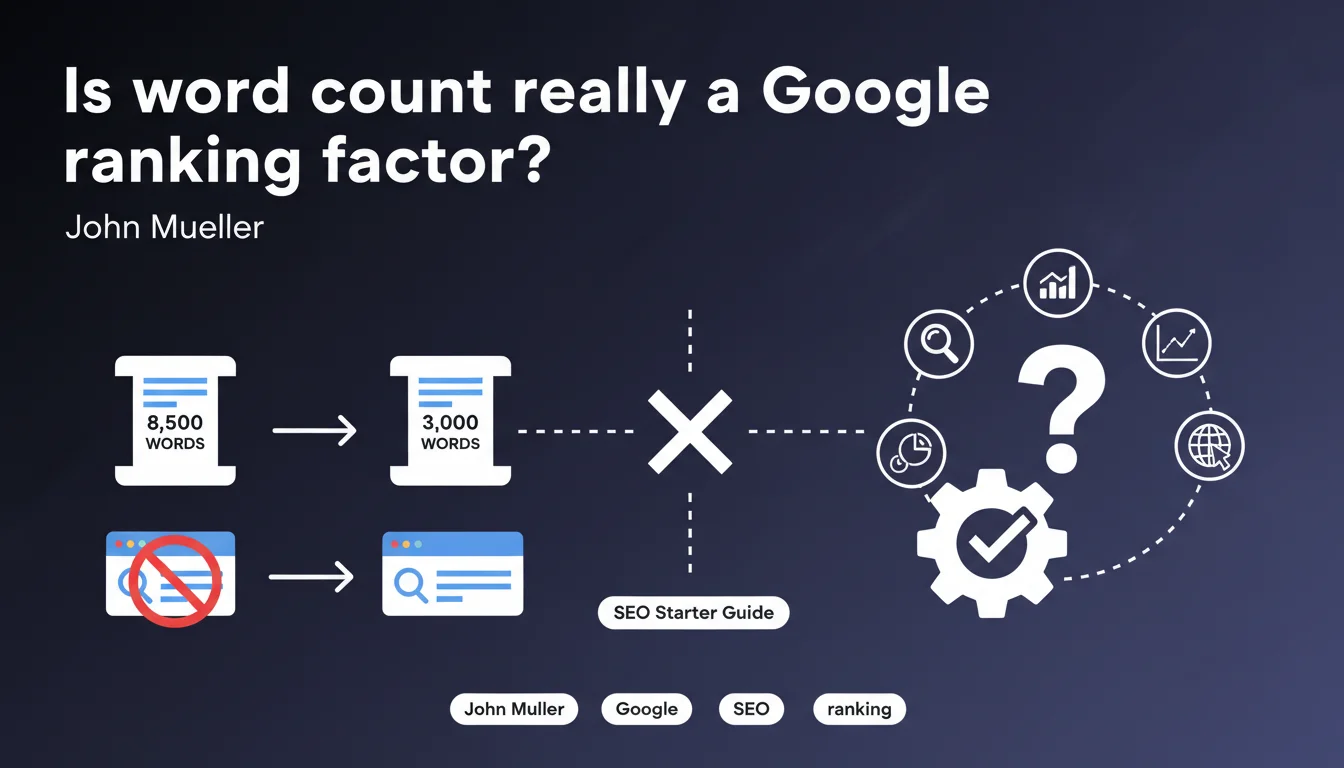
Google clearly states that word count is not a ranking factor. Proof: the SEO Starter Guide was reduced from 8,500 to 3,000 words with no negative impact. What matters is relevance and content quality, not volume.
What you need to understand
Why does this statement challenge a deeply rooted belief?
For years, the SEO community has treated word count as an almost sacred rule. Articles of 2,000+ words, comprehensive guides of 5,000 words — everything was based on the idea that lengthy content automatically signals depth to Google.
Mueller puts an end to this: volume is not a ranking signal. The example of the SEO Starter Guide being cut in half without consequence demonstrates that Google practices what it preaches. If 3,000 words suffice to cover a topic, why write 8,500?
What actually matters to Google then?
It's not quantity but relevance to search intent. One informational query may require 3,000 words, another just 500. Google evaluates whether your content fully answers the question posed, not whether it hits a specific length target.
The trap: confusing correlation with causation. Long content often ranks better, not because it's long, but because it covers a topic in depth and accumulates more backlinks. That's the consequence, not the cause.
Is this position from Google new?
No. Mueller and other Google spokespeople have repeated this for years, but the myth persists. This fresh iteration with the concrete example of the Starter Guide aims to definitively close the debate.
Yet SEO tools continue recommending word count ranges based on competitor analysis. These benchmarks can be useful as indicators of expected level of detail, but they should never become goals in themselves.
- Word count is not a direct ranking factor
- Relevance and complete topic coverage take precedence
- A 500-word article can outperform a 3,000-word piece if it better serves the intent
- Correlations between length and rankings are explained by other factors (backlinks, depth, authority)
- Google practices what it preaches: its SEO guide was drastically reduced without issue
SEO Expert opinion
Is this statement consistent with what we observe in the field?
Yes and no. In practice, exhaustive content often dominates competitive SERPs — but rarely because of word count alone. It ranks because it generates more engagement signals, more links, and better covers semantic entities related to the topic.
The problem? Many SEOs still blindly optimize to hit a word threshold. Result: filler, repetition, dilution. Google can easily ignore these superfluous sections — or worse, consider them thin content.
What nuances should we add to this claim?
Mueller isn't saying length is always unimportant. In certain contexts — YMYL content, complex topics requiring detailed evidence — thorough treatment is essential. But it's depth that counts, not word count itself.
Another rarely mentioned nuance: the language models Google uses (BERT, MUM) analyze meaning and completeness, not length. A concise, precise text can score better for relevance than a verbose block of text. [To verify]: to what extent do behavioral signals (time on page, bounce rate) counterbalance this official statement?
In what cases might this rule not necessarily apply?
For ultra-competitive queries, long content remains the norm — not as an algorithmic requirement, but because your competitors have set a high bar. If the top 10 results all feature 4,000-word guides, publishing 800 words risks seeming superficial… at least in users' eyes.
Also watch programmatic content or e-commerce category pages: 50 words may suffice if the rest of the value comes from products, filters, reviews. Conversely, a pillar page or content hub often needs substantial development.
Practical impact and recommendations
What should you concretely do with this information?
Drop minimum word count objectives from your briefs. Replace them with topic coverage objectives: what questions must be answered? What concepts need explaining? Let length emerge naturally from this requirement.
Audit your existing content: identify pages that artificially inflated without adding value. Test reduction and consolidation. Sometimes cutting 40% of a text improves clarity — and performance.
What mistakes should you absolutely avoid?
Stop comparing yourself blindly to competitors' average word counts. This metric is misleading: it ignores quality, freshness, and each site's authority context.
Avoid filler to hit a threshold. Google increasingly detects passages with no added value. If you have nothing relevant to say after 1,200 words, stop.
How can you verify your approach aligns with this recommendation?
Test your content with real users. Do they quickly get their answer? Do they read through or skip ahead? Engagement metrics (reading time, scroll depth) are more revealing than a word counter.
Use content scoring tools that evaluate semantic coverage, not just length. Verify you're covering entities, concepts, and secondary questions related to your main topic.
- Remove minimum word count objectives from your editorial processes
- Write to fully answer the intent, without padding
- Audit your long content: identify superfluous sections and test removing them
- Prioritize information density over raw length
- Measure user engagement (scroll depth, time on page) to validate relevance
- Compare semantic coverage with competitors, not word count
- Test consolidating fragmented content into more concise pages
❓ Frequently Asked Questions
Dois-je réduire mes articles de 3000 mots déjà publiés ?
Comment définir la longueur idéale d'un nouveau contenu ?
Les outils SEO qui recommandent un nombre de mots sont-ils obsolètes ?
Un contenu court peut-il vraiment ranker sur une requête compétitive ?
Faut-il continuer à analyser le nombre de mots des concurrents ?
🎥 From the same video 10
Other SEO insights extracted from this same Google Search Central video · published on 25/01/2024
🎥 Watch the full video on YouTube →
💬 Comments (0)
Be the first to comment.