
Official statement
Other statements from this video 10 ▾
- □ Why is Google's SEO Starter Guide absolutely crushing it with users?
- □ Do you still need to worry about HTTPS for SEO in 2025?
- □ Has mobile compatibility really become a non-issue for SEO?
- □ Is word count really a Google ranking factor?
- □ Does HTML structure really have minimal impact on Google rankings?
- □ Can you really trust modern CMSs to handle title tags automatically without any manual oversight?
- □ Should you remove the meta keywords tag from your website?
- □ Do you really need Google Analytics or Google Ads to rank better in search?
- □ Should you really change your domain name to boost your SEO rankings?
- □ Should you ditch optimized HTML templates in favor of unique content?
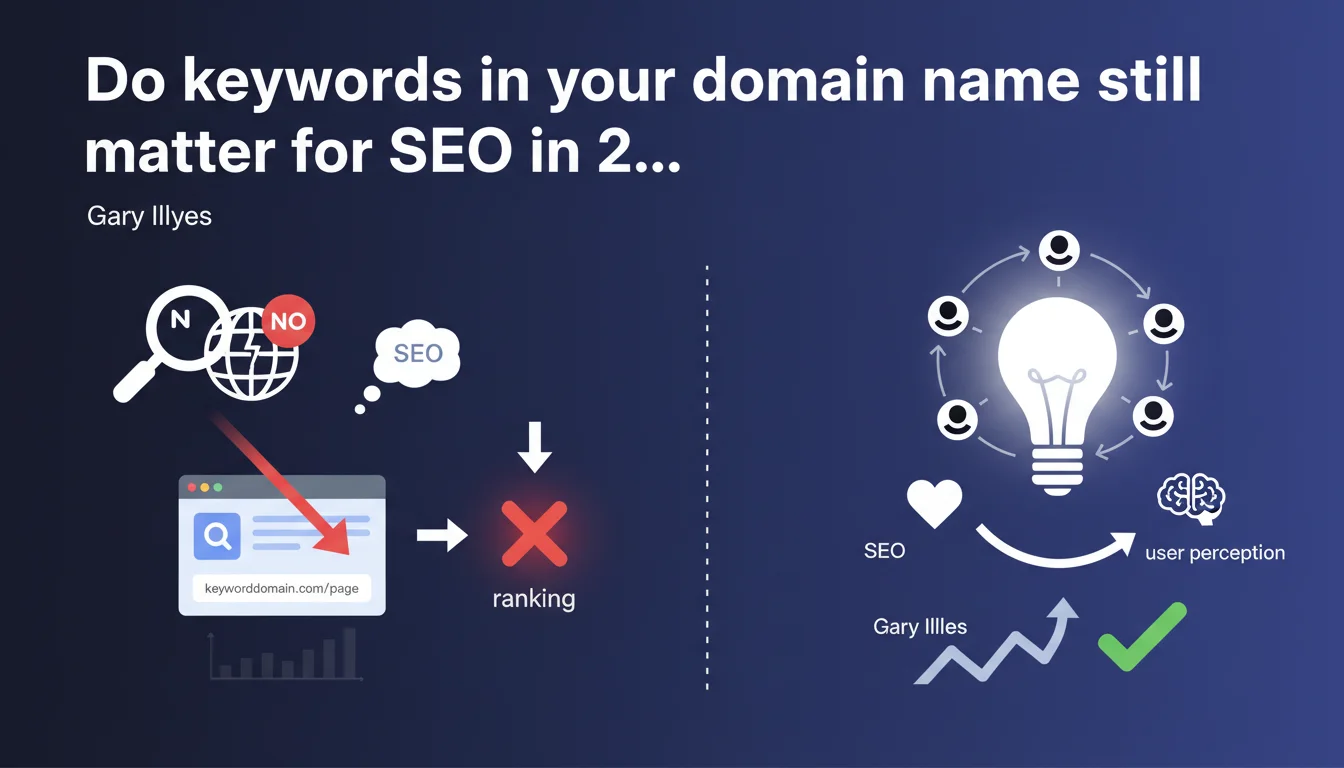
Google claims that the impact of keywords in your domain name or URL on rankings is now negligible. There's no point investing time and money in an EMD (Exact Match Domain): the priority should be user experience and brand memorability rather than domain SEO optimization.
What you need to understand
Why is Google downplaying the importance of keywords in domain names?
Historically, Exact Match Domains (EMD) — domains containing exactly the target search query — had their heyday. A site named "assurance-auto-pas-cher.fr" could rank easily for these terms without content effort.
Google has progressively closed this loophole. Today's algorithms prioritize content relevance, site authority, and user signals. A domain packed with keywords no longer provides the competitive advantage it offered ten years ago.
Gary Illyes makes it clear: this signal has become so weak that it doesn't deserve strategic energy.
What about keywords in internal page URLs?
The statement covers URLs too. A structure like /category/keyword-rich-slug versus /category/p12345 would have only marginal impact on rankings.
Important caveat — this doesn't mean URL structure is unimportant. It matters for user clarity, site consistency, and potentially for click-through rates in search results (a readable URL inspires more trust than a cryptic identifier).
What should you focus on instead?
Google is pushing toward a user-centric approach: a memorable domain name, short, easy to spell, and one that reinforces brand identity.
Strong brands generate direct traffic, word-of-mouth, branded searches. These indirect signals probably carry more weight than a keyword stuffed into your domain.
- Keywords in your domain have negligible effect on rankings today
- URL structure remains relevant for UX and CTR, not for pure ranking
- Prioritize memorability and brand identity over domain SEO optimization
- Brand signals (branded searches, direct traffic) likely carry more weight
SEO Expert opinion
Does this statement align with real-world observations?
Let's be honest: in ultra-competitive niches, a recent EMD without history or quality backlinks doesn't cut it anymore. We see this regularly. The sites dominating the rankings often have brand names, not keyword strings.
However — and this is where it gets tricky — some old EMDs with solid history continue to rank well. It's hard to untangle what comes from domain age, accumulated backlinks, or a residual effect from the name itself. [Needs verification] with more precise comparative data.
In what cases does a descriptive domain name still hold value?
For small local searches or ultra-specific queries, a descriptive domain can still facilitate immediate understanding of the business. "plumber-denver.com" explicitly states what it does — but that's more about UX and CTR than a direct algorithmic boost.
Similarly, in contexts where users quickly compare multiple results, a clear URL can increase click probability. But that's not a ranking signal — it's an indirect behavioral signal.
What nuances should we add to this statement?
Gary Illyes talks about an effect "so weak" it's not worth your time. That's not zero — it's negligible. Important distinction: if all other factors were strictly equal (extremely rare in practice), a slight residual advantage might exist. But in 99% of cases, other SEO levers will deliver far better results.
Another point: this statement says nothing about the negative impact of an over-optimized or spammy domain. A domain crammed with hyphens and keywords can send low-quality signals and harm trust — which indirectly impacts SEO.
Practical impact and recommendations
What should you do if you're launching a new site?
Forget the EMD race. Choose a domain name that's short, memorable, and brandable. Think about pronunciation, spelling ease, extensions (.com, .co.uk). Anticipate growth: a domain that's too niche can lock you into one market.
Put your energy into site architecture, content quality, and backlinks. These levers have an SEO ROI far superior to keywords in your domain.
Should you migrate an existing EMD domain to a brand?
Not necessarily. If your EMD has history, backlinks, and direct traffic — a migration could destroy value without clear gains. It's often not worth the effort.
However, if you're building a long-term brand strategy, investing in a new brandable domain and gradually redirecting can make sense. But that's a business decision, not pure SEO.
How do you structure internal URLs optimally?
Prioritize clarity and consistency. A URL should be understandable by humans. Avoid unnecessary parameters, cryptic identifiers, and excessive depth levels.
Include keywords in the slug if it improves readability — not to force a ranking boost. Think about CTR in search results and shareability on social media.
- Choose a brandable domain rather than an EMD for new projects
- Don't migrate a performing historical EMD without solid business reasons
- Structure your URLs for human readability, not algorithmic ranking
- Invest your time in content, authority, and UX signals
- Avoid over-optimized domains with multiple hyphens and keyword lists
- Anticipate scalability: an overly specific domain can limit your growth
❓ Frequently Asked Questions
Un Exact Match Domain (EMD) a-t-il encore un avantage SEO en 2025 ?
Faut-il inclure des mots-clés dans les URLs de mes pages ?
Dois-je migrer mon ancien EMD vers un domaine brandé ?
Les tirets dans le nom de domaine sont-ils pénalisants ?
Quelle extension de domaine choisir pour le SEO ?
🎥 From the same video 10
Other SEO insights extracted from this same Google Search Central video · published on 25/01/2024
🎥 Watch the full video on YouTube →
💬 Comments (0)
Be the first to comment.